Michelin Mexico: One less star, one more question
The Edén Benavento restaurant in Guadalajara was the chosen venue for the third Michelin star awards ceremony in Mexico.
Before the awards, the acknowledgments. The president of CANIRAC, Ignacio Alarcón Rodríguez Pacheco, took to the stage and delivered a speech that sounded more like a business association rallying cry than a gastronomic celebration. But the most revealing aspect wasn't the tone: it was the list. Alarcón thanked, one by one, the tourism trusts that make Michelin's presence in Mexico possible. The Baja California trust. The Los Cabos trust. The Mexico City mixed fund. The Quintana Roo council. The tourism secretariats of Nuevo León, Puebla, Yucatán, and, especially, Jalisco. Also, the Puerto Vallarta trust and the Guadalajara Metropolitan Area trust, the evening's host city.
It wasn't a protocol lapse. It was the system's architecture shamelessly exposed.
Then the governor of Jalisco, Pablo Lemus Navarro, arrived to explain why his state deserved to be included in the guide. Among his arguments, the most honest was the 2026 FIFA World Cup. Guadalajara will receive millions of visitors. The Michelin star, he said, will be a distinguishing feature in that context. Cuisine as tourism infrastructure. The chef as a brand ambassador for the destination.
Outside that auditorium, Jalisco continued to make the news for reasons that no Michelin inspector records in their notebook.
What comes in and what goes out
The third edition concluded with these figures: 133 recommended restaurants, 63 Bib Gourmand awards, 11 Green Stars, 26 one-star restaurants, and two two-star restaurants. The numbers are growing. The map is expanding. Jalisco, Puebla, and Yucatán have joined the six regions already included in the selection.
But the most awkward story of the night wasn't in the applause. It was in the silence.
El Califa de León lost the Michelin star it received in 2024. It didn't close. It didn't change chefs. There was no scandal. It remains in Ribera de San Cosme, the same working-class neighborhood a few minutes from the Historic Center where it has always been. The guide simply decided it no longer deserved the star. And in its place, among the new restaurants that received a star tonight, was La Once Mil: a taqueria in Lomas de Chapultepec, one of the wealthiest areas of Mexico City.
Both are taco shops. But the distance between them isn't measured in kilometers.
According to the National Institute of Statistics, Mexico has more than 138,000 registered taquerias. Of that number, Michelin chose to award one in 2024 and then withdraw the recognition two years later. The one that came to replace it has its own merits: the vertical rotisserie is worked, the flour tortillas are made to order. That's not up for debate. What is up for debate is the movement itself: the average taco in Mexico costs 25 pesos; the cheapest one at La Once Mil costs almost the same as the most expensive one at El Califa de León. That comparison alone speaks louder than any discourse on gastronomic inclusion.
The system and its sponsors
The guide doesn't arrive on its own. It comes with institutional agreements, tourism promotion trusts, and government ministries that invest public resources to put their region on the map. This isn't a secret—the guide operates this way in several countries—but it's rarely stated with such transparency as the president of CANIRAC did tonight.
What remains unspoken is the direct consequence of this model: if being recognized by Michelin requires institutional investment, then the cuisine that receives awards isn't always the best, but rather the best funded. States with active tourism trusts are included. Those without this financial muscle are invisible to the guide. Guerrero, Hidalgo, and Tabasco, with culinary traditions as deep-rooted as any of the award-winning regions, remain invisible territory.
And within the states that do have them, something similar happens on a micro scale: restaurants that can maintain the type of operation that inspectors recognize as "serious" are the ones with a real chance of receiving a distinction. That comes at a cost. And not everyone can afford that cost.
The award winners
Pujol and Quintonil consolidated their two stars. No surprises: both have been the face of Mexican cuisine for years, a cuisine the international circuit knows how to interpret. Xokol—the restaurant of Xrysw Díaz and Óscar Segundo—received its first star and a green star. Neither of them was at the ceremony. They were in their kitchen, where a chef is supposed to be. The most telling absence of the night: the only contemporary indigenous cuisine awarded chose service over the European consecration ritual that would have consecrated it.
Damiana, Ixi'im, and Xokol received green stars—the three newest additions to that category. Ixi'im also earned a red star. Other new additions with one star include Alcalde, Gaba, Huniik, La Barra de Huniik, and La Once Mil.
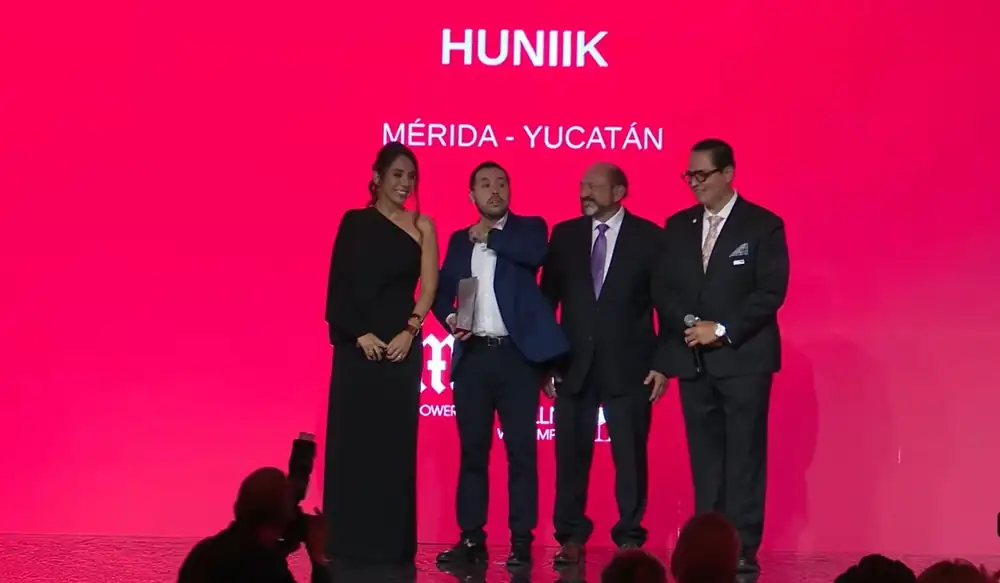
The special awards painted an interesting picture: the Michelin Service Award went to Huniik in Mérida, accepted by Rodrigo Caltenco Núñez. The Sommelier of the Year award went to Jonathan Robles of El Mural de los Poblanos in Puebla. The Best Mixologist award went to Priscila Moreno of Máximo. And the Young Chef Award went to Xóchitl Valdés of Pancho Maíz, also in Mérida—making Yucatán, recently added to the guide, the state with the most special awards that night.
The Bib Gourmand list closed this year with 63 restaurants. The distinction, according to the guide itself, exists to recognize exceptional cuisine at a good price. Several of the restaurants included this year have an average check exceeding €75—higher than the cost of dining at many European Bib Gourmand restaurants. What Michelin considers a good price in Mexico is not necessarily a good price in Mexico.
The question that remains
The third edition of Michelin Mexico didn't answer the questions left by the second. It deepened them.
If in 2025 the question was whether the guide understood the true diversity of Mexican cuisine, in 2026 the question is more specific and harder to avoid: What does Michelin do when the popular cuisine it celebrated is no longer convenient? Does it abandon it? Does it replace it with a more manageable version of the same concept, but in a postal code that the system recognizes better?