Wine and the Sea III: The Pacific in the Glass
Gabriel, the fishmonger, who years ago earned his nickname for his crusade to bring species back to the table, trusted the judgment of the renowned wine critic, who, with all his experience, put together a wine list specifically looking to the ocean on the other side of the Andes.
Gabriel and the coves
Gabriel learned to coax secrets from the sea in Málaga, but his connection to the sea began long before. “I spent my childhood summers in the coves of Chile, and that's where I first connected with the ocean. My family has always been involved in cooking; I grew up witnessing the evolution of Chilean gastronomy. But when I returned from Spain, I found that everything was haute cuisine, with creamy sauces and a very limited selection. They didn't have the products I remembered from my childhood, the quality of the coves and what I used to eat raw among the rocks with my father. In Spain, everyone ate fish at the markets, with a huge variety, and in Chile, getting fresh seafood was very difficult. In my search for independence, I had a lightbulb moment and discovered selling fish. I started traveling to the coast to build a network of fishing contacts and began delivering the product to chefs. I lived between restaurants, with my truck loaded with fish, until it became obvious that I had to cook and start something.” In 2016 (and until 2022), Gabriel set up the emblematic La Calma, in Santiago de Chile, a place that, in addition to being iconic for its concept, generated that explosion of flavors that he had in his memory.
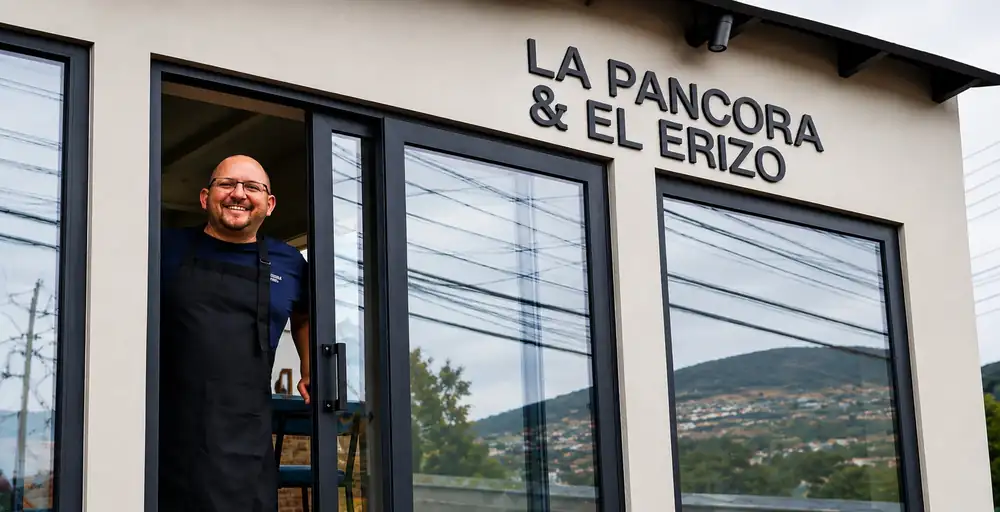
Several years later, at La Pancora y el Erizo, Patricio Tapia had the noble task of translating the sea into wine. He is a person who has to taste thousands of wines a year for his renowned Descorchados scoring guide, but on this occasion, he is challenged to set aside the critic a little to prioritize a new selection. “What Gabriel wants is to bring the flavors of the sea to the table, trying to make the taste of the sea fill your plate,” Tapia tells us, and continues: “And in that sense, Chilean white wines have a lot to offer. Sauvignon Blanc is a great variety to pair with seafood and fish, but the new Chardonnays that grow by the sea also show a special ability to complement this type of food. Then there are much more personal preferences: I really like lighter Pinot Noirs, which go well with dishes that require a bit more preparation, I'm referring to fish cooked over an open flame. The idea was to try to maintain the purity of the flavors of both the wine and the ingredients. And always keeping in mind that this is a restaurant where the star is the cuisine and Gabriel's interpretation of the Chilean sea. The wines are an accompaniment that doesn't seek to overshadow, but rather to further highlight its qualities. That, for me, is extremely important.”
Chile has a very interesting raw side: clams, sea squirts, sea urchins, lots of oysters and seafood. But, in the task of finding his identity, Gabriel had to detach himself from the Peruvian part to find his own. “What defines Chilean seafood cuisine is its purism, the quality of the product itself. We are very fortunate that our waters are touched by the current; our coastlines are teeming with marine life. We have many valuable species that are not as common or reach the same size in other areas. The intertidal zone provides ingredients that our indigenous peoples ate; there is an abundance of shellfish, crustaceans, and seaweed among the rocks. As children, we loved to go shellfish gathering, collect things, and eat them right there. Chilean cuisine is about that: the fresh flavor and umami of the seafood, with almost no intervention. There are fried preparations and broths that come from Spain. It's cooked over hot coals and baked in its own juices. There's also a Peruvian influence, where seafood is cooked with lemon and cilantro. For me, Chilean seafood cuisine needs cilantro, onion, and green chili pepper. And in Chile, we make a mix of raw seafood dishes. Our most prized shellfish are the piure (sea squirt), the sea urchin, and the…” clam; together they release a juice that tends to be a tiger's milk, it's pure power."
Gabriel always had the ultimate vision of creating a new, contemporary Chilean seafood restaurant that would offer a different experience from the traditional ones, which served old-fashioned cuisine: fish with margarita sauce, clams with Parmesan cheese but laden with poor-quality cheese, or heavy seafood dishes with no reduction in portion sizes. The cooking times, temperatures, and techniques were a major shift, and while it's a profitable business to sell what people already know, it was interesting to offer new things and for people to rediscover flavors and customs from their childhood that had been fading away. This brought not only new dishes but also emotions and memories.
Whites, common sense for fish
“For a long time I wondered how to avoid falling into the common sense of whites for fish,” Patricio Tapia begins, speaking about creating a 100% seafood menu, which had the challenge of innovating without leaving people out. “In principle, I don't put much stock in strict rules of food and wine pairing, but I do believe there are some things you just don't do, like a Cabernet Sauvignon with sea squirts or a Merlot with sea bass ceviche. You have to respect certain parameters, governed more by logic than by rules. This menu allows you to combine everything with everything and experiment a little; that's my idea. There are light reds that can go very well with oily fish. And, obviously, we've selected some Manzanilla wines for more adventurous pairings, like sea squirts or sea urchins, which are very specific products that, from experience, I can say: no Sauvignon Blanc can handle them. On the other hand, a good Manzanilla from Sanlúcar, which is on the menu, is perfect. These are some of the liberties we took when creating the menu, leaving the Pacific and traveling to southern Spain.”
Fishermen, a dying trade
The romantic image of boats on the horizon transforms into a deeply demanding profession upon closer inspection. The artisan of the sea struggles against industrial fishing, and a generational clock is ticking. The number of fishermen is dwindling, and finding fish and variety is becoming increasingly difficult. La Pancora y el Erizo is not just a restaurant; it also houses a fish market. It's the first point of contact with the sea and, in a way, the first kitchen: the connection with the fishermen is palpable. “The fishermen’s life of sacrifice is admirable. It’s a simple life, worthy of recognition. They know the sea by heart, they read it by instinct, long before GPS. They have a great sense of taste and a refined appreciation for flavor; they know the quality of the fish. Their recipes are the ones I ultimately use, because it was rare for a fisherman to put cream on fish. I often saw fishermen in their little huts making an omelet with limpet eggs, and I wondered why that dish wasn’t on the menu at any of the local restaurants. That’s the kind of recipe book that needs to be rescued because it’s truly valuable and full of flavor.”
Much of this world is sea, much more than land even. And in those deep caverns, a balance of aquatic flora and fauna has lived for millions of years. On the surface, wine takes root, shaking off the dust of fleeting trends, clinging to its soil like the crab lives inside the sea urchin. We approached the sea with a terrestrial gaze until we learned, little by little, to think of it as watery, salty, wet. Hunters and gatherers immersed in the water, with the sun of the cove, the salt seasoning the palate, and a growing respect, because those who know respect, and those who respect learn to love.