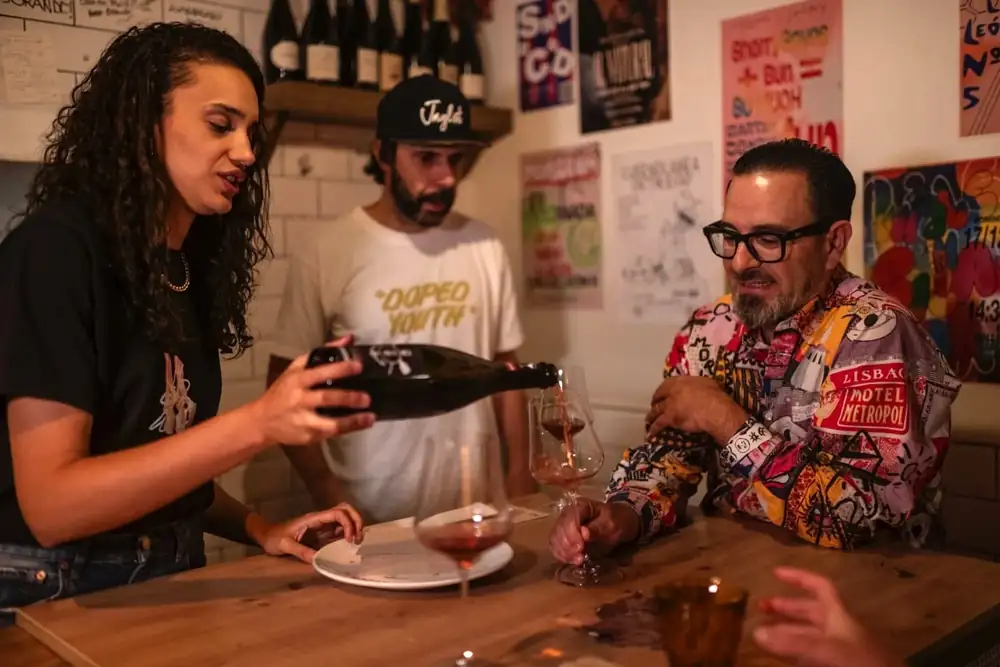
The new sommelier takes a step back and finds her footing
The way we consume wine has changed a lot.
The way we consume wine has changed a lot. This is due to a greater openness: we've long since moved beyond "Rioja, Ribera del Duero, Verdejo, and Godello" to broaden our horizons to other regions of Spain (Priorat, Jerez, Gredos, the Balearic Islands, the Canary Islands…), focusing more on places than on specific grape varieties. It's also because we understand gastronomy differently. We've traded abundance and excess for a more careful and conscious selection, where fewer glasses are consumed, but perhaps enjoyed more fully. And then there's the health consciousness, the emphasis on physical fitness, and the need for constant monitoring. But that's a whole other story.
It's not just consumers who have changed. Experts, sommeliers, have changed too. It's increasingly difficult to find a wine professional you'd hesitate to ask questions of, yet there are plenty of sommeliers who speak to you through emotions and only appear when you need them, so the conversation flows naturally and you take away a feeling rather than just data-driven knowledge.
This way of working, perceived as a mere extra in the film unfolding at the table, is practiced by Amanda Leite (pictured above), Judit Ayago, and Mario Tofé. Leite does so at Bocanada (Madrid), a 12-square-meter micro-tavern and natural wine bar whose culinary offerings change radically every few weeks thanks to chef residencies. Mario, for his part, opened the Michelin-starred restaurant Èter (Madrid) with his brother Sergio in 2020, where they offer a tasting menu that changes seasonally under a personal and minimalist concept. And in Zarautz, there's Masta Taberna, where Judit's wines complement the hearty, understated, and humble cuisine of chefs Javier and Gari. They represent a small but significant sample of what it means to be a sommelier today.
References that tell more than
Everyone has their own distinct and defined tastes, and this is reflected in their wine selection. In Judit's case, values and philosophy are paramount, as she seeks out wines she identifies with, whether because they represent her origin, have their own style, evoke emotion, or something similar. Amanda sets the selection criteria based on the winemaking process, which must be natural, though she doesn't excuse imperfections such as oxidation or other imperfections: “I'm all for natural or minimally intervened wines because that's what I like, and because both in the vineyard and the winery, the landscape and the flavor of the grapes are respected. If you start using chemicals in the vineyard, the grapes develop organoleptic characteristics that impact the wine's flavor, and the same goes for yeasts. When you do that kind of thing, I think the wine loses its richness and becomes a formulaic product. At that point, it loses its meaning for me, and I don't like the taste.” Precisely for this reason, Leite seeks to ensure that the wine represents the characteristics of its origin, that is, if it is a Bobal from Murcia, the wine should have volume, a certain degree of alcohol and tannins.
Èter's wine list speaks volumes about Mario's tastes, a connection rooted in emotion: "I like to move people, and when you're moved, you transmit that feeling." Thus, his selection is brimming with white and sparkling wines, very light wines made in cool climates with higher acidity, such as those from Burgundy, Jura, Loire, Champagne, the Basque Country, Galicia… He's also passionate about Sherry and has a soft spot for France, "my stepfather is French, so I don't have to argue with people because I use that as an advantage," he jokes. For Tofé, it's important that the wine allows you to continue drinking and eating without feeling overwhelmed, something for which acidity is fundamental.
Short menus and tailor-made pairings
There's a place for everything, and there are restaurants where a long, extensive wine list takes up space. But the truth is, it's becoming less and less common. The trend is evolving towards shorter, more carefully curated menus, selected based on very personal criteria. Before, abundance was associated with prestige; now, luxury is about scarcity and understated elegance. "There's a paradigm shift; now, luxury is, or should be, quiet. The customer has changed: there's much more access to information, the selection is very stimulating, and wine is much more accessible."
This has led to a more discerning approach, and the abundance that was once applauded is now perceived as mere fluff,” Judit remarks. The sommelier believes that when a wine list boasts many labels, the professional is more protected; however, with a short list, the weaknesses are more apparent. It's a boom in "label-itis," which Mario admits he was part of, “but then you realize you have those 100 labels you always wanted, but they don't sell, and what you're selling are simple, delicious, and well-crafted wines,” he acknowledges.
Ayago goes further, linking this trend to the fast-paced nature of modern life, since "nobody likes the idea of having to spend 40 minutes poring over an encyclopedic wine list to select a wine." This frenetic pace is reflected in increasingly volatile trends, which in this sector involve idolizing a wine only to forget it a year later. Mario calls it "the gambling addiction of wine," which creates a feeling of always being on the hunt for the unicorn, but once it's found, it's not enjoyed because you're already thinking about the next one.
Wine pairings have also changed. Mario sees it every day at Èter, where no one asks for the classics anymore: “When you ask them if they want 11 glasses of wine, they say no. You have to listen to that. That's why I think many of us started using the word 'harmony,' which refers not only to harmonizing with the dish but also with the customer, who might want to have three glasses.”
Amanda focuses on relaxation and personalization of the experience, greeting guests at Bocanada with a simple question: “What would you like, sparkling wine, white wine, or red wine?” From there, she guides the wine pairings, which, in her case, are independent of the dishes, allowing each person at the table to drink at their own pace and in their preferred style. “The aim is to create a unique experience for each person. This fosters that spontaneous flow that is both enjoyable and fun for them and for me. The price of the glasses, which ranges from €6.80 to €7.50, is important so that people aren't preoccupied with the cost and can simply relax and enjoy the experience,” she concludes.
Less alcohol
Zero alcohol consumption is one of the challenges facing the sommelier sector, as the decline in alcohol consumption is a reality. “Beyond the sociological interpretation, many people who don't drink feel guilty and even apologize. I'm here for you to enjoy yourself, and I understand why you don't drink alcohol.”
“For these people to feel good and be able to enjoy this liquid experience, I think sommeliers need to start working on the 0.0 experience,” Mario asserts. He does this with alcohol-free wines like those from FULL.MI.NANT (Germany), whose sparkling wines fascinate him; with hot and cold infusions prepared by Luis from Black Pepper; and with his experiments using the Korean Ocoo machine, in which they place pears whose water is oxidized and then cold-stabilized, “and after six or eight months you have something similar to an alcohol-free Pedro Ximenez.”
A healthy relationship with the diner
All three are clear on this: diners shouldn't be overwhelmed with information. It's neither interesting nor will it improve the experience. They focus on serving the enjoyment, not getting in the way, and explaining things while understanding the needs of the person sitting across from them. "Telling them the plot faces southwest is irrelevant; they're not a Boy Scout or looking to buy a vineyard," Judit states emphatically. She sees herself as "a link between the person working tirelessly in the fields, with only one chance a year to do well or poorly, and the person receiving the wine, the customer." Amanda shares this view, preferring not to interrupt a conversation to explain anything. "I have to sell the place and the experience, not the references," she maintains. Therefore, if the customer likes what she's served, she'll initially mention the grape variety and the location, but only share the story if asked. Although she acknowledges that such conversations don't usually happen, she clarifies, "People come to Bocanada to have a good time; nobody comes to focus so much on the wine."
For Mario, the key principles regarding the relationship between sommelier and diner are to stop striving for the spotlight, stop pursuing stardom, and focus on being a waiter. “People don’t come to see the sommelier; they come to enjoy the experience, and you accompany them,” he states. Thus, emotion is paramount in his work, and that’s why he likes to get to know the person sitting across from him with questions like, “What region have you always wanted to try?”, “Where did you meet?”, or “Where was your first trip outside of Spain?” Because for Mario, Amanda, and Judit, building an emotional narrative is what connects with enjoyment and allows for lasting memories.