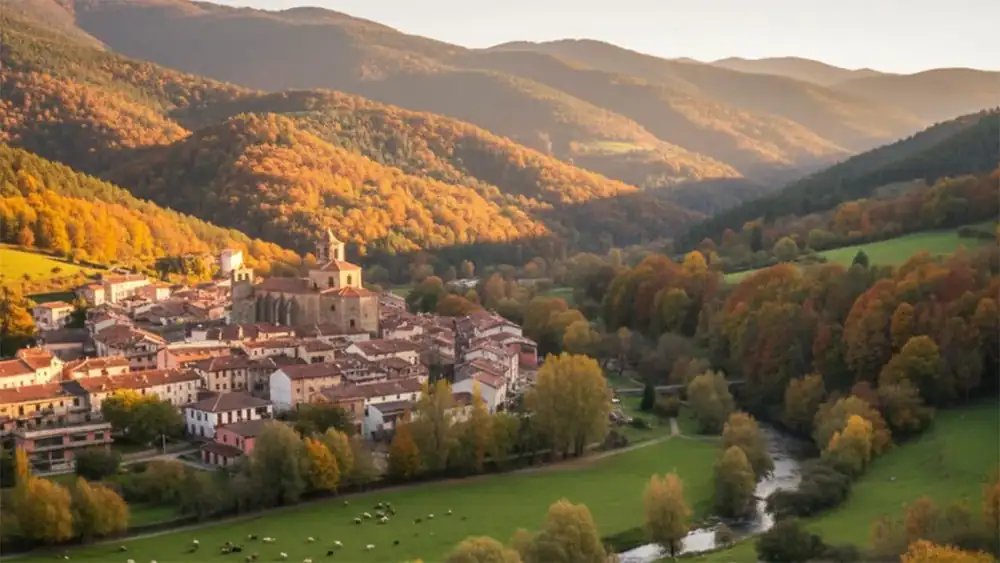
A village hidden among the mountains of La Rioja where cheese reigns supreme over wine
In the greenest heart of La Rioja, nestled among mountains covered in beech forests, lies a small village that has decided to defy the stereotype.
Nestled on the banks of a river with cold, clear water, and boasting three historic neighborhoods connected by bridges and cobbled streets, this mountain enclave has made mountain livestock farming and a Protected Designation of Origin cheese its most authentic calling card. Only those who venture into these valleys discover why, here, cheese has ultimately eclipsed the wines.
A valley in La Rioja where cheese reigns supreme over wine
In a region known worldwide for its red wines and endless vineyards, there's a corner of La Rioja that insists on going its own way. Surrounded by mountains, forests, and meadows, this small mountain village has built its identity around a much humbler product, but one capable of making all the difference on any table: cheese.
Visitors arriving by road are immediately struck by a landscape that doesn't fit the classic image of Rioja. Instead of rows of vines, there are hillsides covered in beech and oak forests and pastures; instead of large livestock barns, there are small cheese dairies, stone houses, and springs of fresh water that recall the importance of livestock to the local economy. Just a few kilometers are enough to understand that this is a different Rioja, more mountainous, quieter, and cooler.
This scenario leads to a very specific municipality: Torrecilla en Cameros, in the heart of the Sierra de Cameros mountains and on the banks of the Iregua River. Here, the name that resonates among bars, shops, and markets is not that of a winery, but that of a dairy product with a history: Queso Camerano, the only Rioja variety protected by a Protected Designation of Origin and the true gastronomic ambassador of the town.
Torrecilla en Cameros, green heart of the mountains
Torrecilla en Cameros serves as the natural capital of the Cameros region. Nestled in the upper and middle valley of the Iregua River, it lies at an altitude of 700 meters, surrounded by rounded mountains and forested slopes. The village is divided into three hamlets—Barruelo, San Martín, and El Campillo—which are spread across both sides of the river, a somewhat unusual arrangement for mountain villages in this area.
The town's skyline is defined by the Church of San Martín, a Gothic-Renaissance temple that rises above red-tiled roofs and stone houses. At its base, narrow streets preserve facades adorned with coats of arms, wooden balconies, and old mansions that recall the town's textile and livestock past. For centuries, transhumance and the cloth industry gave Torrecilla an economic dynamism that left its mark on its architecture.
Walks among beech forests, fountains and viewpoints
The natural surroundings are one of the main reasons to visit Torrecilla. From the town itself, trails lead into beech and oak forests, ideal for easy family walks or longer hikes through the mountains. In autumn, the valley is painted in yellows, oranges, and reds, transforming the landscape into a vibrant palette of colors that contrasts sharply with the gray of the rocky cliffs.
Another symbol of the town is its fountains and springs. The quality of the water has shaped local life and given rise to many points of interest along walking routes: stone fountains in squares and crossroads, traditional watering troughs, and historic springs in the surrounding area. Strolling from fountain to fountain is also a way to understand the relationship between the mountains, the water, and the cheese produced in the region.
A town center with history and illustrious figures
Beyond its stunning scenery, Torrecilla boasts a remarkable cultural heritage. It was once the seat of the Camerano nobility and preserves stately homes bearing coats of arms that speak of its splendor in the 17th and 18th centuries. The bridge over the Iregua River, the chapels scattered throughout its neighborhoods, and the layout of its streets all recall the town's role as a central hub for the region.
Neither Cadaqués nor Santillana del Mar: the most beautiful Cantabrian village to visit has a beach and Gaudí works
Adding to this is the figure of Práxedes Mateo Sagasta, one of the great Spanish politicians of the 19th century, born in Torrecilla. The town is now home to the Espacio Sagasta, an exhibition center dedicated to his life and legacy, which explains his roles as an engineer, journalist, and Prime Minister. Visiting it adds history and context to a getaway that, at first glance, might seem to revolve solely around nature and gastronomy.
Camerano cheese, the flavor that made the town famous
If there's one thing that explains why Torrecilla en Cameros is much more than just a pretty mountain village, it's Camerano Cheese. This traditional cheese from the Rioja mountains is made with goat's milk and has been linked for centuries to the flocks that grazed in these hills. Its importance is such that, since 2009, it has held the Protected Designation of Origin (PDO) seal, which officially recognizes its origin and production method.
The regulations for this designation, established by regional and national legislation, define a cheese that can be presented in four main styles: fresh, young, semi-cured, and cured, all made exclusively with goat's milk from the area. The Regulatory Council monitors both the origin of the milk and the maturation of the product to guarantee that what reaches the consumer maintains its traditional characteristics.
What is Camerano Cheese like and why does it stand out?
Camerano cheese is easily recognized by its cylindrical shape and the braided markings on its rind. Historically, this pattern came from the wicker molds used to drain the curd; today, modern molds reproduce this texture to preserve the product's visual identity.
- The fresh one is juicy, with a soft texture and a mild milky flavor, ideal for eating in salads, with olive oil or with honey.
- The tender cheese retains a certain creaminess, but begins to develop more intense aromas and a slight acidic note.
- The semi-cured cheese offers a firmer paste and complex flavors, with notes of nuts and dried grass.
- The curing process concentrates all the character of the mountain goat's milk, with a deep and persistent flavor, perfect for cheese boards and pairings with aged wines.
In recent years, the PDO has promoted the recovery of small livestock farms and cheese dairies linked to the Cameros region, strengthening the connection between landscape, grazing, and the final product. In Torrecilla, this history is evident in the stories of the producers, on restaurant menus, and in the small shops that proudly showcase their selection of local cheeses.
Where to try it and how to organize the visit
Those who come to Torrecilla en Cameros seeking nature often discover the cheese almost by surprise. The best way to experience it is to order it in the village's bars and restaurants, where it's usually served in portions, on mixed platters, or incorporated into traditional recipes: warm salads, scrambled eggs, sauces for meats, or simply accompanied by rustic bread and nuts.
In grocery stores and local shops, you can buy whole wheels or packaged portions of cheese with varying degrees of aging. Many establishments include information about the PDO seal and how to consume each type of cheese: fresh and soft cheeses are best eaten immediately after purchase, while aged cheeses travel better and can withstand a few extra days of maturation without any problems.
A complete getaway: cheese, river and mountains
The appeal of Torrecilla en Cameros extends far beyond its cheese. The village is an ideal starting point for exploring the Sierra de Cameros, visiting the nearby Sierra de Cebollera Natural Park, following marked trails through the Iregua Valley, or connecting with other mountain villages such as Villoslada, Ortigosa, or El Rasillo.
After a day of hiking, there's nothing better than returning to the town center, crossing the bridge over the river, sitting on a terrace, and ordering a glass of Rioja wine accompanied by a platter of Camerano cheese. It's then, when you combine landscape, history, and local produce, that you understand the phrase many repeat in the area: in this village nestled among valleys, the cheese has long been more famous than its wines.