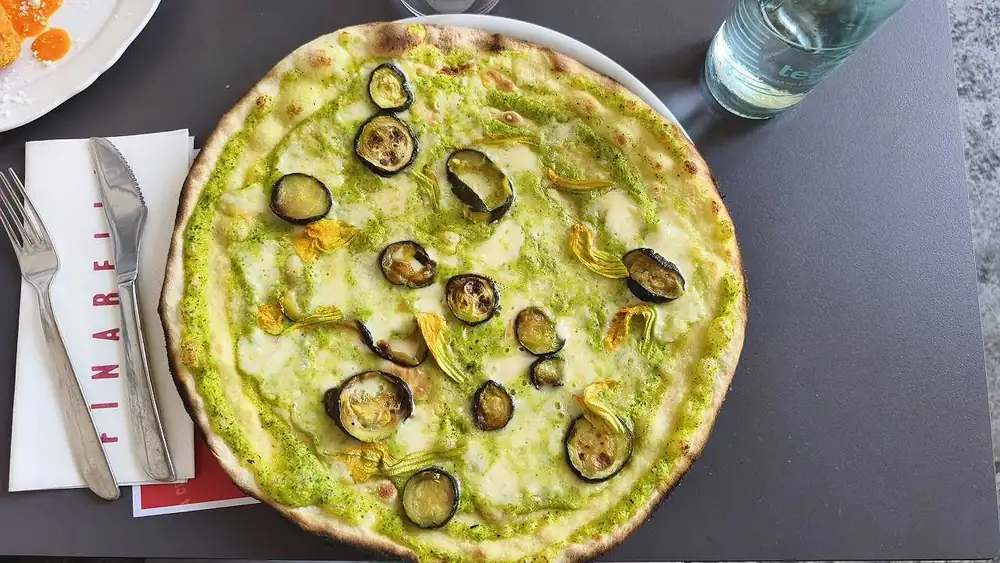
Finarella in Turin, the round Roman pizza that respects its “tradition”
Finarella opens in Turin, because evidently the new trend in Turin, after the Roman pan pizza, is the round Roman pizza.
Where is the Finarella pizzeria in Turin?
Pizzeria Finarella is located in Turin on Corso Vittorio (Emanuele II, we like to shorten streets with overly pompous names here: we have Corso Regina – Margherita -, we have Piazza Vittorio – Veneto, Emanuele is the Corso! -, up to paradoxes like Corso Galileo, which doesn't imply Galileo but Ferraris, or Corso Unione, which, deprived of the Sovietica, remains so, a bit ecumenical). Right in the center, therefore, an arcade of more or less historic restaurants and bars, almost all with the same characteristics: popular-style size, slightly lower prices.
Finarella, between the three internal rooms and the large outdoor area, can seat over one hundred people, if not more.
Finarella's menu
Finarella offers a lunch menu for €9.50, including water and cover charge. This includes, in addition to various salads and several (too many?) first and second courses, classic pizzas (5 types) and supplì, with a choice of three pieces (actually, five types of supplì, plus a pasta frittata and a croquette). The à la carte menu—also available for lunch, just not at that price—features five "special" pizzas, more pork-based than gourmet (although you can't resist the temptation of the "cream with three sautéed cherry tomatoes" or the "olive earth"). Prices range between €12 and €13.
The pizzas (and supplì) of Finarella
Having discarded the idea of having three fried pieces for lunch, we try them as an appetizer. The supplì al telefono—a cornerstone of Roman pop cuisine—is incredibly delicious, even if it's not... al telefono. In the sense that the mozzarella inside doesn't stretch when cut in half, and overall it's a bit dry. The tonnarello cacio e pepe is equally tasty but creamier and softer; it comes with a pecorino foam that is simply the saltiest thing I've ever tasted in my life: it softens when served with the frittatina, but it's still plentiful, and the whole thing is very savory. Both fried dishes have the undeniable advantage of being thick and crispy, and not at all greasy.
And now we come to Finarella's pizzas. To be thin, they are thin: very thin. To be crispy, too: both when cut and when bitten. And the test of taking a slice from the edge (I wouldn't dare call it a crust, since the sauce reaches almost to the edge) yields the expected, desired result: the slice remains impassive, straight and parallel to the table. The edge, or what's left of it, is a little charred, as are a few black spots underneath, and stands out against an already tanned background.
Now, someone who, by birth and education, understands Roman pizza, explains to me that the charred crust is a characteristic of certain Roman pizzerias of the past, a small imperfection, let's say, that has consolidated over the years and ends up being popular, perhaps because it gives former children a madeleine-like effect. In short, we're in the most classic case of an invention of tradition. The fact remains that many modern pizzerias—though not the most sophisticated and chic—aim for this effect on purpose, and Finarella is one of them.
Of the ones I tried, the Cossack was very tasty, although the cheese, appropriately added after cooking but on a base that should be piping hot, didn't quite blend in. The Zucchina mia—with the vegetable in three textures, cream, sautéed, and flowers—is a lovely idea that's a bit lacking in execution, in the sense that it's very delicate, lacking in boldness despite the smoked provola. But perhaps that's just the fault of the overly strong flavors that preceded it.
The final opinion
A good take on the round Roman pizza, the thin, crispy kind, with all its strengths and weaknesses, whether "traditional" or not. The service is friendly and very fast. It's a shame about the limited beer list, which only includes Baladin craft beer and Peroni on tap. Rating: 7.