Barbie and Coffee: When the Cup Turns Pink and the Coffee Shop Enters Pop Culture
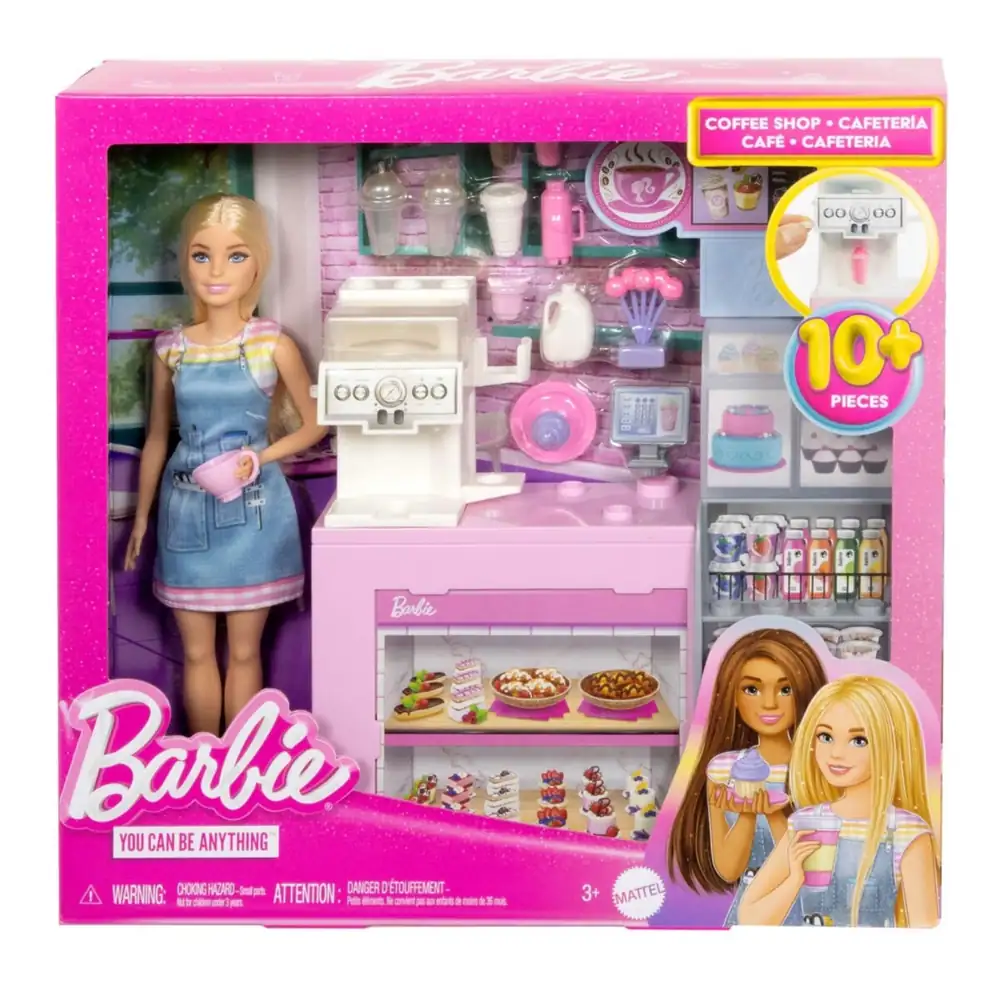
MILAN – Barbie behind the counter, a miniature coffee machine, cups, milk jugs, and a buildable menu.
It is therefore not surprising that Barbie also found one of her ideal environments in the bar.
Barbie becomes a bartender
Barbie's connection to the coffee shop didn't originate with recent marketing efforts. The world of coffee has been featured in Mattel's catalog for years.
In 2018, for example, Mattel presented a set in which Barbie and Ken worked together in a café, complete with a panini press, sandwich, cup, and plate. Barbie, of course, wore a pink apron, while Ken played the kitchen worker.
In 2020, the Barbie Coffee Shop Playset arrived, designed specifically around the idea of running a coffee shop. The set included Barbie, the coffee shop, and over twenty accessories. The doll could make coffee, smoothies, and tea, serve desserts, and operate the cash register.
The café thus enters the universe of Barbie Careers, the line through which Mattel uses role-play to represent different professions and activities.
And the theme continues today. The Barbie Cafeteria playset is available in the Italian Mattel store, featuring a barista doll, counter, coffee and smoothie maker, and over ten accessories. It includes a milk jug, coffee and tea cups, glasses, and a cash register.
A small detail that reveals something bigger: the barista and the coffee shop have now entered the collective imagination of professions and urban environments instantly recognizable even by the youngest.
From toy to real Barbie Cafe
At a certain point, however, the trend reversed. It wasn't just Barbie who entered the coffee shop anymore: the real coffee shop transformed into Barbie's world.
One of the most significant examples is the Malibu Barbie Cafe, a project developed by Bucket Listers under license from Mattel and conceived as an immersive experience inspired by the Malibu Barbie of the 1970s.
The format debuted in 2023 in New York and Chicago, coinciding with the global explosion of the Barbie phenomenon linked to the film directed by Greta Gerwig. Visitors entered an environment inspired by 1970s California, with pink furnishings, beach references, a dedicated menu, and numerous photo opportunities.
The project didn't stay confined to those initial openings. The Malibu Barbie Cafe's official website now presents the format as a traveling experience, built around retro glamour, Barbie colors, brand-inspired dishes, and photo opportunities, including the iconic life-size Barbie box.
This is an interesting transition for the Horeca sector: the restaurant no longer sells just what is consumed at the table, but a narrative universe that can be physically entered.
The bar as a set for photographs
This is where Barbie and the contemporary world of coffee seem to best meet.
In recent years, some international coffee shops have increasingly placed emphasis not only on the product, but also on its visual presentation and the identity of the spaces. Colors, glassware, latte art, packaging, interior design, and table settings all contribute to shaping the consumer experience.
In the case of Barbie, this logic is taken to the extreme: pink is not simply a decoration, but an immediate code of recognition.
Customers don't just come in to eat or drink. They come to be, at least temporarily, inside Barbie World.
And coffee is particularly suited to this type of operation because it already has a strong ritual component: you order, you wait for it to be prepared, you consume it, you converse and, increasingly often, you photograph it.
When Barbie met Lavazza
In Italy, the meeting between the two worlds became particularly evident in 2025, when Lavazza transformed its flagship store in Piazza San Fedele in Milan for the Lavazza Goes Pink for Barbie project.
From October 9th to November 2nd, 2025, the venue was painted pink and hosted an immersive experience built around the world of the Mattel doll. The project also included a Barbie Icons exhibition and, most importantly, a Pink Limited Edition Menu, developed by the Lavazza Training Center.
Coffee became an integral part of the narrative.
The offerings included the Espresso Nuvola, served with pink cotton candy, and the Glittery Cappuccino, made with white chocolate cream and a sparkling component. The menu also included the Marshmallow Blendissimo, with espresso, fiordilatte gelato, and strawberry syrup, along with other food and beverage options.
The project also coincided with the return of the Barbie Coffee Shop Playset, creating a particularly effective connection between the toy and the real coffee shop experience.
In other words: the toy coffee shop almost became a life-size coffee shop.
From product to experience
The operation demonstrates one of the most interesting directions in contemporary marketing applied to food and beverage.
A coffee brand can use pop culture to reach audiences beyond coffee aficionados, while an entertainment brand like Barbie finds in the coffee shop a real place to make its imagination come alive.
The result is a meeting point between licensing, catering, retail and experiential marketing.
The drink remains central, but it's inserted into a broader narrative. A cappuccino is no longer simply a cappuccino: it can become pink, glittery, limited edition, and, most importantly, recognizable in a photo posted on social media.
The success of pink in food and beverage
Then there is a chromatic element that is impossible to ignore.
Barbie possesses one of the most recognizable visual codes in pop culture: pink. Applied to food and beverage, this color transforms traditional products into objects instantly associated with the brand's universe.
The principle is particularly effective with cappuccinos, creams, milkshakes, desserts, and cold preparations, where textures and ingredients allow for greater aesthetic freedom than traditional espresso.
The collaboration with Lavazza is significant precisely because it also involved the latter: the Espresso Nuvola kept the cup at the center, adding a highly scenic pink element.
The message is clear: even one of the most essential preparations of Italian coffee culture can be included in an entertainment operation without necessarily disappearing behind the concept.
A Barbie at the counter also tells how the bar has changed
Looking at these examples together, a curious aspect finally emerges.
In 2018, Barbie and Ken symbolically opened their own café. In 2020, Barbie ran a coffee shop. In the years that followed, real Malibu Barbie Cafes arrived, and in 2025, an Italian flagship café temporarily transformed into a Barbie universe.
From toy to real café, the journey indirectly recounts the cultural evolution of the coffee shop.
The bar is no longer just a place to grab a quick cup of coffee at the counter. It's also a space to work, meet, spend time, create content, and enjoy an experience.
And perhaps it is precisely for this reason that Barbie, after having been an astronaut, doctor, athlete and protagonist of hundreds of professions and scenarios, continues to return behind the counter of a coffee shop.