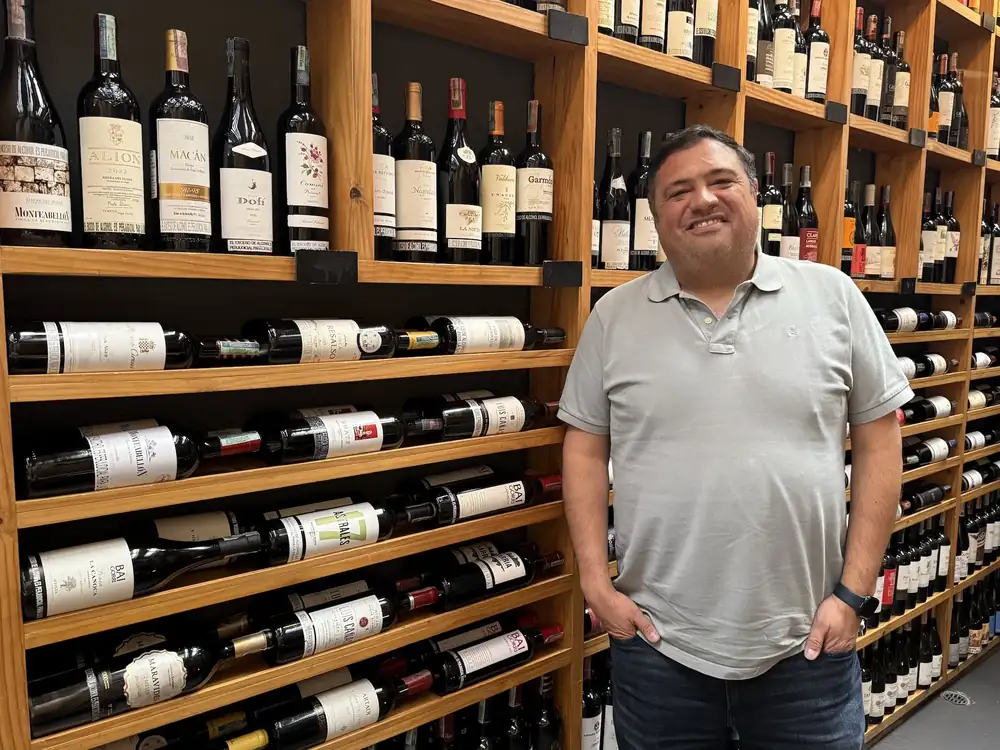
Pedro Escobar (Nueve Restaurant): “We have to let people taste the wine”
At Nueve restaurant in Bogotá, the price range at Nueve is between six euros for a glass of Avaniel red wine from Ribera del Duero and 35 euros for a glass of Pertinace Barolo nebbiolo from Piedmont.
For those coming from Europe or South American wine-producing countries, this will come as no surprise, but wine is expensive in Colombia. This, coupled with a nascent wine-drinking culture, results in a limited selection, with restaurants charging 10 euros or more for a glass of house wine, which often leaves much to be desired. It's worth noting that in the last 15 years, the culinary scene has grown significantly in cities like Bogotá, Medellín, Cali, Barranquilla, and Cartagena, and there are now some interesting wine lists, but Nueve's offering stands out.
What's strange is that, nearing its twentieth anniversary, it's still a hidden gem in Quinta Camacho, Bogotá's English quarter. Perhaps because when it opened in 2009, the area was mostly offices, shops, and family homes, not restaurants. Perhaps because from the beginning, the concept was a private dining experience with a doorbell, something uncommon at the time. Perhaps because Pedro's personality is that of a bon vivant, a lover of wine and food. He's unpretentious, and his aim is to let people taste, choose, and learn. To serve his delicious dishes so that, instead of just one course and one wine, they can enjoy several.
From lawyer to cook
Pedro came to Bogotá from his hometown of Manizales to study law. He chose the field because he had no idea what to study. His grandfather, a lawyer, told him to study law. He wasn't practicing; he worked as a coffee growers' leader. It sounded sensible to Pedro. The initial realization that he needed to cook came with the first shopping cart from his roommates: mac and cheese, tuna, and, of course, aguardiente. "I did participate in that one," he recalls with a laugh. "But seriously, are we going to eat this?"
That's when he understood how fortunate he was to have grown up alongside his father, José Fernando Escobar, an architect and university professor with a master's degree from the Sorbonne in Paris, where he had learned to cook. “My dad was a great cook. He had a vegetable garden at home. He grew his own things and cooked on weekends. I didn't know whether to go out partying or stay home cooking with him. He made everything. He'd grab the Salvat cookbook, La Buena Mesa, and other books, and prepare something. His culinary library was large. We still have it at our house in Manizales. He was happy cooking. That's how I grew up.”
That's precisely why Pedro never went to restaurants. “For me, a restaurant was Kokoriko (very traditional in Colombia) when we went out for roast chicken. And what was available in Manizales at that time wasn't anything special. My dad would say: we eat better here, we're not going to a restaurant. I didn't know anything about cooking, I had no idea that chefs existed, so I didn't see it as an option. I never saw it as a job.”
And since necessity knows no law, Pedro told his dad he needed to learn to cook. “He sent me Doña Sofía Ospina de Navarro’s ‘La Buena Mesa’ cookbook. He told me to start there, that later I could do everything. I began; he would send me books, and I would prepare recipes with one of my friends who also enjoyed cooking. We would buy different products, like artichokes, and the others would look at us and ask if we were going to eat that.” He started making frozen pizzas to sell to his classmates and teaching cooking classes in his apartment.
Between cookbooks, pizzas, and classes for his friends' girlfriends, Pedro graduated with a law degree and practiced for six months. Then he knew he wanted to study cooking and enrolled at the Gato Dumas Institute, which had just opened in Bogotá. Not wanting to waste any time, he volunteered to work at Pepper, a friend's restaurant, then moved to San Isidro de Monserrate, a city icon, and after graduating, started working at the Habitel Hotel.
From each place he learned something he treasures today. From San Isidro, his obsession with the product: “They were all about the product, the product, the product, when here nobody cared and most people were looking for the cheapest option.” Habitel, for its part, allowed him to begin his professional career in the world of wine, studying to become a sommelier and creating a broad and diverse wine list, something unusual in the Colombian hotel industry.
Start your own business
It was while studying that he met Jaime Villegas, his partner at Nueve. At the time, Jaime was selling wines and hosting tastings, for which Pedro prepared the food. It was Jaime who encouraged him to open a venue for his events and who found the house that Nueve occupies today, which they initially shared with a furniture and decoration shop. Pedro's idea was to go cook in another country, but his father died, plans changed, and he reconsidered the idea, taking a different approach.
“I told Jaime we should do it the other way around. That we should offer companies our space for tastings and other events, as a strategy to get people to know us as a restaurant. We didn't have a penny; I built this with the money my father left me, which my sister and I split. Back then, you didn't need to hire influencers to promote the restaurant, but we had working capital for networking with companies and acquaintances.” His partner wasn't clear on this at first. In fact, one day he said, “Oh, this is a restaurant.” Pedro replied, “Of course, it's a restaurant. Otherwise, we'll go bankrupt. And if we're going to go bankrupt, let's go completely bankrupt. Otherwise, I can't make a living from this, so we won't do anything.”
That's how Nueve began. Over the years, the space has remained the same, with changes in its layout and capacity. The furniture store moved, taking over the entire house and initially subletting some areas. They continued with the same thirty-five original stalls. Later, with Ronald Schneider, a customer who became a friend, they opened a small gourmet shop, "but Bogota customers are funny. They'd come in, fall in love with everything, and then buy it at the supermarket: the olive oil, the olives..." Then, on a trip, Pedro discovered El Barón, one of Cartagena's most renowned bars, and knew he wanted something similar; that's how Ocho y Cuarto was born.
They hired an architect, trained as bartenders, and before they knew it, they had Ocho y Cuarto up and running. Serving food from Nueve, it has been a landmark bar in Bogotá for years. Due to family reasons, Ronald moved on to another job, but Ocho y Cuarto, now larger and occupying the front part of the house—where they previously ran a Stella Artois bar with Bavaria—continues to operate.
Try, decide, share
Returning to wine, a key differentiator for Nueve, Pedro feels it was a serendipitous discovery. “We were trying to understand how Bogotá works, a city of gastronomic conglomerates. The vast majority of restaurants that thrive belong to groups or renowned individuals. So I asked myself how I could last as long as Harry Sasson, an example because of the kind of person he is. How can I be like Leo Katz? A genius. And I thought I had to have something that would truly revolutionize things. I was concerned that there was nowhere to drink wine in Bogotá. People were drinking low-quality Chilean brands. Since my partner was involved in wine sales and the general feeling was that Colombia didn't know much about wine, we decided to serve it so people could try it.”
Their value proposition has always been the same: try it. If you like it, they serve it to you; if you don't, they find alternatives. For Pedro, it was also important to bring people down to earth, dispelling the myth of the sommelier who arrives with a taster to offer the most expensive wine, something they don't like, without considering what the person is eating. “Here, we're used to ordering wine without having decided on the food. And often, you start eating and the wine has nothing to do with it. We chefs put in the effort in the kitchen, we burn ourselves out, we try to create good dishes, but if the flavors don't harmonize, the food will be bad, and so will the wine,” he notes.
They wanted to move beyond the snobbery that had surrounded wine, “the kind of people who were beautifully dressed but terribly ill-informed, because there were no sommeliers in the country. Some waiters had acquired a little knowledge, but in the end, all they talked about was nonsense. And they didn't talk about what people wanted to know. All they did was confuse things. People were drinking bad Cabernet Sauvignon. Who's going to like wine like that? So why don't we drink more wine? Because many of us grew up with those awful, tannic, strong wines. It's not wine for the Colombian palate.”
Pedro delves into something little explored. “We have a sweet tooth; we like things with sweet finishes, and you give them the least sweet grape variety. So, our initial idea was based on something that's very popular today. We sold by the quarter glass, half glass, and full glass, as well as by the bottle, of course. We divided a bottle into five glasses, and the price of a glass (multiplied by five) is the same as the bottle. That way, you don't have to pay more for a glass. What happens? You go to a restaurant, and the strategy is to recoup the cost of the bottle with two glasses. So, a glass that should cost six euros ends up costing you twelve. And it doesn't matter if the waiter sells it or not.”
At Nueve, everyone is committed to selling the wine. “We have to sell five glasses to make it profitable. And it's not six, because we give people samples. Didn't like it? We'll exchange it. Don't drink something you don't like. I need them to leave happy, otherwise we're not doing anything.” That's the principle. Educating people, which is why everyone is trained. Their wine list is very comprehensive and well-explained, but the idea is for people to think as little as possible and, above all, for what happens at the table to be about what arrives there: the wine and the food they're served.
During his travels, Pedro developed a fondness for tasting menus. “Where, truly, chefs brought out their best to offer you a wider selection. Something that's largely been lost today. So I wanted to offer a tasting menu, but it was still relatively unknown. And I thought, let's let people create their own tasting menu, without selling it as such, without imposing what they're going to eat. I'll give them small plates so they can try three, four, or five dishes, dividing their experience so they won't be so disappointed if they don't like something. In the end, they'll ask themselves: 'Which one did I like best?' Instead of thinking it was awful if they have a bad experience with just one dish.”
And so are their 250 wines, sourced from Spain, Italy, France, Argentina, Chile, New Zealand, Austria—from countries now available in Colombia. Pedro says that in terms of wine trends, we're lagging far behind. The market used to be dominated by aged wines, heavily oaked and structured, but people's tastes have changed. “A couple told me they liked their wine a little sweet. At that time, when I was starting out, I would bring them a Malbec, which I find sweet because of its ripe fruit. But they still found it bitter. And I was running out of options. One day I gave them a cream sherry, a blend of Oloroso and Pedro Ximénez, a sweet sherry, and they loved it. They asked for another glass. I explained that it was just a wine meant for one glass, but they didn't mind and left happy. They started learning, asking me to let them taste, and now they seek out Burgundies, wines steeped in tradition.”
To accompany the wagyu empanadas with tree tomato chili and roasted garlic, try the charcoal-grilled chicken wing gyozas with pickled cabbage or the crab rice cake with creamy peanut sauce and roasted avocado. For dessert, there's the incredibly crispy dulce de leche mille-feuille with banana ice cream. This is Nueve, the restaurant still tucked away in Quinta Camacho, a place that deserves a spot on The 50 Best Discoveries list, because Pedro has no interest in the lobbying that would get it on the list. He appreciates it; he knows it helps him retain his clientele and attract new visitors. A niche restaurant run by an unpretentious chef and sommelier. A true connoisseur who knows his stuff but doesn't boast about it. One who jealously guards his free time to go out and try new places with his wife, Marcela.