Off Season Greece: Winemaker Michael Kouloglou on Santorini's flavours, viticulture and seaside peace
For winemaker Michael Kouloglou, the decision to move from the mainland to Santorini 11 years ago was a simple one.
On top of the siren’s song of Santorini’s prized volcanic terroir, however, Kouloglou says he appreciates that the region’s windy conditions allow him to pursue his other passions: surfing and kitesurfing.
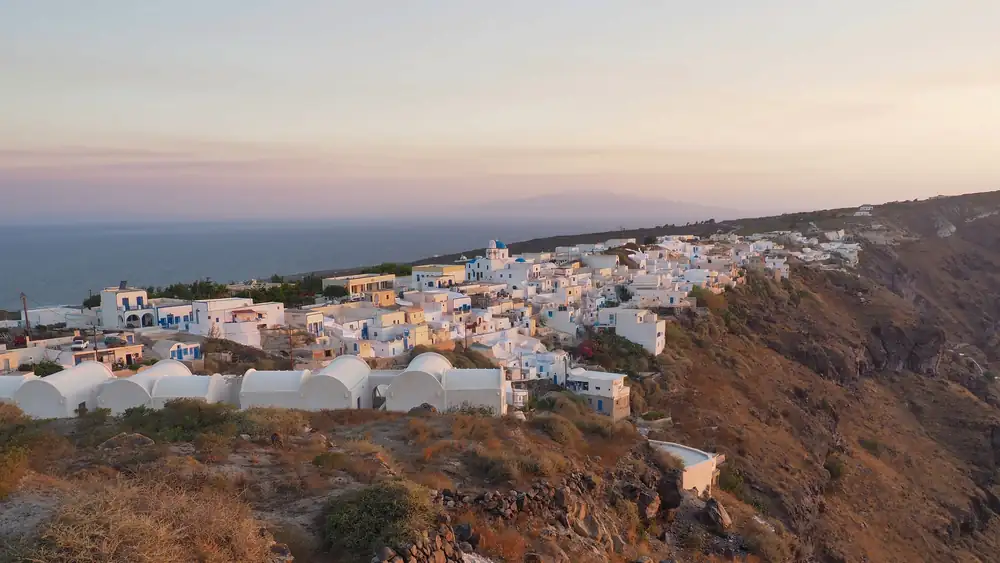
He’s currently settled in Monolithos, a quiet seaside village in the east – but has historically lived all over Santorini, which has offered him great insight into the rhythm of the island. “Each village has its own unique character,” he says, “far beyond the image [of Santorini] that most visitors see.”
Here, the longtime Santorini local shares why autumn is his favourite time of year – and all the treasures of the off-season.
What would you say is the sweet-spot time of the year to visit – when the travellers have not yet arrived, but local life is buzzing?
If I had to choose the best time to visit, I would choose the entire off-season, from late September until around May. Every part of [offseason] has its own personality: Autumn brings relief after harvest, winter offers complete peace, and spring fills the island with optimism as nature comes back to life, just before the new season begins.
What do you love most about being there during the off-season?
Santorini has two completely different lives. One is the island that millions of visitors experience during summer. The other begins in October and lasts until spring. That is the Santorini only the people who live here truly get to know.
By the end of harvest [in September], both the vineyard and I are exhausted. After weeks of living on adrenaline, my body is desperately asking for rest. Around the end of September, the evenings become cooler; you need a sweater after sunset, the days grow shorter, and the strong summer Meltemi (the Aegean wind) gives way to a gentler, northern wind. Everything feels softer. All the locals are tired after another demanding [tourism] season, but at the same time there is a feeling of optimism. Restaurants and bars begin to close for the season, and that's when the closing parties begin; friends you haven't seen for months suddenly reappear. You don't even need to make plans; you know you'll see them somewhere during a closing party.
Who’s around this time of year? Is it all locals? Greek domestic visitors? Are there any travellers at all?
During autumn you'll still find some travellers, but they are completely different from the summer crowds. They usually come looking for a quieter side of Santorini; they enjoy walking, hiking, discovering wineries and small villages, instead of rushing from one attraction to the next.
By the end of November, even the last seasonal workers have left the island. We have a saying here that "the last boat has sailed." From that moment on, Santorini belongs almost entirely to its locals. Conversations become longer, people have time for each other again, and everyday life feels calmer. I think that's the Santorini most visitors never get the chance to experience.
What’s notable about the locals in Santorini: do they have any of their own unique traditions or a reputation amongst Greeks for anything in particular?
One thing that has always impressed me about the locals is how deeply everyday life is connected to the Orthodox Church and its traditions. Almost every small chapel on the island has its own patron saint, and every saint's feast day is celebrated with a panigyri, a traditional village festival. During the summer, many of these celebrations continue late into the night with traditional music, dancing and plenty of local wine.
What I also find fascinating is that many of the locals still organise their year around the feast days of the saints. They won't say, "I'll start pruning in late November." They'll say, "I'll start after Saint Philip's Day and I have to finish before Saint Alexios' Day." That's how they measure time. It's a tradition that has been passed down from generation to generation, and it's still very much alive today.
Where would we find you eating during this time?
During the off-season, you will most likely find me at Pentozali, a traditional taverna that serves authentic meze from both Santorini and Crete. I absolutely love it for its relaxed atmosphere, its genuine food, and its people. What I appreciate most during this time of year is that it becomes a gathering spot almost exclusively for locals. It is very common for me to run into someone who has just finished a hard day's work in the vineyards. We’ll sit down together for a glass of wine and a little chat, with absolutely no rushing around.
What’s the seasonal dish to order at this time of year?
If you are lucky and the spring timing is right, the dish to order is definitely an omelette with wild asparagus. It’s a rare treat because you can't just find it every day; it completely depends on whether someone woke up early in the morning and gathered the wild asparagus fresh from the countryside. Another staple that is almost always on the table is our traditional Santorini fava topped with sautéed onions. It is incredibly simple, but when cooked properly, you truly don't need anything more.
Are there any areas of the island that really come alive during the off season?
As the summer venues close, the life of the island doesn't disappear; it just shifts to the places where people actually live year-round. Areas like Karterados and Messaria become the real hubs. They are central points on the island that stay busy and full of life all year. The the local closing parties of fall range from wild gatherings by the beach bars to more laid-back evenings in traditional cafés and small local hangouts. Later, in the winter, as people begin gathering more at homes, these central areas remain the heart of our social life.
But if you want to talk about a completely hidden side of Santorini that comes alive in a very quiet, spiritual way, it’s the Askitaria. These are old stone monk lodgings perched right on the edge of the cliff on the mountain between Perissa and Kamari. In the spring, you will find many locals sitting there for hours, doing nothing in particular but gazing out at the endless blue, the passing ships, and distant islands like Anafi, Ios, and Anydro.
How does the weather change the destination during this time of year, and what are the (dis)advantages of that?
Autumn and winter are much warmer and sunnier than most people expect. They bring a rare, beautiful peace. For us winemakers, even the rain is a blessing, not “bad weather” – it’s a relief to see the vines finally get a drink after months of summer drought. The main disadvantage, if you can call it that, is the unpredictability: March, for instance, is a strange and stubborn month with strong winds, cold snaps, and constant weather shifts.
What does a perfect Saturday in the off-season look like to you?
My perfect off-season Saturday starts slowly, without checking my watch – perhaps walking through the narrow paths of the caldera in Fira or Oia. Later, I would meet up with friends. There is always an excuse for an impromptu barbecue, either with meat or, even better, fresh seafood; almost every group of friends here has at least one good fisherman. We would share a coffee or wine, talk without any rush, and if we are lucky, someone might randomly pick up a lute, a tsampouna, or a violin. No big plans or appointments needed, just letting the night unfold naturally.
Do you have any favourite activities during this time of year?
My favourite activities are tied to the water. The Aegean is ideal for kitesurfing due to its consistent winds, and as paradoxical as it may sound, specific weather systems often generate great surf here during the winter. We have a small but tight-knit community of surfers on the island, and when the conditions are right, we all head out into the water.
Even though the water is still cold, the feeling is incredible. Sometimes you might even catch people paddleboarding inside the Caldera with absolutely no sea traffic, no cruise ships or catamarans, just you travelling parallel to the old quarries and rusty iron piers that hold the island’s history.