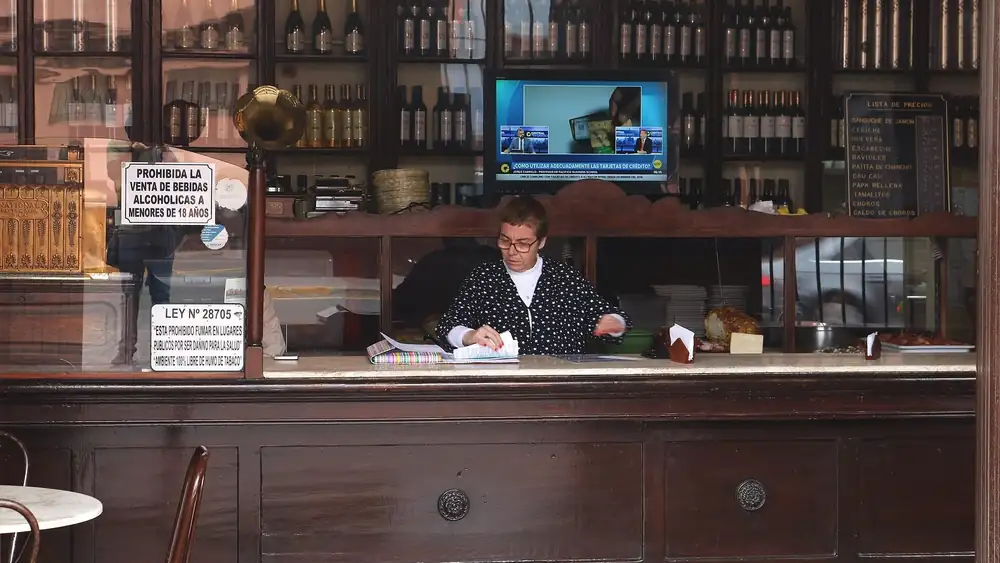
Lima thinks he's rediscovering the tavern. He never left
La Antigua Taberna Queirolo has been serving cau cau, tacu tacu and butifarra in Pueblo Libre since 1880, without interruption and without anyone celebrating it as a trend.
The tavern is not a Lima invention, not even in its original 1800s version. The word comes from the Latin *taberna*, the establishment in Rome where wine and food were sold to travelers; in Spain, it became established centuries later with the roadside inns. What arrived in Lima was not that pure format, but rather its fusion with the Italian immigration of the late 19th century: bodegas that began by selling wine and ended up serving stews in the back room.
That's why Queirolo and Cordano have Italian surnames, not Spanish ones. This is the detail that articles about the "rebirth" of taverns often overlook: the 1880 format never completely disappeared; it simply became invisible in the media for decades, while a handful of survivors—Queirolo and Cordano, for example—continued serving chilcanos and butifarras without anyone considering it a symbolic act of resistance. What Rómulo Vinces did when he opened La Botica in 2011, guided by his mother's and mother-in-law's recipes, and without any formal culinary training, wasn't reinventing the Lima tavern.
It was noticing that the model was dying out commercially everywhere except in those few places, and opening a new one just when no one else was doing it. Chef José del Castillo acknowledged La Botica as the inspiration for Isolina, which opened in 2015 and gave that idea the technique and presentation of a professional kitchen.
Gastón Acurio's Bodegón opened in 2017 and transformed the area into a cosmopolitan hub. Its kitchen, helmed by Cinzia Repetto, attracts Peruvians and tourists alike with its hearty stews and substantial sandwiches.
Vinces, meanwhile, continues serving its classic dishes at the same old bar, its name barely mentioned in the articles celebrating this return. That's the first uncomfortable truth of this wave: what's being sold today as a renaissance is, at best, a re-edition with a better design of something a handful of places never stopped doing.
Something similar is happening with the new picanterías, although with a sharper edge. This format, initially run by women (unlike the tavern), proliferated from the 16th century onwards, where chicha was sold to farm workers.
Then, in the 19th century, these chicherías (taverns selling chicha, a fermented corn beverage) began to sell food, giving rise to the format we know today. In 2013, Héctor Solís transplanted to Surquillo something that until then had only existed in Chiclayo: fish chosen and cooked according to the technique requested, and a shared table among strangers because there was no other way to sit.
That urban picantería model is now being replicated by other picantería formats. And just as it had become established as a trend, Solís closed La Picantería after fourteen years—not because of failure, but for a bigger comeback, planned for 2027.
There's a first idea worth emphasizing: this wave isn't a spontaneous rediscovery of what's popular; it's the belated generalization of formulas that were already proven. That doesn't invalidate it.
But the question to ask with each new opening changes: not whether the format works—we already know it works—but what real work is behind it. That's where the cases differ.
Francesco de Sanctis didn't arrive at Alegría, his Piuran picantería, through nostalgia-driven marketing; rather, it was after his experience training picantería owners in northern Peru in proper food handling. This fieldwork is what distinguishes his ceviche—spelled with an "s," as it's done in Piura—and his chicha de jora from mere garnish. Luciano Saco, at Pálpito, doesn't cook Arequipa-inspired dishes; he cooks what he learned from his grandmother Berta in Mollendo (Arequipa), a locro de pecho (a hearty stew) that's practically nonexistent on any Lima menu. In both cases, there's a verifiable lineage, a commitment to rescuing forgotten recipes.
At Bruto, Arlette Eulert translates the home-style Lima cuisine that was already emerging at Matria, with escabeches and carapulcras, into a tavern format. Or Cumpa, where Renzo Miñán brings the northern tavern to Surquillo with duck cooked in a drum oven and green rice served in a brass pot, and an old-fashioned huancaína sauce with balls of hand-kneaded yellow potato. Or, also, La Perlita, chef Ricardo Martins' more relaxed space, where Creole waltzes play on a Pleyel piano from 1822 (a year after Peru's independence), accompanied by slow-cooked dishes like pork knuckle adobo with corn pepian, olluquitos with grilled shrimp, or his now-famous ají de gallina with crab.
Traditional dishes revived, but with an indulgent or modern twist, depending on the case. Glasses of strawberries soaked in mistela and crowned with cream or huevo chimbo, a colonial dessert made with abundant beaten egg yolks flavored with pisco, conclude the dinner, giving way to pisco sours and Creole music.
A symptom of where all this might be leading could be M Taberna Picantera, owned by Carlos Tapia in Punta Hermosa, which no longer even chooses between the two formats, but merges them into a single brand offering seafood and Creole dishes. It's honest, in the sense that it doesn't fantasize about a distinction that the market no longer needs.
But it also confirms that taverns and traditional eateries have begun to function as a branding genre, something that can be named and packaged without needing to carry the same groundwork as Vinces, Solís, or Del Castillo. This is where new names still have to prove themselves, with their menus rather than just their aesthetics, whether they are reviving recipes or simply engaging in a marketing exercise.
The format is so successful that Renzo Miñán ventured into another tavern format with the new Taberna E. Palacios (currently in its soft launch), where he mixes traditional Peruvian dishes such as homemade chicken causa and carapulcra with short ribs, with Madrid bar classics such as calamari sandwiches, potato salad, gildas of the day, patatas bravas and mussels in oil.
What separates those that will last from those that will quickly become obsolete isn't the formula—sharing plates in the center of the table, a short menu, an unpretentious atmosphere—but whether it's based on authentic cuisine or one that only cites its origins as an Instagrammable hook. And here I prefer not to be neutral: half of this wave is rescuing something real—a traditional Piuran eatery, a grandmother's recipe, a stew that was being lost—and the other half is using the word "tavern" like someone using a filter.