Japanese Style Avocado Egg Salad with Wasabi Mayo
This is outrageously good. ★★★★★
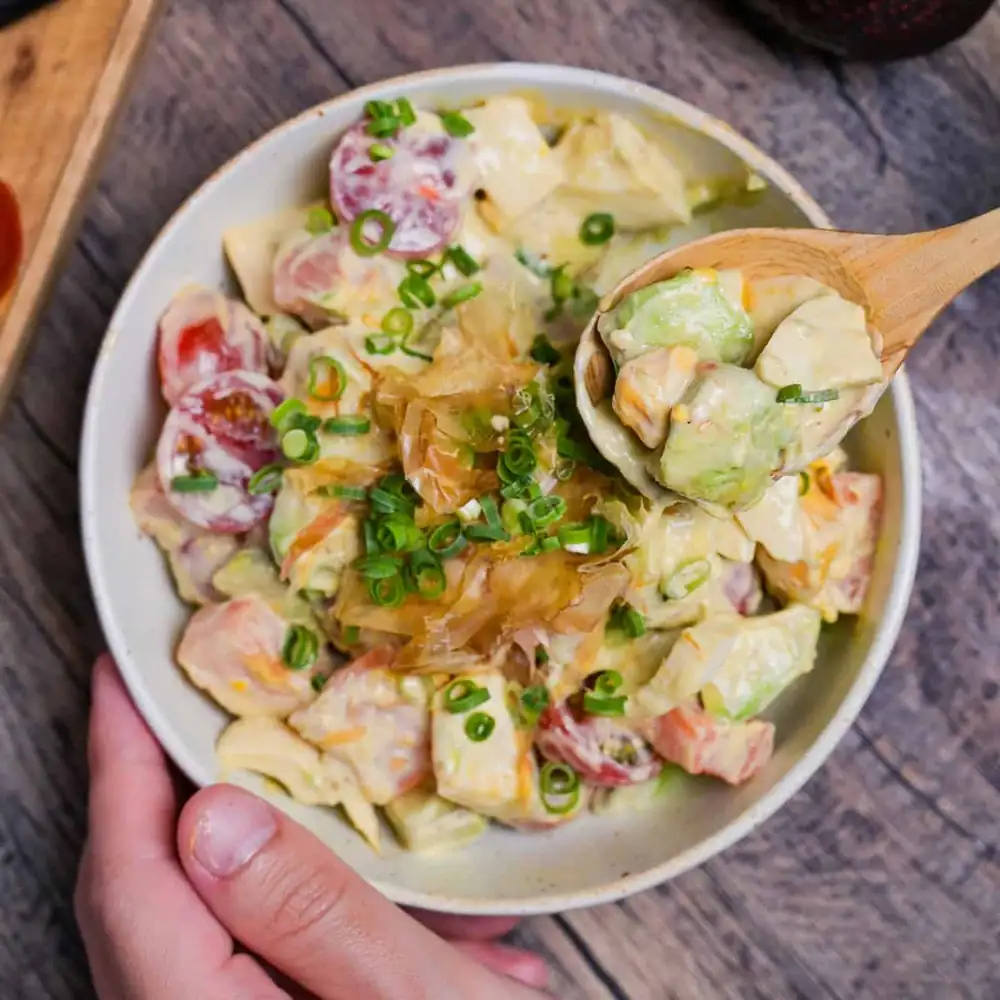
- 2 tbsp Japanese mayonnaise
- ½ tbsp Japanese soy sauce (koikuchi shoyu)
- 1 tsp toasted white sesame seeds
- 1 tsp wasabi paste (adjust heat to your preference)
- ½ tsp toasted sesame oil
- 1 pinch sugar
- 5 mini tomatoes (cherry or grape)
- 2 boiled eggs (hard boiled works best, about 10 minutes of boiling)
- 1 avocado (ripe yet firm)
- 100 g sashimi grade salmon (or cold-smoked salmon, then cut soy sauce a little)
- 1 tbsp finely chopped green onions (optional)
- 1 tbsp bonito flakes (katsuobushi) (optional)
- Take a large mixing bowl and add 2 tbsp Japanese mayonnaise, ½ tbsp Japanese soy sauce (koikuchi shoyu), 1 tsp toasted white sesame seeds, 1 tsp wasabi paste, ½ tsp toasted sesame oil, and 1 pinch sugar. Whisk until everything is combined.
- Halve 5 mini tomatoes and 2 boiled eggs. Scoop out the yolks and then cut the whites into cubes. Cube 100 g sashimi grade salmon and 1 avocado, then add everything to the bowl with the sauce. Mix gently until all of the ingredients are evenly coated.For best results, chill in the fridge for at least 20 minutes before serving.
- Transfer to serving bowls and sprinkle with 1 tbsp finely chopped green onions and 1 tbsp bonito flakes (katsuobushi) (optional). Enjoy!
Featured Comment
This is outrageously good. ★★★★★
I took the avocado salad concept apart and rebuilt it. I crossed it with Japanese potato salad, then layered in the quiet seasonings of Japanesey flavors until the dish stopped resembling either parent. What came out is an avocado salad I have never seen in any kitchen, restaurant or home.
Make it once and you will understand.
Japanese Avocado Salad
- What is it? A cold Japanese-style avocado salad built on the structure of wafu potato salad, dressed in a soy, sesame oil, wasabi, and Japanese mayonnaise mix, finished with salmon, boiled egg, and bonito flakes scattered at the moment of serving.
- Flavor profile: Creamy avocado meets buttery salmon meets silky eggs, all carried by a sesame-oil and wasabi dressing with a quiet warmth that sits at the back of the bite.
- Why you will love this recipe: It takes 10 minutes of active work, 1 bowl, and 0 heat, and it lands as a meal-in-a-bowl rather than a cubed-avocado-in-soy-sauce side.
- Must-haves: 1 ripe Hass avocado, salmon, and Japanese mayonnaise.
- Skill level: Beginner-friendly. The whole technique is sequence, not skill: dress first, cube the avocado last, fold once, chill 20 minutes, top, serve.
Summarize & Save this content on: Japanese avocado salad is not a codified dish.
It is a category: cubed ripe avocado dressed cold in soy-leaning seasoning, finished within the day. When a dish has Japanese influence we often call it wafu, which means Japanese style. Wafu is a register, a way of seasoning that lets the loudest ingredient stay loud and the quietest stay quiet.
The dish itself is roughly 30 years old. Avocado was barely eaten in Japan before the late 1980s, and it went from exotic curiosity to weekday refrigerator staple in a single generation.
In my version, I crossed the avocado salad concept with Japanese potato salad. A boiled egg, sashimi-grade salmon, Japanese mayonnaise binding everything with soy sauce, wasabi, and sesame oil.
I am using more typical and peculiar Japanese condiments than most avocado salads. It looks like a variant, but it is not.
- Avocado: The skin should be charcoal-dark with no green left on the shoulder, and the little stem button at the top should pop off cleanly with a fingernail flick to reveal pale green underneath. Press gently with the pad of your finger, the give should be like a softened pat of butter, not bread dough.
- Sashimi-grade salmon: Sashimi-grade is a US-specific labeling convention. The label is a vendor’s word that the fish has been frozen at minus 35°C (minus 31°F) or colder for the parasite-killing window required by the FDA, then thawed for the case. Look for it labeled sashimi-grade or sushi-grade.
- Wasabi: S&B from the tube is fine. Watch out for the cheap green tubes, they are sometimes dyed horseradish, which reads as harsh sinus-burn rather than the rounded warmth wasabi gives.
A few honest words before the swaps. The spine of this dish is the avocado-and-egg-and-mayo-and-soy quartet, pull any 1 of those 4 and you are making a different salad. The salmon, the wasabi, the sesame oil, the cherry tomato, the green onion, and the bonito flakes all have working swaps that land you somewhere in the same neighborhood.
Read this section before you shop, it saves you a trip back to the store. Substitutions:
- Sashimi-grade salmon → Smoked salmon: This is the safest swap if your grocer does not carry sashimi-grade fish. Cold-smoked salmon (the silky deli-counter kind, not the dry hot-smoked fillet) brings the same fat-meets-savory profile, but it arrives already cured. Cured means salty, so cut the soy sauce in the dressing by a quarter teaspoon to compensate.
- Sashimi-grade salmon → Sashimi-grade tuna: One-for-one swap by weight. Tuna is usually leaner than salmon, so the dish reads a little more austere, less buttery, more clean savory.
- Sashimi-grade salmon → Skip the fish entirely: Dial up the boiled egg from 2 to 3 and add a generous pinch of sesame seeds for the missing fat-and-savory layer.
- Real wasabi paste → Karashi (Japanese yellow mustard): Different heat profile, but acceptable. Karashi gives a sharper, more nasal warmth that pairs interestingly with the salmon.
Have trouble finding Japanese ingredients? Check out my ultimate guide to Japanese ingredient substitutes!
Variations:
- Half-avocado, half-cucumber: Cube 1 ripe avocado and half an English cucumber together for an additional clean crunch.
- Crispy nori topping: Tear half a sheet of toasted nori into rough strips and crumble them on top with the bonito flakes. The seaweed brings a roasted-ocean note that the bonito alone cannot quite carry.
How to Customize:
- Lean weeknight protein: Skip the salmon and use well-drained Japanese-style canned tuna.
- Lean rice bowl: Spoon the salad over a bowl of warm Japanese short-grain rice. The rice catches the dressing that pools at the bottom of the salad bowl, which is the most underrated part of this whole dish.
If you prefer to watch the process in action, check out my YouTube video of this Japanese avocado salad recipe! i.
In a medium bowl, combine the Japanese mayonnaise, the soy sauce, the toasted sesame seeds, the wasabi paste, the toasted sesame oil, and the pinch of sugar. ii.
Whisk until the mixture goes from streaky-and-loose to smooth-and-uniform. i.
Cube the avocado, eggs, and salmon and place them in the bowl. Add halved cherry tomatoes and mix gently until all the ingredients are evenly covered. ii.
Cover the bowl and chill it in the fridge for 20 minutes. One of my readers tried this recipe with more accessible alternatives to sashimi-grade salmon and had great success! She reported that smoked salmon, canned salmon, canned tuna, and even salmon flakes all worked well.
i. Divide into serving bowls and top with bonito flakes and chopped green onion (optional).
Enjoy! Fridge: Eat the dressed salad the same day, ideally within an hour or 2 of mixing.
If you must hold it, press plastic film directly onto the surface of the salad and refrigerate up to 24 hours, but the sashimi salmon shortens the safe window to same-day only. Freezer: Not recommended.
Meal prep: Cube the cherry tomatoes, slice the green onion, and boil the eggs the night before, then store them separately in sealed containers in the fridge. If the wafu side of Japanese home cooking pulls you in, browse my full collection of Japanese salad recipes and pick your next bowl. The ingredient brands and tools I trust are in my Japanese pantry guide and my cooking tools guide.
Can’t find certain Japanese ingredients? See my substitution guide here.