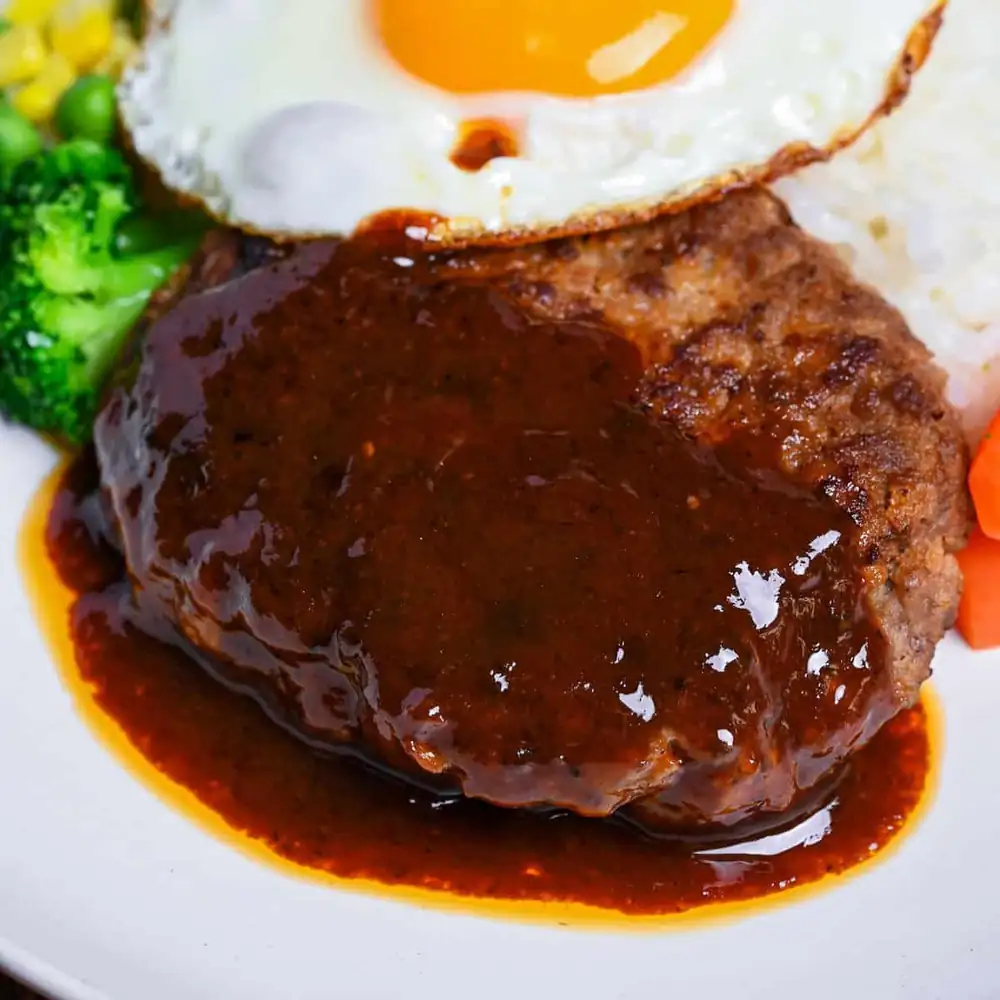
Japanese Hamburger Steak with Egg and Rice (Hambagu)
I found this recipe to be *incredibly* delicious, and so did my family!
- 2 tsp unsalted butter
- ½ onion (finely minced to ~5mm, 100-150g per 300g meat)
- 4 tbsp panko breadcrumbs (or Western breadcrumbs, avoid seasoned types)
- 3 tbsp whole milk
- 200 g ground beef (or 50% beef and 50% pork, ~20% fat content recommended)
- 100 g ground pork
- ½ tsp salt (0.8-1.0% of meat weight)
- ¼ tsp ground black pepper
- 1 pinch nutmeg powder (optional)
- ½ tbsp lard (optional, use if meat is lean)
- ½ tbsp cooking oil
- 1 tbsp water
- 1 tbsp red wine
- 2½ tbsp tomato ketchup
- 1 tbsp Worcestershire sauce
- ½ tbsp honey
- ½ tsp smooth Dijon mustard (avoid whole-grain)
- ½ tsp Japanese soy sauce (koikuchi shoyu)
- ⅛ tsp dashi granules
- 1 tsp unsalted butter
- fried egg
- cooked Japanese white rice
- steamed vegetables (or fresh salad)
- Warm a skillet over medium heat and add 2 tsp unsalted butter. Once melted, add ½ onion (finely diced) and sauté until golden and translucent. Transfer to a wide bowl to cool completely.
- Measure 4 tbsp panko breadcrumbs into a small bowl and add 3 tbsp whole milk. Mix to rehydrate the breadcrumbs and make a "panade".
- Take a large bowl and add 200 g ground beef, 100 g ground pork and ½ tsp salt. Knead for about 1 minute to evenly distribute, being careful not to overwork it.
- Add the panade, ¼ tsp ground black pepper, and 1 pinch nutmeg powder to the bowl. If you used lean meat, consider adding ½ tbsp lard to make the patties juicer. Mix with open fingers until evenly distributed.
- Gently knead, then divide into 2 equal pieces for large adult portions, or 3 for standard portions or 4 for small portions.
- Toss each ball from one hand to the other to remove air pockets, the motion through the air keeps the meat cool. Shape into ovals about 2cm thick and make a shallow dent in the center on one side. Rub your finger along any cracks to smooth them out.
- Place the shaped patties in a wide sealable container, then cover and refrigerate for 20-30 minutes.
- Heat a skillet over medium and add ½ tbsp cooking oil. Once hot, place the patties in the pan with the dimple-side faving up and sear for about 2 ½ minutes or until the underneath has formed a thin brown crust.
- Flip and fry on the other side for 1 ½ minutes.
- Splash 1 tbsp water into the pan and cover with a lid. Steam for 3 minutes, then turn off the heat and leave covered for 1 minute to continue gently cooking in the residual heat.
- Check the internal temperature of the patties with an instant-read thermometer. They should read 71-75℃ (160-167°F) or the juices should run clear. Transfer to a wire rack to rest for 1-2 minutes.
- While you wait, return the pan to a low heat and deglaze by adding 1 tbsp red wine and scraping the bottom of the pan with a spatula.
- Add 2½ tbsp tomato ketchup, 1 tbsp Worcestershire sauce, ½ tbsp honey, ½ tsp smooth Dijon mustard, ½ tsp Japanese soy sauce (koikuchi shoyu), and ⅛ tsp dashi granules to the pan and mix until combined. Simmer for about 1 ½ minutes or until slightly thickened and syrup-like. Finish with 1 tsp unsalted butter and mix until melted into the sauce.
- Place the patties on serving plates along with your choice of sides. I opt for cooked Japanese white rice, steamed vegetables and a sunny-side fried egg. Drizzle with the sauce and enjoy!
Featured Comment
I found this recipe to be *incredibly* delicious, and so did my family!
★★★★★ Why do Japanese families love hambagu as much as curry rice, takoyaki, and omurice?
Because it’s the dish that unites generations. From casual diners to home kitchens, it sits beside chicken karaage and gyoza as a national favorite. Now you’ll see why everyone swears by it.
Hambagu
- What is it? A juicy, tender Japanese hamburger steak with rich, savory sauce.
- Flavor profile: Savory, Tangy, Umami-rich
- Why you’ll love this recipe: It delivers a comforting, homemade one-plate dinner in under an hour, perfect for busy weeknights without complicated steps.
- Must-haves: Ground meat blend, Onion, Salt
- Skill Level: Medium
- Freezer Friendly? Yes!
- Suitable for Meal Prep? Yes!
Summarize & Save this content on:
Hamburg steak, or hambāgu (ハンバーグ) in Japan, is a juicy pan-fried patty made from seasoned ground meat. While it traces its roots back to Germany’s Hamburg region, the dish was adapted in Japan during the Meiji era (1868 – 1912) and has since become a classic home-cooked favorite.
It belongs to the family of yoshoku (洋食), which means Western-inspired Japanese dishes that were reimagined for local tastes. Other well-loved examples include tonkatsu, korokke, hayashi rice, and Japanese style potato salad.
The beauty of Hamburg steak is in its versatility! It can be saucy and tender for kids or meaty and rich for grown-ups.
That’s why it’s earned a permanent place on Japanese dinner tables, much like pasta or pizza in the U.S.
What You’ll Need for Hamburger Steak
- Ground Meat (Beef & Pork Blend): In Japanese-style hamburg steak, a blend of beef and pork is the go-to choice, and the ratio (will explain later) makes all the difference. If you can only find pre-mixed “meatloaf mix” at your store, that works perfectly too.
- Onion: Finely diced and lightly sautéed, onion mellows any gamey taste, adds natural sweetness, and helps bind everything together.
- Panko (Japanese Breadcrumbs): Think of panko as the fluff factor that keeps your hambagu tender instead of dense. These airy crumbs create little pockets inside the meat that trap moisture and give you that melt-in-your-mouth texture.
What You’ll Need for Hambagu sauce
- Red Wine: A splash of cooking wine in the sauce brings depth. Grab a bottle labeled “cooking wine” or use a leftover red you’d actually drink (slightly sweet varieties work great).
- Panko: No panko? Use Western breadcrumbs, regular sandwich bread or crackers instead. Tear half a slice of bread (crusts removed) into small pieces and soak in milk just like you would with panko. Crackers can be crushed into crumbs and soaked too.
- Nutmeg: If you don’t stock nutmeg, try a tiny pinch of allspice or even a mix of cinnamon and clove. Just be careful to only add a little, since they can be overpowering in large amounts.
- Worcestershire Sauce: The Japanese version is sweeter and thicker than the British Worcestershire sauce. If you can only find the British kind (like Lea & Perrins), use little less and add a little extra of ketchup/honey to balance the sharpness. In a pinch, A1 steak sauce can get you surprisingly close.
- Red Wine: Avoiding the use of alcohol in your cooking? Sub with unsweetened grape or pomegranate juice to keep that fruitiness without making it too sweet.
Have trouble finding Japanese ingredients? Check out my ultimate guide to Japanese ingredient substitutes!
The mix of beef and pork you use changes everything about your hambagu, from how rich it tastes to how difficult the cooking experience can be. Here’s how to pick the right blend for you and your family.
Beef brings that savory, grilled-meat aroma and deep umami taste that makes hambagu feel substantial. The downside?
Beef fat hardens when it cools, which can make leftovers feel dry. Basically, the more beef you add to your hambagu, the more difficult it will be to perfect.
Pork is your insurance policy against dry patties. Its fat melts at a lower temperature and stays soft even in the fridge, plus it adds a subtle sweetness that rounds out the flavor.
Too much pork, though, and you’ll lose that bold “meaty” punch. I recommend sticking with from 70% beef, 30% pork to 50/50 for your first try to prevent dry patties and cracks.
If you prefer to watch the process in action, check out my YouTube video of this hambagu recipe! Before you start: Keep the ground meat in the fridge until the moment you mix.
Cold meat binds better and keeps fat from smearing. If mixing by hand, rinse your hands in cold water first so body heat doesn’t warm the meat.
Also finely chop your onion. i. Warm a skillet over medium heat, melt the butter, and sauté the finely minced onion until pale gold and just sweet.
ii. Spread on a plate or bowl and cool completely to 20-25℃ (68-77°F) before mixing.
Adding hot ingredients into ground meat melts and smears the fat, which leads to mealy texture and moisture loss as it cooks. Keep everything cool so fat stays in distinct pockets that melt into juiciness later. For 300 g meat, use 100-150 g onion: more onion for softer, juicier patties; less for a meatier bite.
i. Stir milk into panko (or plain breadcrumbs) and let it hydrate until thick and spreadable.
This pre-soaked crumb won’t steal juices later, instead, it cushions proteins for tenderness. If you’re out of milk, use water or unsweetened soy milk.
This bread and milk mixture is called a “panade”. If you’d like to make your hamburg steak dairy-free, you can substitute the milk in the panade with beef broth, soy milk, oat milk, or even just water.
Also, using old bread rolls soaked in your chosen liquid before mixing them into the meat works great for achieving that tender texture. i.
Put the chilled meat in a large bowl, sprinkle in the salt. 0.8-1.0% of the meat weight hits the sweet spot for binding without toughening.
ii. Then knead just about 1 minute until the salt is evenly distributed. Salt helps dissolve salt-soluble myofibrillar proteins (notably myosin), which bind the meat into a moisture-holding network as it cooks, great for juiciness, as long as you don’t over-develop it.
iii. Stop as soon as the paste clings to the bowl.
Overworking now can make the final texture bouncy and dense. i.
Add the panade, black pepper, nutmeg, and the cooled onion to the salted meat. If you used lean ground meat, consider adding lard to help make the patties juicier. ii.
Mix with open fingers in big circles just until everything looks evenly incorporated and the mixture feels slightly sticky again. Then stop. Many recipes might call for egg (or egg yolk) as a binder, but I skip it to keep the focus on pure meat flavor.
I find the salt-kneading technique provides enough binding power. iii. Divide evenly (2-4).
iv. Then “toss” each portion between your palms 5-6 rounds to push out air pockets. v.
Seal any seams, form into ~2 cm thick ovals, and make a shallow ~2 cm center dimple. A shallow dimple prevents “burger bulge” so patties cook flat; chilling keeps fat solid for cleaner browning and less shrink.
vi. Cover and refrigerate 20-30 minutes to firm the fat and set the shape.
This hambagu recipe serves 2-4 people. If you divide the mixture into 2, you’ll get slightly larger servings suitable for adults, 3 would be average, and 4 would be smaller kids size.
i. Heat a skillet over medium, add oil, and place patties dimple-side up.
Sear about 2 ½ minutes until the bottom is browned. Resist the urge to poke, prod, or flip early.
Moving the patties too soon tears the delicate crust and can cause them to stick. Cast iron, carbon steel, or thick stainless steel works best for this dish. Thick pans hold heat steadily.
When you add cold patties, the temperature barely drops, so you get even browning and consistent cooking all the way through. ii.
Flip and cook 1½ minutes. iii. Then drop to low, splash in water, cover with a lid, and steam 3 minutes.
iv. Turn off the heat and keep covered 1 minute to settle the heat.
If the patties aren’t quite done but the bottom is starting to scorch, drop the heat to the lowest setting, cover, and give them a few more minutes. Check them frequently to avoid overcooking.
v. Slide an instant-read thermometer into the side of the thickest part.
Aim for 71-75℃ (160-167°F) at the center, clear juices are a secondary cue. Rest 1-2 minutes on a plate or a container to let bubbles subside before saucing.
i. With patties resting, return the same pan to low heat, add red wine, and scrape up the fond. Deglazing dissolves flavorful browned bits into the sauce so none of that seared goodness is left on the pan.
ii. Stir in Worcestershire, ketchup, Dijon, honey, soy sauce, dashi granules, and any resting juices.
Simmer about 1 ½ minutes until lightly syrupy. A Japanese brand like Bull-Dog is ideal, but a Western brand like Lea & Perrins works too.
Just stir in a tiny bit of sugar, ketchup, or unsweetened applesauce to round off its edge and nudge it toward the Japanese style. For the full breakdown and my side-by-side cooking tests, see my guide to Japanese Worcestershire sauce. iii.
Swirl in butter, stirring until it melts and enriches the sauce. Remove from heat. i.
Plate each hambāgu and spoon the sauce generously over the top. This sauce is rich and there’s plenty of it (more than just for patties), so serve everything on one plate: the patty, a mound of steamed rice, plain sunny-side-up egg, and a pile of steamed or fresh vegetables (or a simple salad).
ii. Skip the dressing or seasoning for the other elements!
The sauce and meat juices will flavor everything else beautifully.
- Keep the ground meat chilled until mixing.
- Always cool the sautéed onions to room temperature before mixing.
- Salt the meat before adding other ingredients and knead for about 1 minute.
- Stop mixing once the patty mix turns sticky.
- Chill the formed patties 20-30 minutes in the fridge to firm them up.
With these simple tips in mind, you’re set for success every time you make hambagu. Fridge: Store cooked hamburg steaks in an airtight container after cooling completely.
Keep in the fridge for up to 2 days. Always reheat thoroughly before eating.
Freezer: Cooked patties freeze better than raw ones. Once cooked, cool completely, then wrap each patty individually in plastic wrap, pressing out all air. Place wrapped patties in a freezer-safe zip-top bag, squeeze out excess air, and seal.
Store up to 1 month. Raw patties can also be frozen but are more prone to juice loss.
If doing so, use within 2 weeks. Meal Prep: Hambagu is highly meal-prep friendly. Double or triple the recipe and freeze extras for busy weeknights.
You can also prep the sauce separately. Reheating: For frozen patties, microwave on medium power for 1½-2 minutes, flip, then continue in 20-second bursts until hot throughout (160°F / 71°C at center).
Alternatively, place frozen patties in a covered skillet with 3 tablespoons of water over low heat and steam for 5-6 minutes or until heated all the way through. Avoid natural thawing at room temperature or packing frozen patties directly into bento boxes. Why is my hambagu burnt outside but raw inside?
This happens when the heat is too high or the patty is too thick. Cook over medium or medium-low heat, cover with a lid, and steam, then let it rest covered.
Keep patties around 2 cm thick for even cooking. If it’s still red inside, finish gently in a skillet or microwave, but avoid scorching the outside again. Why does my hamburg steak crack while cooking?
Cracks mean trapped air or weak binding. Pat the mixture between your palms 5-6 times to release air and smooth the seams before cooking.
Proper “salt kneading” strengthens the meat so it shrinks evenly. If cracks appear mid-cook, patch them with cheese or press lightly by hand, then cover with sauce to disguise them.
Why is my hambagu dry and tough instead of juicy? Too little fat or overcooking are the culprits. Use a beef-pork blend or add a panade (breadcrumbs + milk) for tenderness.
Don’t keep pressing or cooking past doneness. Aim for an internal temperature of 71-75℃ (160-167°F) and then rest it briefly.
- Japanese Teriyaki Chicken
- Miso Marinated Beef Steak
- Shogayaki (Japanese Ginger Pork)
- Japanese Style Mapo Tofu (Mabo Dofu)
Looking for more quick weeknight meals? My simple Japanese dinner ideas has you covered with easy-to-follow recipes. The ingredient brands and tools I trust are in my Japanese pantry guide and my cooking tools guide.
Can’t find certain Japanese ingredients? See my substitution guide here.