An easy bread recipe for beginners with self raising flour!
Ever since I remember baking, I always wondered whether I can make self raising flour bread.
- 500g self-rising flour (17.5 ounces) without added salt. If you’re in the US, the self raising flour most likely contains salt already added to it. If you can’t find any flour without salt, try using plain flour and add 6 flat teaspoons of baking powder to the mix.
- 330ml beer, blonde pale lager such as bottled Heineken (1 1/3 of a cup)
- 1/2 tsp salt
- 2 tbsps olive oil
- To prepare this easy bread recipe, add into a basin all the ingredients and blend with your hands, until the dough becomes an elastic ball. Alternatively, add all the ingredients into a bowl and mix using your hand-mixer with the dough hook attached until the dough is soft and does not crumble. Depending on the kind of flour used, the weather and many other factors, you may not need to use all the flour, or you may need some more. Leave 50g of flour aside and add a little bit at a time, until the dough is firm and not too sticky.
- Preheat the oven to 200C (400F) (with both top and bottom heating elements on) or 180C (350F) fan. Because in this easy bread recipe you are using self-rising flour and beer it is not necessary to wait for the dough to rise.
- Turn the dough out onto a floured board, wet your hands and split it in half. Knead each half with your hands, to form two round loafs.
- Sprinkle the bread loafs with some water and sieve with some flour. You can also sprinkle with some sesame seeds for some extra crunchiness.
- With a sharp knife, score the top of each loaf. Make 3-4 slashes across the top with a few deeper than the others.
- Layer the bottom of a baking tray with some greaseproof paper and place the loafs on top. Bake in the preheated oven at 200C (400F) with both top and bottom heating elements on or 180C (350F) fan and bake for 60-70 minutes, until a nicely coloured crust forms and is cooked throughout.
Conventional baking wisdom would dictate that you always need yeast and strong bread flour to make bread. But sometimes you just don’t have any laying around.
So I made this amazing bread with only four ingredients and best of all? Its preparation lasts less than the walk to the nearby bakery store! Only 10 minutes!
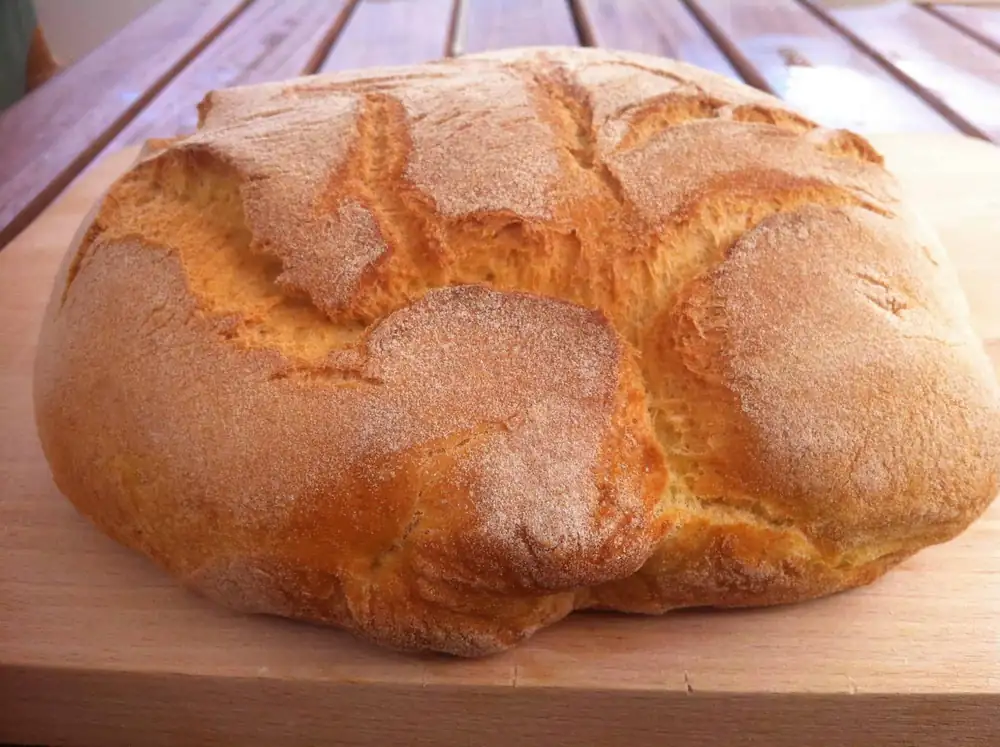
Try out this super easy bread with self rising flour recipe and you will be rewarded with a crispy golden-brown crust, a fluffy, soft and slightly chewy delicious loaf of bread. Enjoy while still warm with a spread of your favorite creamy butter or as a side to your delicious moussaka!
Can you use self raising flour to make bread? Of course you can!
After all, the difference between self raising flour and plain flour is that it has baking powder and some salt added to it. Baking powder acts very similarly to soda when making bread and the Irish just love soda breads! In contrast to yeast, baking powder acts very differently when making bread.
As soon as water is combined with the self-raising flour it starts to act, producing air bubbles that give the bread that fluffy appearance and texture. On the other hand, yeast requires time to digest the sugars and ferment the bread.
So while a yeast bread may need 4-5 hours to prove this self raising flour bread is ready to bake almost immediately. Do you need yeast when using self-raising flour to make bread?
No, at least not the traditional bread yeast. When using self rising flour the bread proofs much faster.
Therefore, if you also add yeast to it you will need to wait for it to act. As a result your bread will be way over-proofed and will most likely collapse while baking.
However, by skipping the yeast entirely you will loose out on that delicious bread flavour. To make your bread taste delicious, there are three tricks that make all the difference.
How to make the perfect easy self raising flour bread
There are three things that make this self raising flour bread taste simply amazing.
- Firstly its the beer. It contains natural yeast that will substitute that bread-y flavour that yeast would normally give. Beer also contains air bubbles that will give your bread a delicious soft and chewy texture.
- The second trick is not to let the bread prove at all. When you are done kneading it, shape it and bake it. This will contain how much the bread rises and it won’t collapse.
- The third trick is kneading. Self raising flour doesn’t contain as much gluten as bread flour so its best to put in a little extra elbow grease in to let the gluten develop or just use a hand mixer with a dough hook to do the work for you.
Love bread? These delicious bread recipes are made for you!
If you love bread as much as I do, then this list of my favourite breads recipes is made for you! What to serve it with? What I love the most about having freshly made bread is soaking up that a delicious stew sauce, dipping it in my salad and of course covering it with delicious dips!
Take a look at my very best dishes that go great with this bread in the links below!
Description
A super easy bread recipe using only four ingredients!
As you are using self rising flour and beer for this easy bread recipe, you don’t need to wait for the dough to rise. So more time to enjoy it!
Nutrition
- Serving Size: 1 piece
- Calories: 157kcal
- Sugar: 0.1g
- Sodium: 84.7mg
- Fat: 2.3g
- Saturated Fat: 0.3g
- Unsaturated Fat: 1.9g
- Trans Fat: 0g
- Carbohydrates: 28.1g
- Fiber: 1g
- Protein: 3.8g
- Cholesterol: 0mg