Breaking In The Whole30 Cookbook
Crack open any cookbook and you are confronted with a dizzying collection of recipes. If you are actually going to make something for dinner (and it’s OK if you’re not!), choices need to be made.
“Don’t you dare tell me this is hard. Beating cancer is hard. Birthing a baby is hard. Losing a parent is hard. Drinking your coffee black is. not. hard.”
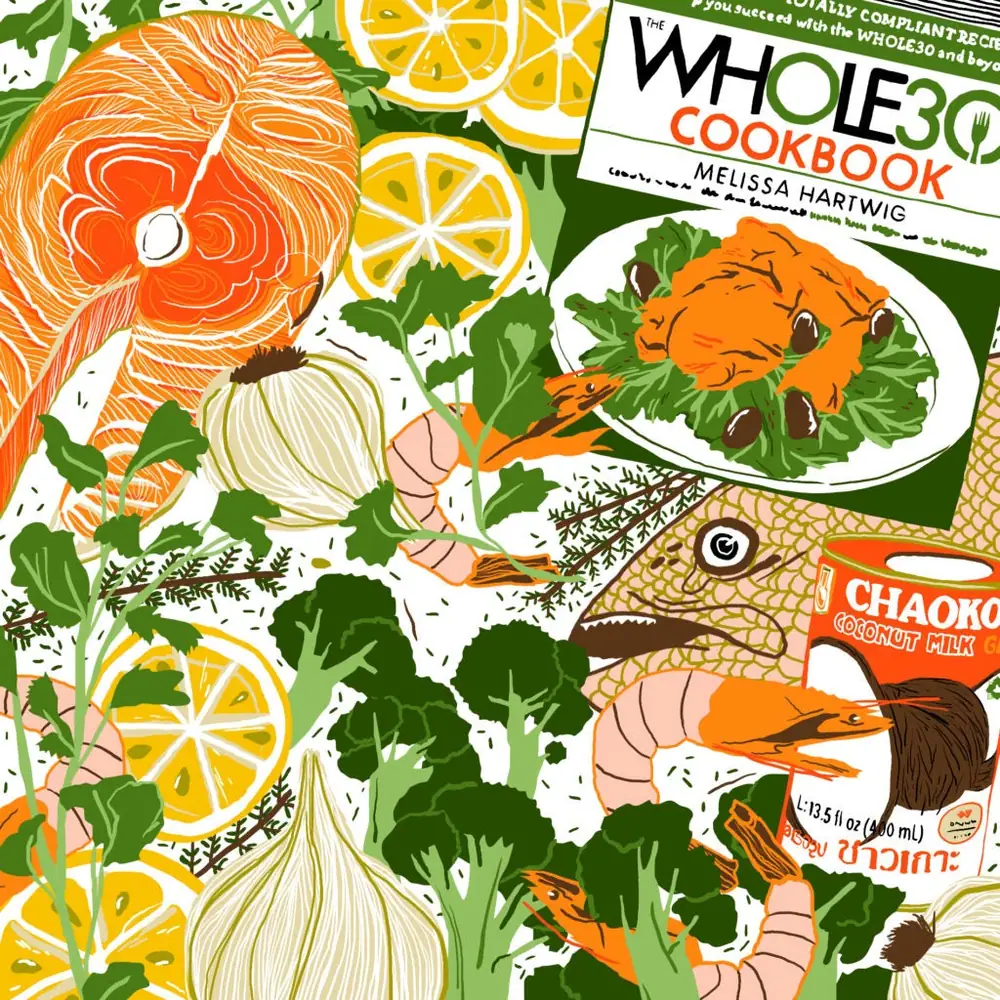
In BREAKING IN , we prepare a few interesting recipes to get a feel for the book. The diet in question today is Whole30, a 30-day plan that’s a near replica of the paleo diet. Last year the plan’s co-creator Melissa Hartwig wrote The Whole30 Cookbook (Houghton Mifflin Harcourt), full of “150 delicious. Totally compliant recipes” to help aspiring health nuts feel better about their bodies and their selves.
For a book so focused on healthy attitudes, the introduction is quite militant. In the “It’s for Your Own Good” section, Hartwig preaches: “Don’t you dare tell me this is hard.
On a recent Sunday evening, my roommate and I knocked out three recipes for a single meal: the “dump ranch” dressing, the shrimp gremolata. The one-pan herb-crusted roasted salmon with roasted broccoli steaks. We fed a table of five, and somehow—despite the starchlessness of it all—the meal felt plentiful, the fish and the shrimp and the vegetables and the chopped salad dressed with faux-ranch. Regardless, I’m very happy to have a container of it—with a little extra salt and garlic powder. Onion powder shaken in—in our fridge, for mixing with grains (forgive me, Melissa Hartwig!) or dipping vegetables in when I’m feeling like a healthy mindless snack.
Slather this on your fish, slice some broccoli “steaks,” brush those with oil and salt and pepper, and roast at 400° F. SHRIMP GREMOLATA We mostly made the shrimp gremolata since it called for very few components and we had a large bag of frozen shrimp from Costco in our freezer. Essentially you broil the shrimp—the book’s instructions to nearly cut them in half “horizontally” are confusing, but we made a slit in their bellies rather than all the way down their backs—and then toss it with a mixture of minced garlic, chopped pine nuts, and lemon zest, broil for another minute, and dress it with “snipped” parsley leaves.
We only had to broil ours for half the prescribed time, and we thought the parsley should have been tripled. Chopped into the garlic mixture, but otherwise this was a zippy 20-minute shrimp method I’d be happy to have in my arsenal if I were tired and strapped for time and working on my Whole30 lifestyle. When we acquire another large bag of Costco shrimp, this is what I’ll want to do with it.
For a book so focused on healthy attitudes, the introduction is quite militant. Two eggs and two potato slices and four bacon slices are meant to serve two, but I housed them both myself; half of this wouldn’t have held me over for more than two hours, but all of it felt overwhelmingly heavy so early in the day.
The eggs made the bacon a little soggy; next time I’d lay the slices on top of everything like a weird ’90s garnish. I don’t think I’d make it again—I like to be bad in the mornings and enjoy a bowl of 2 percent Greek yogurt—but I will admit this is the most successful egg-poaching technique I’ve ever tried: You just slip your eggs into vinegar-infused boiling water, turn the heat off, and let them sit for three to five minutes.
If I were going all in on my own #Whole30 challenge (which, you’ll be shocked to hear, I’m not), I’d be happy to have this book as a resource. And as all good cookbooks do, The Whole30 Cookbook provides snippets that you can take with you past the confines of their recipes.
You don’t have to swirl the hell out of your egg-poaching water; broiling is a perfectly fine way to cook shrimp in two minutes.
- Who: Whole30 · Melissa Hartwig
- Percentages: 2 percent
- Figures: 2 percent