Garnachas del planeta Huasco
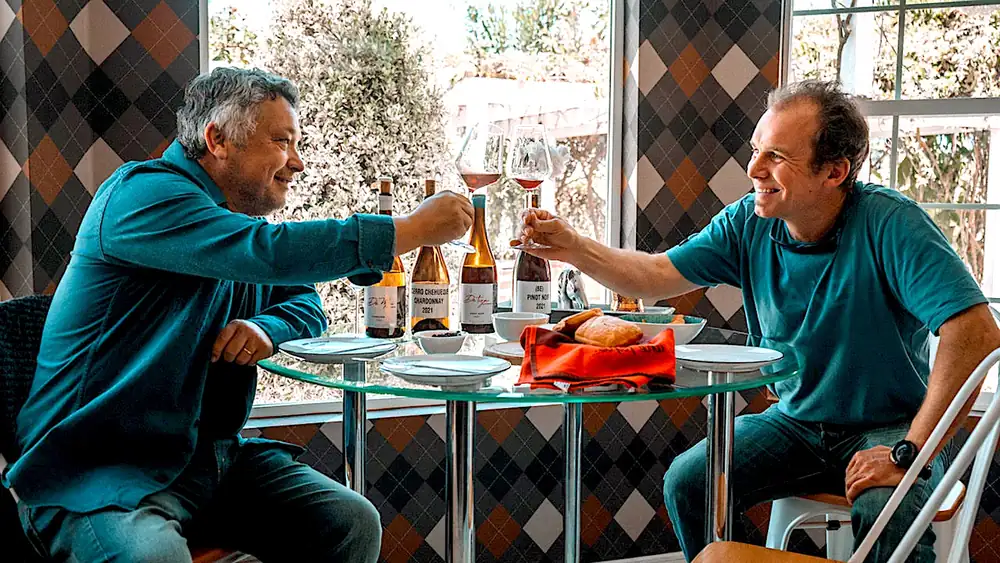
Las trayectorias profesionales de Daniel Llorente y José Pablo Martín no tenían nada en común; se conocieron a través del buceo.
The professional lives of Daniel Llorente and José Pablo Martin had nothing in common; they met through diving. Llorente worked with metals, and his father, an immigrant from the Sabero coal mines in Spain, fulfilled his dream by buying and cultivating a field with vineyards for pisco and olive groves in Huasco, an oasis in the middle of the Green North desert of Chile. Martin, an agronomist and oenologist, had enjoyed a successful career, first in vineyards in central Chile and then, since 2006, in the Limarí Valley, some 250 kilometers south of Huasco. Despite the distance, considerable, though not far for this long South American country, both were part of the same Green North, and they met while diving the waters of its extensive beaches and bays.
The idea of working together, making wine, came from Llorente, who one day, amidst tanks and masks, asked his friend if he thought it would be a good idea to plant wine grapevines on his land, on terrace three south of the Huasco River, 36 kilometers from the sea. José Pablo hesitated. He thought the place would be warmer than Limarí, the region he loved and had chosen to make his own wines. They both knew that the only fine wine project underway on the valley's coast, Tara from Viña Ventisquero, was already achieving success with cool-climate grape varieties, and that a century earlier there had been an attempt with Pinot Noir, which had failed due to a lack of knowledge and technology.
Llorente's enthusiasm spurred the work in 2014. They began exploring, measuring temperatures and digging soil profiles to assess their needs. Martin discovered it was similar to Limarí, but even more extreme. “It had the limestone and clay of its alluvial terraces, with rounded stones, it had northern sunlight, and although I swore it was warmer, I realized that the Huasco River valley, with its outlet to the sea, is colder. In the Limarí vineyards, there are mountains in front that protect them from this; here, there's no such protection, the valley is open and temperatures rarely rise above 27°C.” In 2017, Martin told Llorente: “Don't overthink it, you have to plant.”
They chose the classic Chardonnay, Pinot Noir, and Syrah grapes, ideal for cool climates, along with Chile's emblematic reds, Cabernet Sauvignon and Carmenere, to make the full-bodied reds Llorente envisioned. The following year, 2018, they added Garnacha, a very popular red grape variety in Spain. Both wanted to see what would happen with it. For Llorente, it evoked memories of his father's land; for Martin, it brought back his experiences as an intern on the Iberian Peninsula.
The Garnacha grapes didn't deliver the quality they expected in their first year of harvest. Their first grapes of 2020, Martin explains, had extraordinary vigor, “it was very difficult to manage, because the plant grows very strongly even in poor, calcareous soil like this. You have to work hard, thinning the bunches. By regulating the crop load, you can achieve quality.”
It's worth mentioning that, between one thing and another, Martin had become independent and was about to launch his own line of wines. After coming up with names that were impossible to register, he called them JP Martin. Meanwhile, in exchange for grapes, he had become the winemaker and consultant for Buena Esperanza, the vineyard that Llorente and his wife, Mai-Nie Chang, would found in Huasco. Today, Buena Esperanza has 12 hectares of vineyards and five wines from its estate on the market, all of them well-received. But let's get back to the Garnacha.
That first Garnacha wine they made, Martin recounts, “I really liked it, even though it was an induction wine. Very fresh, with crisp fruit, notes of gunpowder, soil, damp earth, very entertaining, but with overly rich acidity and a very low pH (3). I didn't have high hopes for it” he jokes. “It had little color, little structure. Whether it was a lack of courage or maturity on my part, I said: better not to do it.”
That first Garnacha never made it to market. The truth is, it's often less glamorous than it seems, and it was sold in bulk. A friendly winery in Maipo bought it and added some Syrah. To everyone's surprise, it was chosen as the best Garnacha in a national ranking.
The following year, the 2021 harvest, Martin decided to make some wine for his JP Martin project and add it to his new small family of wines: two from Limarí (Syrah and Carmenere) and three from Huasco (Pinot Noir, Chardonnay, and Garnacha). “Now I can” he thought, “I’ve been in the industry for 20 years; it’s not the same starting a new project, without a history.” His first Garnacha was born, called De Cal (26,000 pesos, about 22 dollars), named for the soil and the sensation it conveys of tannins as fine as lime. It was featured in various rankings along with his other wines from Limarí and Huasco. He repeated the success in 2022 and continues on the same path, surprising everyone.
Llorente, on the other hand, didn't want to risk adding another wine to Buena Esperanza in 2021. “We wanted to take it slow. He who grasps at too much accomplishes little, and I preferred to concentrate and focus, and thus avoid overloading ourselves with labels. We launched five labels in 2022: a pinot noir, a fresh (unoaked) chardonnay, and the gran reserva chardonnay, which will now be called Cerro Chehueque, in addition to the red blend, and a pinot rosé.”
Buena Esperanza took the plunge in 2022, and will add a Garnacha from this vintage to its family, in addition to a new 2021 Syrah.
For Martin, Pinot Noir is exceptional in Huasco, as is Chardonnay, and he's right. However, for me, Garnacha is unique, even among the other Garnachas that are now emerging in Chile; there are quite a few, at least 20 labels, from Huasco to Itata. The charm of those born in Huasco lies in their vibrant tension and, at the same time, polished tannins, which awaken any palate and continue to resonate strongly even several days after the bottles are opened; something, admittedly, contradictory for a variety known for its tendency to oxidize during vinification if not protected.
One might wonder, how can they be differentiated if they come from the same vineyard and are made by the same winemaker? “Both” explains the winemaker, “are harvested under the same conditions, with the same philosophy, and there can be minimal differences of three days between the harvests. Part of the fruit is vinified at the Buena Esperanza winery, and the other part, mine, at the winery where I vinify all my wines, in Limarí. Furthermore, the aging concept is different. Buena Esperanza is a newly built winery, and we have to be very careful because there is a lot of new wood. What we do there is age a percentage of the wine in new barrels, another in used barrels, and another in stainless steel tanks. Because Daniel's concept is more about wines meant for aging, with aging potential. My philosophy is different: I started with old 400-liter barrels, and the barrel replacement is less noticeable each year. Then everything goes into concrete eggshells and from there to the bottle. The eggshell softens the wine, adds something special, and also protects it.” In conclusion, Martin tells us, the difference has more to do with the winemaking times, “because even if I want to make identical wines, they will always be different. Each barrel from the same batch also produces different wines. You don't have to force the wines to be different; now they are siblings, in similar styles, each with its own characteristics. They have a common thread.”
We tasted both wines at different times. De Cal, even before I knew Buena Esperanza existed. Both also have a vibrant, medium-to-light red color, although Martin's Garnacha is lighter in hue. Then there are the aromas, with that same common thread as Huasco, with red fruit, like a tart cherry, austere, with hints of salinity, and gunpowder or talcum powder, without the perfume often associated with its commercialization. The Buena Esperanza wine has a sweeter, fruitier note, both on the nose and palate. Meanwhile, JP Martin's Garnacha is more austere and more vibrant due to its sharp acidity. Compared to their respective Pinot Noirs, the Garnachas are lighter than voluptuous, tighter on the palate, and lack the pronounced undergrowth notes on the nose.
“We want to plant a bit more Garnacha next year” says Llorente, “and see how it performs in the market. Because it needs to be reflected in sales, and it’s still a very unknown variety in Chile. It might give the impression that it’s a very light wine, but little by little, younger people are becoming enthusiastic about these lighter wines… I came across such a beautiful text that said: wine isn’t made, wine is aged, and you become a winemaker. And I liked that, because my experience with wine is minimal, except for being a lover, and it’s true, I’m aging it. That excites me. And I think that if Garnacha has received so much care and sunshine in this terroir, it has to turn out well.”
The Garnacha from Buena Esperanza, the undisputed sister of De Cal, doesn't yet have a label or price, but we already know it will have a name that continues to honor the valley and its traditional farmers; it will also have a painting by Arancha, the daughter of Llorente and Mai-Nie. Everything will be finalized soon, because by November it will be making its debut and refreshing the market.