The power of minimal stories
That piparra pepper was tiny. Barely three centimeters long, maybe even less, slender, thin, delicate, like a work in progress, barely a sprout of the piparra that we'll later find pickled in vinegar and bottled in glass jars, now more than five centimeters long.
That piparra pepper was tiny. Barely three centimeters long, maybe even less, slender, thin, delicate, like a work in progress, barely a sprout of the piparra that we'll later find pickled in vinegar and bottled in glass jars, now more than five centimeters long. They were called Ibarra prawns (those from Ibarra, of course, cultivated inland in Gipuzkoa), and time brought them a seal of quality with this name. It surely has its story, and someone can tell it. The play on words combines the slightly curved shape of the piparra, a thin, elongated chili pepper, harvested green with a barely perceptible heat, preserved in vinegar, and eaten fresh sautéed or fried, and the orchards of Ibarra where it's typically grown, very near Tolosa.
Andoni Aduriz placed them on the table, announcing them as "teardrop" peppers. The name hinted at a playful exchange among columnists and a clash of realities. In contrast to the craze for the "teardrop" pea, ever smaller, ever less flavorful, less pea-like, more chlorophyll, there was the stoic, minimal, stark pepper, reminiscent of a vegetable eel dipped in the hue of a seagrass meadow. Also preserved in vinegar, and therefore even more intriguing. The subtle and elegant flavor, barely revealed yet undeniable, the tenderness of the vegetable, definitively free from the firmness of its skin, the measured exposure to an acidic medium… Suddenly, the surprise exploded where it was least expected, at the end of a dinner featuring renowned chefs, Andoni Aduriz, Quique Dacosta, Albert Adrià, Nacho Manzano; the grand dinner of the 5th Meeting of the Seas, in a hotel on the coast of Adeje, in southern Tenerife. It was one of those small stories that make a meeting great.
There were two tables of die-hard fans left, and Aduriz hopped from one to the other with a small platter in his hand. “Look, teardrop peppers” he said to me. And the magic happened. Surprises are expected and found when the table is filled with writers like them, but this one happened off-script, after the meal, once the laughter and confidences that are shared over glasses after the meal had begun. It was the least expected, and therefore the most impactful. Elegant, delicate, eloquent, subtle, also demanding… anything I say falls short. I dreamt about them the other night, and it almost became one of those special dreams.
A neighbor of Mugaritz grows them, and Andoni asked her for shoots that would allow him to escape the weight of the skin, always a bit firmer than expected. The result was there. I don't know if it was a mischievous act or a prelude to something that might end up exploding on the restaurant table. Can that matter more than the moment? Maybe I'll try them again and they won't be the same, but the memory will stay with me for a long time. The first time is always a different story. The memory lingers on my lips as I write, tangy, elegant, and mischievous.
The second little story came from Sardinia in a tin can, at least a kilo in weight, though I thought it was one of the kilo-and-a-half kind. It went as far as two kilos; it was enough for forty. Apologies for the missing detail; a journalist's lapse of memory, forgetting the reference point in favor of emotions. Inside the can was bluefin tuna from the almadraba (traditional tuna trap) in oil, canned thirty-five years ago in a factory in Carloforte, an island near Sardinia. The result held more certainty than surprise. Someday I'll have to talk and write about the canning cellars, about the cans marked with an arrow to help turn them in order every four or six months, so that the oil circulates again as it settles to its natural position, infusing the fish, and helping to soften the texture turn after turn, year after year. Another day, though; I have a lot of stories to tell.
The tuna that Luigi Pomata brought had spent all the time necessary to achieve ultimate delicacy and more. It was a breathtaking, intimate, velvety, sinuous, almost creamy morsel. Preserved fish on the verge of perfection. It took barely two bites, but it felt like a whole meal.
At first glance, the smoked and dried shellfish from Chiloé that Lorna Muñoz presented on the second morning of the Encounter didn't seem like much. There were mussels, oysters, and sea squirts, prepared in the way they preserve seafood there. They hang them high over the hearth and smoke them while they dry. They end up looking diminished and dark. It's the only way to preserve their identity in a humid and often hostile environment. Prepared by her, they reveal the ultimate expression of the sea. Intense, powerful, incisive, primal, endearing, intimate… They preserve the flavors of the cuisine of the past, which are never necessarily better, but are always essential. Cooks like Lorna continue and will continue to keep alive the flame of an idea that I find powerful: with them, the kitchens remain ours. No matter what happens.
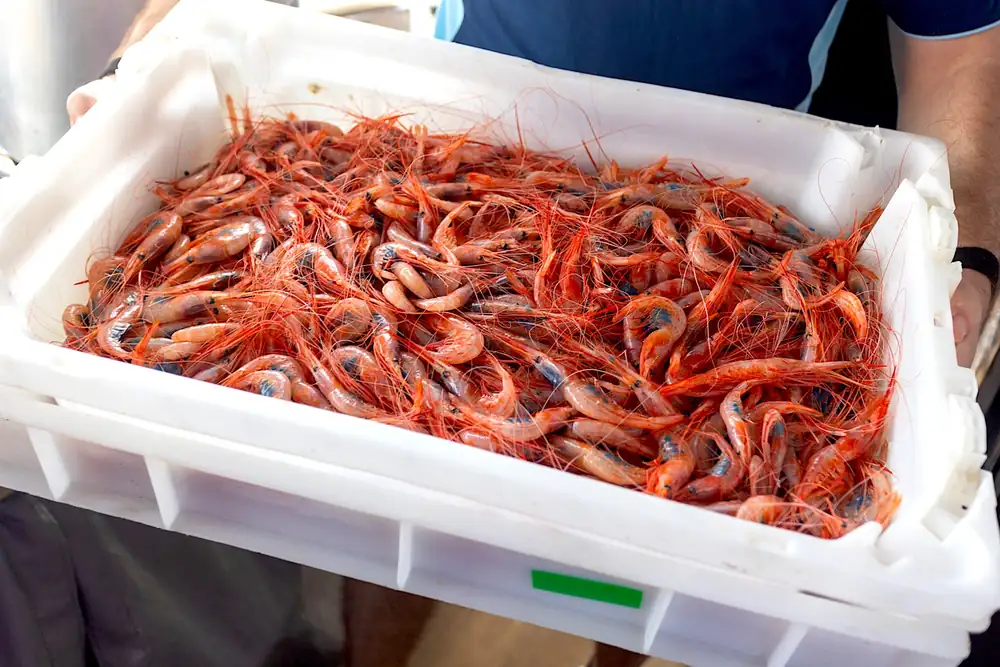
Then they took us onto a catamaran. Stories of conferences; four hours of presentations and then six hours trapped in the sun in an environment that for some is hostile and for a few others immensely boring. Everyone asked the same question every minute and a half: when will this end? Luckily, halfway through the crossing, a fishing boat appeared with Diego Schattenhofer (Taste 1979) on board and a box of freshly caught shrimp in his arms. They were a welcome respite in the midst of what seemed like an interminable ordeal: the sweet taste of the sea and an invaluable appetizer. Braulio Simancas's father (Silbo Gomero, La Laguna, don't miss it under any circumstances), a fisherman by trade and a second-rate cook, finished off a squid with potatoes on board, which acted as artificial respiration; mouth-to-mouth resuscitation for survival. After that, they could have dragged us along chasing dolphin fins for as long as they wanted.
Benjamín Lana has already written about Ralph Chami and his proposal to put a price on the elements that define the image of the sea, corals, seagrass, cetaceans, and pay for their conservation (and encourage it, and transform what they consider commonplace into heritage and a source of income). I thought it was the most important thing about the Fifth Meeting of the Seas. By far. I wish we had dedicated as much time to it as we did to that catamaran.