When rural areas become tourist destinations
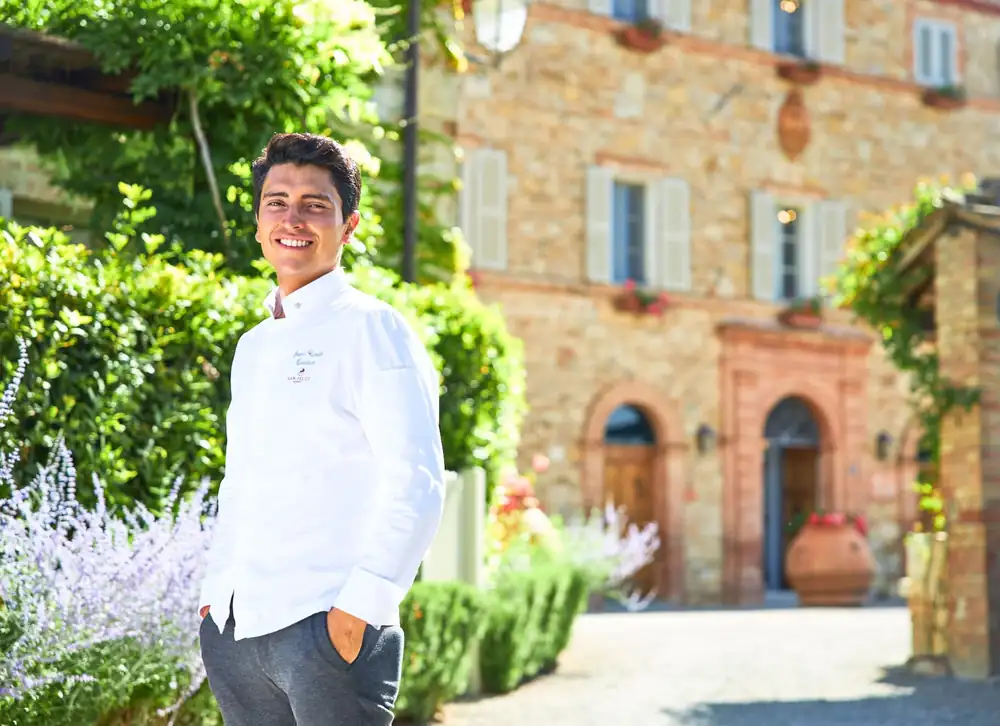
Chef Juan Camilo Quintero, of Il Poggio Rosso, champions a rural cuisine that honors the producer in an increasingly visited Tuscany.
Tuscany has long attracted visitors from all over the world, from E.M. Forster's English explorers to today's tourists, phones in hand. Now, visitors are also seeking to discover what the region offers beyond art and photographs.
It's important to remember that Tuscany is a major agricultural region, with the fertile hills of Chianti as its main attraction, and a producer of excellent olive oils, rice, and vegetables. Juan Camilo Quintero showcases this rural Tuscany through gastronomy at Il Poggio Rosso, in the Borgo San Felice hotel, a Relais & Châteaux surrounded by the Crete Senesi landscape.
Quintero, a Colombian who has lived almost half his life in Italy, warns: “A rural restaurant located in a tourist area is a double-edged sword, because we’re talking about a well-informed tourist, environmentally conscious, and looking for quality and excellence.” Being in a tourist area makes it easier to attract customers, but it also means you have to stay vigilant.
For the chef, luxury in a rural setting lies not in the design or the wine list, but in cooking with freshly harvested vegetables. That's why he picks the aromatic herbs from his garden fifteen minutes before service, ensuring the plant's aromatic properties remain virtually untouched. Before taking charge of the kitchen at Il Poggio Rosso, he worked at Arzak and with Massimo Bottura.
Its basic principle is sustainability, which, according to him, "must stop being a fad and become an essential part of restaurant management." He acknowledges that there is no single formula: "It's a mistake to think that what Nordic cuisine does can be applied elsewhere; each restaurant must analyze its own identity."
In rural cuisine, the producer is the guarantor of the local identity. "The chef is simply the public face of this process," he states, because the true protagonist is the producer who obtains the best possible raw materials.
Quintero also emphasizes the social impact: his restaurant's garden is managed by people with disabilities. "There are many ways to generate social change from a restaurant. It's something tangible, with results."