Diana Kennedy Says Goodbye to Her Cookbooks
She’s brilliant, terrifying, and a master of Mexican preparation.
“While the faculties and senses are generally weakened in old age, the palate is strengthened and becomes more sensitive. Because of this, old people lean towards gastronomy.”
The 96-year-old writer ends an 840-mile trip from Michoacán to San Antonio with a very special delivery, and some thoughts on a cook’s pickled nopales. Criticism from Diana Kennedy cuts like a saca tripas fighting blade when the pico de gallo placed before her isn’t correct.
But she’s doing the table a favor when explaining the acidity is fucked up. No one alive rivals the encyclopedic knowledge of this forceful 96-year-old who, for more than half a century, traveled every region in Mexico while documenting its complex cuisines, camping in her truck, inviting herself into kitchens, hunting flea marketplaces for pre-Columbian ceramics, and most crucially, always crediting recipes to her sources.
Detests admitting to a cane. (At 18, she joined the British Women’s Land Army in the forestry division during World War II and cut trees for four years. If Kennedy has any weakness, it’s for her pit bull mutts, a weekly shot of Dewars, and the Metropolitan Opera matinee broadcast she listens to at home in Zitácuaro, Michoacán, on Saturday afternoons. In My Mexico , the most personal book about her adopted country, she writes, referencing an earlier text: “While the faculties and senses are generally weakened in old age, the palate is strengthened and becomes more sensitive.
Because of this, old people lean towards gastronomy.” She has published eight more books, including the deep dive Oaxaca al Gusto, An Infinite Gastronomy; she’s been awarded the Order of the Aztec Eagle and inducted into the James Beard Foundation’s Cookbook Hall of Fame; and a new documentary on her daily routine in Michoacán titled Nothing Fancy: Diana Kennedy won a special jury prize at SXSW in March. The difference between chile de agua and chile manzano when charred and marinated in lime.
Sitting at the same table in 2M Smokehouse is a humbling lesson in rigor as she argues—brown eyes piercing with inquisition—the merits of burnt ends. The inaccuracy of botanas with San Antonio–born pitmaster Esaul Ramos. (She does the same thing with Diego Galicia and Rico Torres of Mixtli when they prepare a spice rub of guajillo chiles not sourced from Zacatecas.) She can’t help herself. Kennedy has always been precise, in both language and recipes, but the urgent conveyance of expertise hints legacy.
Takes an old lady to set a macho on the righteous path, verdad ? (Later, Ramos calls me to say he’s going traditional with pico de gallo al Diana.) “I’m not a Catholic, and don’t believe in the afterlife,” she says with conviction. Not just personal but planetary: Childless herself, and a widow since 1967, she advocates for the next generation.
This pragmatism has driven Kennedy to finally relinquish her private archive: correspondence with Craig Claiborne. Prince Charles, a massive collection of 35-millimeter slides shot on her old manual Nikon in remote territories during research trips, 12 matchless volumes on 19 th century Mexican preparation scavenged over the years in street fairs and other odd places around the country’s 31 states. Before entering the Special Collections vault in the John Peace Library at University of Texas, San Antonio campus, we stop to sanitize our brisket-smoky hands in the ladies bathroom and she rams down paper fluffed to the brim in the trash receptacle. “No one thinks to do this,” she states to her audience of one.
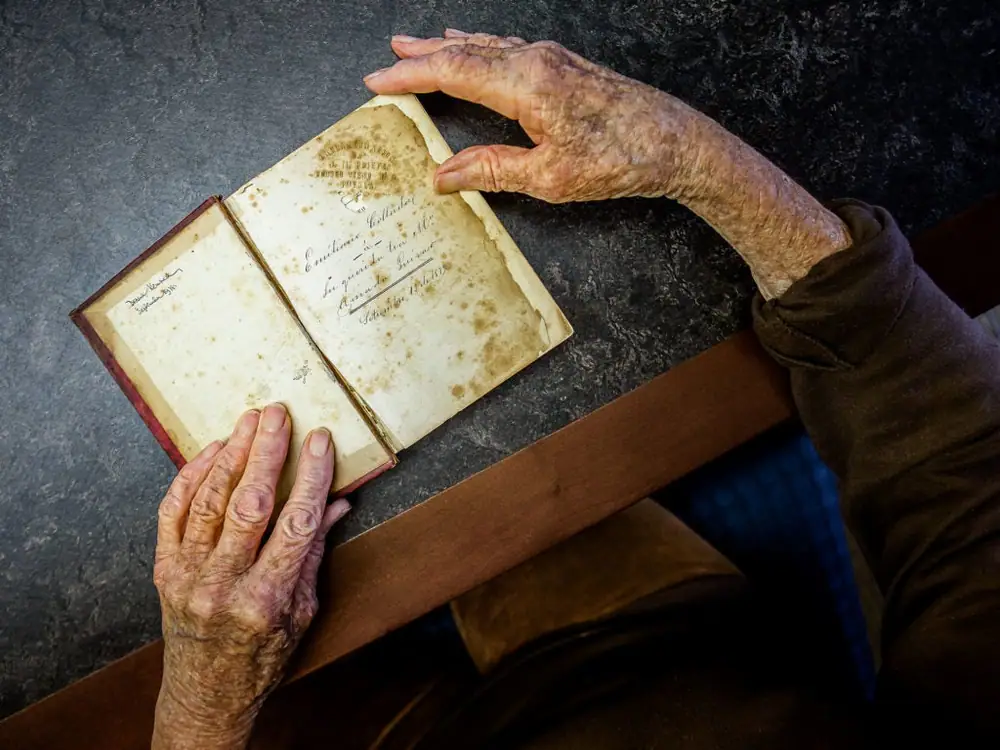
Her own papers will become part of the university’s growing Mexican Cookbook Collection, one of the largest of its kind, with more than 1,900 at present. Head of Special Collections Amy Rushing took Arte Nuevo de Cocina y Reposteria Acommodado al Uso Mexicano to Boston for repair several weeks before. (The university is raising $30,000 to preserve the others.) Published in 1828, it is the first known volume devoted to Mexican cookery.
A woven turmeric yellow wool thread was discovered between pages 32 and 33 by the restorers. “How mysterious,” states Kennedy softly, bending over the little book. Ever!” La Cocinera Poblana (1877), a handsomely tooled red leather volume stamped in gold, is the book Kennedy accredits most in her own writing. A method for arroz con chile ancho has a passing mention of saffron, and that sets me to daydreaming how this ancient spice arrived in Spain during the Moorish Caliphate of Córdoba, and then journeyed to the New World, to wind up in the pantry of a wealthy Puebla housewife who possibly missed the wood-fired paellas of her ancestral homeland.
The climate-controlled vault where these books await future researchers of Mexican culinaria is maintained at 58˚F.