Indian thali: what's served on a platter, how regional variations differ, and how to eat it
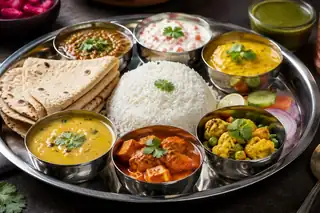
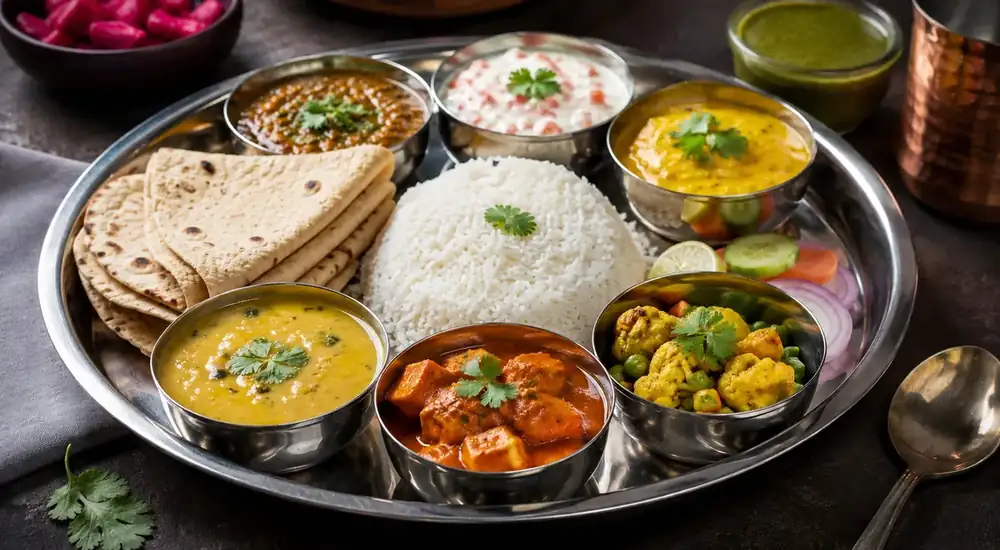
In Hindi, "thali" refers to a specific food format: a round metal platter on which small bowls (katori) are placed. These bowls contain savory and sweet dishes, with rice (often accompanied by flatbread) in the center.
In Hindi, "thali" refers to a specific food format: a round metal platter on which small bowls (katori) are placed. These bowls contain savory and sweet dishes, with rice (often accompanied by flatbread) in the center.
A thali is a full meal, or in restaurant terms, a tasting menu. In a single meal, you can sample several dishes and become familiar with local flavors. Typically, lentil dal, curry, rice, roti, spicy chutney, vegetable and yogurt raita, and dessert are served together. However, the ingredients can vary from state to state. There are also completely vegetarian options, as well as options with chicken, lamb, fish, and seafood. Indian restaurants often offer the thali as a set menu: you can choose one of the options with your selection of favorite dishes, but the ingredients remain the same.
Evgeniya Ofimkina, a Hindi and English teacher and author of the blog English with Jean, told us about the peculiarities of the thali in India.
How to prepare a thali: what's on the tray
Thalis are prepared so that the flavors complement each other: rice and flatbread are neutral, even bland, making them a delicious accompaniment to spicy dishes such as lentils, spicy chicken, and mild paneer cheese in curry sauce or spinach.
The tray is round and holds between 5 and 7 bowls of varying sizes. Thalis contain the most rice, and enough flatbread is served to cover all the bowls (we'll talk about how to eat them properly later). Sometimes, thalis are served on a plate with concave sections.
What ingredients does a traditional thali include?
There is no single, universal menu; its composition varies by state and region, with each offering its own specialties and traditional appetizers. However, certain categories of dishes and ingredients are frequently found.
- Rice and flatbreads are the base. Flatbreads can vary: in northern India, roti (chapati), papad, or naan; in the south, dosa or puri.
- Dal is the generic name given to a broad group of legume-based dishes, primarily lentils. Its consistency is similar to that of a soup or stew. In a thali, dal is often one of the main dishes. In South India, dal is sometimes substituted with sambar, another lentil dish that is eaten as a side dish with rice.
- The vegetables can be stewed with spices or simmered in a thick sauce. The specific ingredients depend on the season. Potatoes, cauliflower, tomatoes, eggplant, and spinach are especially popular.
- Chutneys and pickles add a tangy and flavorful touch to the dish. Raita is a yogurt-based sauce with finely chopped vegetables.
- For dessert, try the rice pudding kheer, the delicate jalebis, or the sweet and soft gulab jamun balls.
Thali Varieties: How Regional Variations Differ
The thali is found in many states of India: for locals, it's a relatively inexpensive and practical way to enjoy a hearty meal. Therefore, there's no single "traditional" way to serve it; thalis vary greatly. Depending on the region, the dishes, ingredients, and even the spices differ.
For example, fish and seafood predominate in coastal regions, while in northern India you can find entirely vegetarian dishes and chicken thali. In the southern state of Kerala, however, there is sadya, a festive meal similar to thali, consisting of two dozen different dishes. However, these are served on a banana leaf instead of a round platter.
How to eat thali properly
In India, thali is traditionally eaten with the hands, using three fingers of the right hand to pick up a piece of roti. This flatbread is often used as a substitute for traditional cutlery: it's used to scoop up curried rice, pieces of paneer, vegetables, or chicken. For convenience, cafes and restaurants often provide spoons for serving, mixing, and tasting the food.
It's not so much about following a specific sequence as it is about understanding the principle: small portions are intended to allow for the combination of flavors.
Ayurveda and Thali: Is there really any relationship between them?
The connection between the thali and Ayurvedic principles is frequently mentioned. For example, the editors of Itihaas suggest that the very idea of a multi-course meal can be linked to the Ayurvedic concept of a balanced diet, which combines the six basic tastes: sweet, sour, salty, pungent, bitter, and astringent.
However, it would be incorrect to claim that every traditional thali is necessarily prepared according to Ayurvedic principles. Sources describe this connection as either historical or hypothetical. The modern thali, on the other hand, is based on the principles of seasonality and consists of familiar local dishes.
Is it possible to prepare thali at home without having all the ingredients?
Yes. There's no set list of ingredients for a thali. Use authentic recipes and ingredients you have on hand, and don't skimp on spices; in Indian cuisine, they're essential for flavor. Try a basic version: unleavened roti rice, lentil soup, stir-fried vegetables, and a yogurt-based sauce. The key is variety, not an exact replica.
What kind of plate is thali served on at home?
Special utensils are optional. A large plate or platter and several small bowls or cups will suffice. In India, lightweight metal utensils are commonly used.
Does a thali have to include meat?
No. A thali can be completely vegetarian. Depending on the region and specific tradition, it may include vegetables and legumes, meat, poultry, fish, or seafood.
How many calories are in a typical Indian thali?
It depends on the recipe, the portion size, and the amount of oil used. Even a restaurant can hardly calculate the calorie content of your portions accurately and reliably. The only way to be sure is to cook at home, weighing each ingredient.
What is worth remembering?
A thali is not a single Indian dish or a strict recipe, but rather a varied meal served on a single platter. Small bowls contain a variety of flavors, from spicy and savory to sweet and sour: dal, vegetables, rice or flatbread, sauces, pickles, yogurt, and sometimes meat or fish and dessert. It is the regional variations that make the thali so interesting; it is the only way to compare, for example, the cuisines of North and South India.