Sea salt: More than a condiment
A life without salt would be a very sad life. It wouldn't even be life, since we need it to survive. But for many, it's simply something we sprinkle on a dish just before eating it, or add to boiling water before cooking pasta.
A life without salt would be a very sad life. It wouldn't even be life, since we need it to survive. But for many, it's simply something we sprinkle on a dish just before eating it, or add to boiling water before cooking pasta.
However, chefs know that salt has much more to offer. It can alter both texture and flavor; it can completely transform ingredients or greatly extend their shelf life. The timing, location, and manner in which salt is used can produce very different results in the kitchen.
The type of salt used is also important. “Processed salts, often called table salt, are typically made up of sodium and chloride ions, plus some bleaching and anti-caking agents” explains Philip Tanswell, managing director of Cornish Sea Salt. “In contrast, natural sea salt contains potassium and sodium, which help balance blood pressure, along with all the other minerals and electrolytes our bodies need to be healthy.”
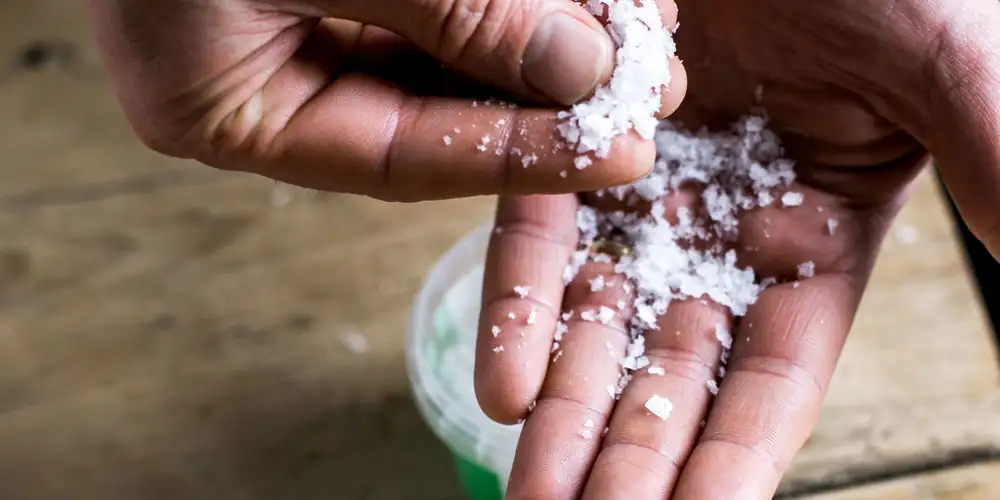
There is a consensus that sea salt is the best for cooking, both for its flavor and its health benefits. However, its form also influences how it reacts in cooking. Cornish sea salt offers crunchy crystals, delicate flakes that can be crumbled with your fingers, and flavored salts (including smoked sea salt flakes) for even greater versatility.
“I would use crystallized salt whenever the salt is going to dissolve, such as in brines or when baking” says Chantelle Nicholson, chef and owner of Apricity in Mayfair, London. “Flaky sea salt is for the finishing touch, adding to salads or for any use where the food will be eaten quickly. Smoked salt adds an extra touch of flavor, as it seasons and gives an extra richness.”
We all know that a dish without salt can be bland and tasteless, but there are many ways to season it. “Cornish sea salt is harvested, obviously, by the sea in the UK, in a beautiful location” says Chantelle, “and in terms of its circular production, it fits perfectly with my philosophy. However, the versatility of sea salt is something that chefs probably take for granted more than home cooks. We use salt at the beginning, during, and end of cooking, as well as to make brines, modify the texture of other ingredients, firm up fish, or tenderize meat… it has so many applications beyond simple seasoning.”
“Since trying Cornish sea salt, I haven’t used any other” adds Jude Kereama of Kota and Kota Kai in Porthleven, Cornwall. “I love being able to see the salt’s origin right from my house! But you can’t imagine how much it enhances even the simplest ingredients. I use it in all my recipes, whether it’s curing fish, making salt-crusted pastries for baking vegetables or chicken, or even in my desserts, where it brings balance to chocolate, caramel, and fruit.”
Sea salt: how to use it
A brine is essentially cold salt water (sometimes with other seasonings added) to which ingredients are added before cooking. This has several advantages: through osmosis, it draws moisture from the food and replaces it with the brine, ensuring that the food is seasoned throughout and not just on the surface. It can also alter an ingredient's texture, tenderizing tough cuts of meat or breaking down vegetables. If left to stand long enough, it also serves as a base for fermentation: many of our favorite fermented foods, such as sauerkraut, kimchi, and pickled cucumbers, are preserved in a light brine, which completely transforms the flavor and texture of the ingredients.
While brining involves dissolving salt in water, curing involves adding salt directly to the ingredient. The process works similarly: the salt draws moisture from the food being cured, which, if left to sit long enough, mixes with the salt to create a highly concentrated brine. This, of course, seasons the ingredient, but the true purpose of curing is preservation. As more moisture is drawn from the ingredient (usually fish or meat), it hardens and becomes drier, thus increasing its shelf life. This technique is responsible for many of our favorite foods (charcuterie, gravlax, bacon) and is often combined with smoking, as the dry, sticky texture of the cured ingredient allows the smoke to adhere. Furthermore, it doesn't have to be a lengthy process: sprinkling some sea salt on a fish fillet and letting it sit for just 15 minutes will firm it up and give it a firmer texture. a little trick that many chefs use in professional kitchens.
As for preservation, pickling generally involves a combination of sea salt, vinegar, water, and sugar, which is then heated until the salt and sugar dissolve. The ingredients are then submerged in this liquid to pickle them. This can be a quick pickle, in which case the liquid is added to the still-hot ingredients and lasts for about an hour, or a longer, more traditional pickle, in which the cooled liquid and ingredients are sealed in a jar or container and left to set for days, weeks, or months. Salt, vinegar, and sugar are natural preservatives, and when used together, they can technically keep the ingredients fit for consumption indefinitely.
Salt can also be a key component in traditional cooking. Salt baking is an ingenious method that involves completely coating an ingredient with a highly salty batter, usually made with flour and water or beaten egg whites, before placing it in the oven. As the batter bakes and hardens, it creates a salty, airtight seal around the food, seasoning it thoroughly and protecting it from the oven's intense heat. It works similarly to wrapping fish in parchment paper and cooking it en papillote: the food steams inside the paper or salt batter, resulting in a very different texture than you would get if it were baked unprotected.
All of these techniques are important skills for your culinary arsenal, but perhaps the most crucial is knowing how to properly season food. A pinch of good-quality sea salt just before serving is usually a good idea, but most chefs add salt at the beginning of cooking, as well as during. If you wait until the end to season, the salt won't have had time to properly infuse all the ingredients. Adding the same amount of salt in three stages, rather than just once at the end, will result in a much tastier dish with even seasoning. However, the most important thing is to taste the food as you cook, a simple task that many of us forget until the last minute.
It's clear that sea salt should be a staple in any kitchen, professional or not. But understanding its true potential, whether to use crystals or flakes, and how to best incorporate it into dishes, makes all the difference.