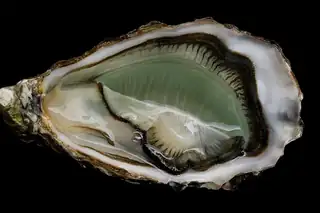
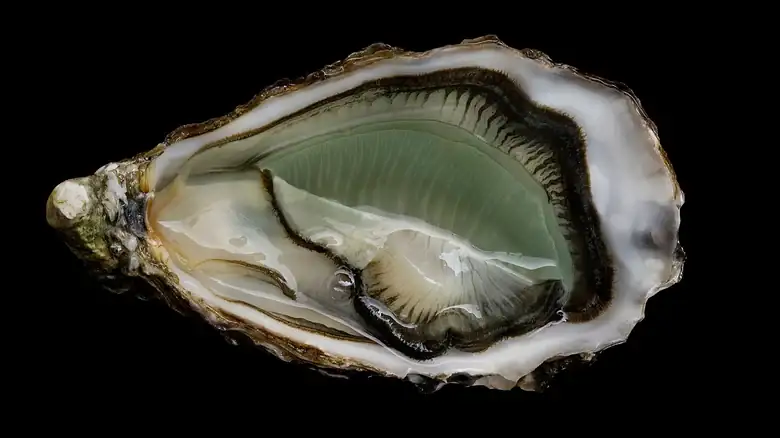
Green-gilled oysters get their color from an algae they eat.
Its blue-green flesh, dyed by an algae they eat, has a salty and earthy taste unlike any other shellfish.
“Cessna used to face an unsellable surplus of green gill oysters every winter until he decided that the mollusks needed rebranding. He began selling them under the alluring name”
A seasonal and regional delicacy, green gill oysters surprise those who try them for the first time. Unlike Rockefeller oysters, whose color comes from their sauce, here the meat has the blue-green hue of seawater. Many are initially hesitant to eat green meat, and in the United States these oysters have gone largely unnoticed, mainly because people are wary of that color. They are perfectly safe to eat and offer a unique experience unlike any other shellfish.
They have a unique flavor profile that has won over palates on several continents. They stand out for a more pronounced saltiness than common oysters, followed by an earthy note that some compare to mushrooms and truffles. Some diners also notice a particular sweetness and a smooth, creamy texture.
The secret lies in their diet. Oysters feed primarily on plankton and algae, and green-gilled oysters consume Haslea ostrearia, a microalga containing marenin, a blue-green pigment. Some of this algae becomes embedded in their gills, which explains both their color and flavor.
This microalga only thrives under very specific conditions: cold water, plenty of sunlight, and clear water. That's why it's limited to a few Atlantic oysters in a handful of regions. It's harvested primarily in western France. It also thrives in North Carolina, where these oysters are known as Atlantic Emerald, Divine Pine, and Wild Green.
For decades, however, they were difficult to sell. Harvesters gave them away at low prices, with large surpluses to discard, because diners expected pale oysters and many feared that green ones were dangerous. That misconception is much less common today, and oysters have gained a loyal following in fine dining.
One of the driving forces behind the change was collector Dave Cessna, known as "Clammerhead." Tired of an unsellable surplus, he decided to rebrand them: he sold them under the name "Atlantic Emerald" at a higher price to emphasize their rarity and seasonal nature. Other collectors followed his lead. Selling them directly to fine dining restaurants also helped, as their waiters could explain the origin of their green color to diners.
Finally, the rise of Instagram has given these oysters a new lease on life, because their bright color makes for a post that people love.