Do not cook Glass Gem multicolored corn as if it were sweet corn
Glass Gem corn is a hard kernel, made for storing and not for chewing, and its crunch is reminiscent of raw popcorn.
“The endosperm forms the substance of the corn kernel, and it is the canvas, while the thinner pericarp and aleurone layers are like paint layered over this base color.”
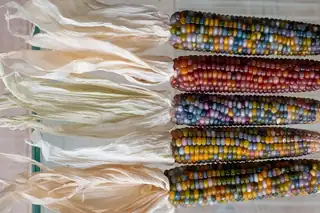
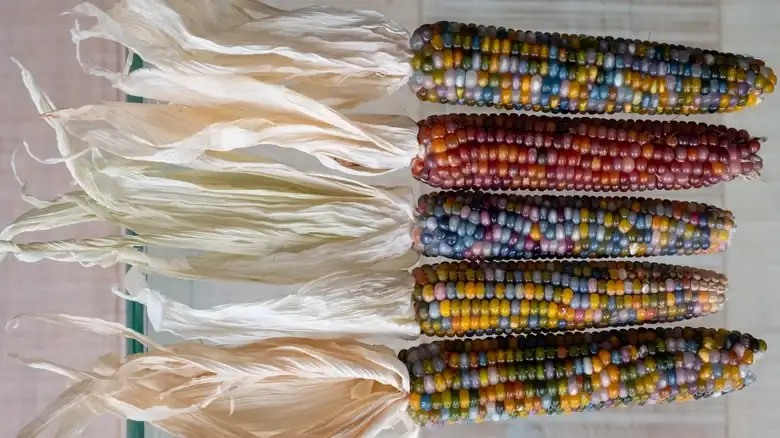
Glass Gem corn has kernels that shimmer in shades of blue, purple, red, and gold, but its flavor isn't that of a tender ear. It's flint corn, not the sweet variety sold at street stalls or supermarkets. Its kernels are hard and mealy, made for storage. Anyone who cooks it like sweet corn will encounter an unrelenting crunch, more like raw popcorn than buttery corn.
All Glass Gem corn is flint corn, but not all flint is Glass Gem. Flint is a broad category of hard, smooth-kernel corn that is harvested only when the hulls have dried to a papery brown and the kernels have fully hardened. At this stage, the sugars have converted to starch, making it ideal for flour or popcorn, although popped popcorn remains white rather than those colors. It should be treated as a grain, not as a side dish with juicy vegetables.
Grind in a grinder or with a powerful food processor, Glass Gem corn is used for hot or traditional cornbread, grits, batter for fried catfish, or Rhode Island-style johnnycakes. It can also be nixtamalized to make masa, the base for homemade tortillas and tamales.
Its vibrant colors tell a story. Farmer Carl Barnes, of Cherokee descent, began cultivating traditional corn varieties to reconnect with his roots. This cultivar was created by selecting varieties with unusual colors. Barnes gave some seeds to farmer Greg Schoen, who crossed them with a popcorn variety, intensifying the colors and giving them a glossy finish. Seed curator Bill McDorman then helped make them more accessible.
The colors come from pigments (anthocyanins and phlobaphenes) that form in the pericarp and the aleurone layer, the outer layer of the kernel, while carotenoids color the underlying endosperm. As scientist Kirk Maxey explains, "The endosperm is the substance of the corn kernel and its base, while the thinner pericarp and aleurone layer are like paint applied over this base color." Each kernel is genetically unique, so no two ears of corn are alike.
After harvesting, the ears of corn should be air-dried in a cool, dry place for several weeks to prevent mold. The seeds can be saved for later planting, always planted away from other ears of corn to avoid cross-pollination. If stored in a paper bag in a cool, dry place, they will remain viable for years.