The knife as a cooking technique
For any cook, the knife is the essential tool, the bow of the violin with which they create their music, but in Minemura's case, it's much more than that. It's not simply a utensil, but a culinary technique. Cutting a product can transform it as much as roasting or boiling it.
For any cook, the knife is the essential tool, the bow of the violin with which they create their music, but in Minemura's case, it's much more than that. It's not simply a utensil, but a culinary technique. Cutting a product can transform it as much as roasting or boiling it.
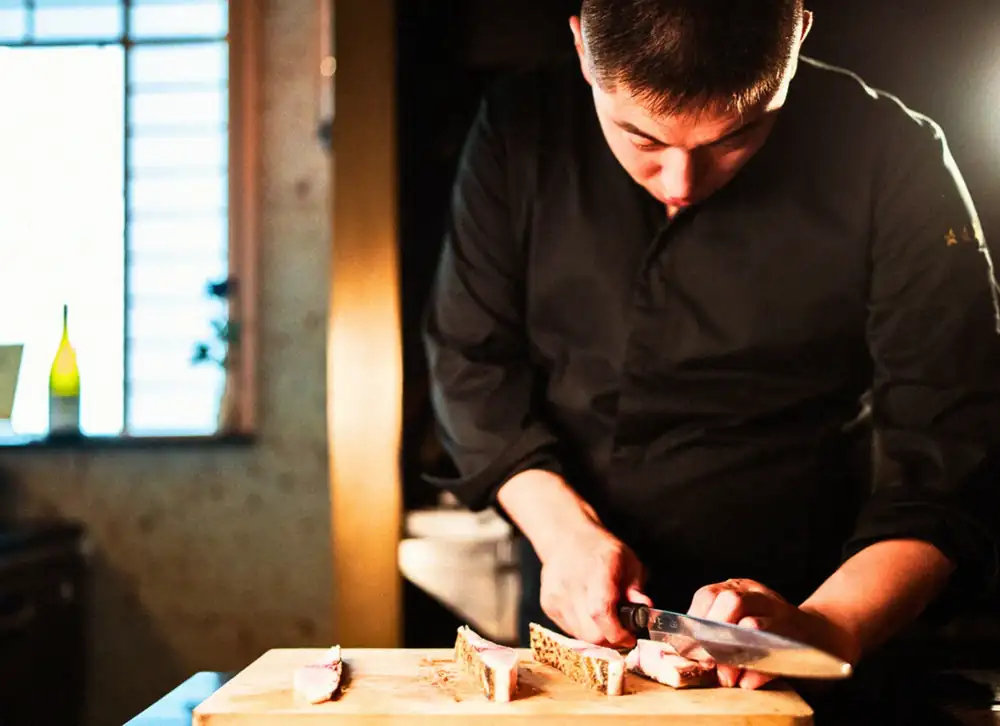
We're sitting at the bar of his restaurant AO, in the Nishiazabu district near Roppongi, Tokyo. To explain the ability of an extremely sharp knife to transform an ingredient once cut, he performs the simple exercise of chopping an onion with an ordinary knife and then doing it with his own, so sharp it reflects light like a mirror.
From white paper to blue
What kind of knives are these, and how are they sharpened to achieve such precise cuts? Shokunin, or master chefs, refer to the finest knives by the curious names of "white paper" (shirogami) and "blue paper" (aogami), so called simply because historically, manufacturers wrapped them in paper of one color or the other. Each name refers to a type of carbon steel, highly valued for its ease of sharpening and edge retention, but with different alloys. "White paper" knives are made of pure carbon steel with few impurities, allowing for a very fine and long-lasting edge. These represent the most traditional choice for high-end knives and are the most commonly used by itamae (chefs), although they rust easily and require careful maintenance. "Blue paper" knives, on the other hand, are made of carbon steel with added tungsten and chromium, which improves their wear resistance and edge retention. However, they are more difficult to sharpen than shirogami. Of course, both are handcrafted, with many layers of steel protecting the harder central layer.
The other half of the pair, Japanese sharpening stones, have little in common with their Western counterparts, starting with the fact that they are used with water instead of oil. They are made with softer abrasive materials and can be natural or synthetic. They are classified according to the fineness of their abrasive particles, called grit. Thus, we have coarse-grit stones (between 120 and 800 grit), suitable for roughing out or repairing damaged edges; medium-grit stones (between 1,000 and 3,000 grit), used for general sharpening; and fine-grit stones (between 4,000 and 8,000 grit), suitable for achieving a very clean and smooth cut. At 5,000 grit and above, sharpening produces a mirror-like edge. Finally, there are ultra-fine-grit stones (from 10,000 to 30,000 grit), the kind used by Koji Minemura, which achieve an extremely fine mirror edge and are used only for very high-quality knives or razor blades.
Heirs of the katanas
In Japan, the art of knife making and sharpening is a true collective passion, and the highest quality knives command high prices, ranging from €500 to over €4,000 for custom-made knives, designed specifically for each individual, tailored to their strength and how they will use them. They are a legacy of the katana culture, commonly used by samurai until the Haitorei Decree banned its public use in 1876.
Koji Minemura surgically slices the only squid caught that day, humanely slaughtered using the ikejime technique. The resulting texture and sweet flavor from these precise cuts make it an unparalleled delicacy. He continues the process with a white snapper and a Japanese sea bream, both with firm, flavorful flesh. His mastery makes it clear that, in Japanese cuisine, the cutting technique can be almost as important as the ingredients themselves. A good, sharp knife not only makes the job easier but also enhances the final quality of the dish in terms of flavor, texture, and presentation.