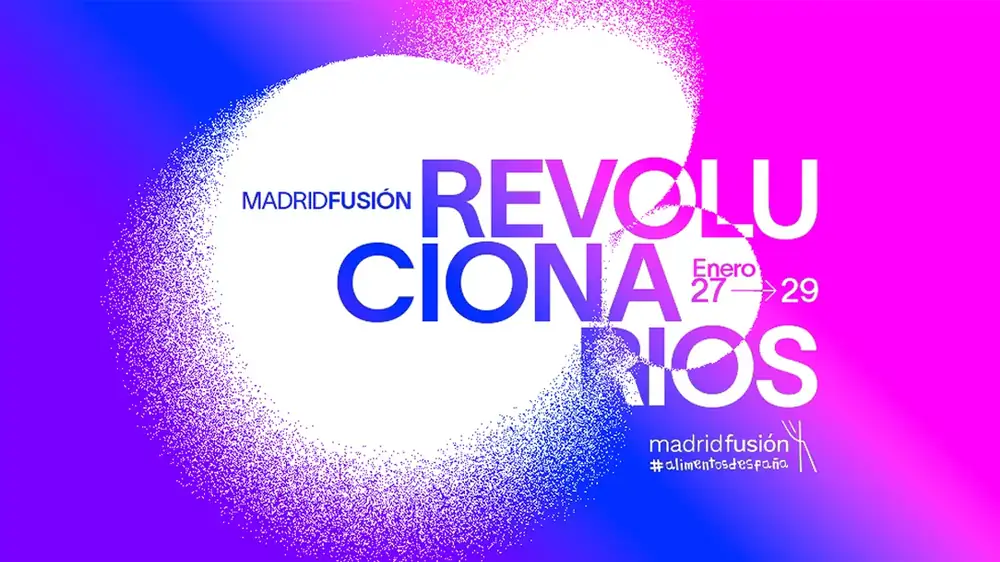
Madrid Fusion looks back on 30 years of the Spanish culinary revolution
Under the title "Revolutionaries", Madrid Fusión Alimentos de España will feature many of its protagonists, starting with Ferran and Albert Adrià, to analyze what that movement meant and its influence on contemporary gastronomy.
Leading chefs from around the world, who consider themselves heirs to the most disruptive and creative thinking that has dominated the international culinary scene in the last century, such as Gastón Acurio, Massimo Bottura, and Yoshihiro Narisawa, will join the inspiration behind that movement on the stage of this global gastronomic summit. The 23rd edition, which will be held from January 27 to 29, will feature the participation of Pedro Subijana, Andoni Luis Aduriz, Dani García, Quique Dacosta, Joan Roca, Carme Ruscalleda, and Martín Berasategui.
The new international culinary scene will also be represented by the presence of, among others, Dylan Watson-Brawn (Ernst*, Germany), Mark Donald (The Glenturret Lalique**, Scotland), Agustín Ferrando (Ando*, Hong Kong) or Jorge Vallejo (Quintonil, Mexico).
This year there will be 17 competitions and the selection of Revelation Chef, Revelation Pastry Chef, Revelation Bartender, Revelation Head Waiter and the Revelation Sustainability Award will also take place.
Creative freedom, the will to change, rebellion, the daring to change the rules, and the generosity to share advances and discoveries are some of the innovations that those revolutionaries introduced into avant-garde cuisine, and which will be remembered during Madrid Fusión Alimentos de España by its main protagonists and many others who continued to be part of that movement or who now continue to carry that banner.
It will be much more than a tribute to the chefs who, at the end of the 20th and beginning of the 21st centuries, changed the course of cuisine worldwide. It's a creative movement that still influences many young chefs and enjoys international acclaim. Spanish cuisine underwent a true transformation led by chefs such as Ferran Adrià and his brother Albert, Juan Mari Arzak, Pedro Subijana, Andoni Luis Aduriz, Dani García, Quique Dacosta, Joan Roca, Carme Ruscalleda, and Martín Berasategui.
It changed the way we think and work
That was the most influential movement in the world of gastronomy since Nouvelle Cuisine, and it impacted the way chefs on all five continents thought and worked. That catharsis in the kitchen changed the mindset of both the chef when cooking and the diner when tasting, thanks to the arrival of the tasting menu. Knowledge began to be shared, chefs stopped being dogmatic, and a new path was shown to the world, one in which cuisine was understood as a language. Kitchens were created that changed the paradigm of how we work, workshops and labs where teamwork is paramount. And new tools and new uses appeared: blenders, siphons, silicone molds, gastrovacs, rotary machines, freeze dryers, sous vide cookers, and Pacojets.
The immense creative capacity led to the creation of entirely new styles: minimalism, deconstruction, a symbiosis of the sweet and savory worlds, and trompe-l'œil. It also gave rise to new techniques and preparations: savory ice creams and sorbets, new soups, sauces, gelatins, frozen powders, airs, foams, clouds, bubbles, cooking with liquid nitrogen, distillates, spherification, obulato techniques, on-the-spot smoking, blown sugar, edible papers, seafood sausages, and new salting methods.
That revolution also left interdisciplinary relationships as a legacy. Chefs began working with tableware designers, opening themselves up to dialogue with science, art, and top-tier education, even going so far as to 'conquer' Harvard by awarding an honorary doctorate to a chef for the first time in history, Ferran Adrià.
Dialogue with Japan and Latin America
Cultural exchange with other continents led to a dialogue with Japanese and Latin American gastronomy. A new perspective on ingredients emerged, assigning equal value to all regardless of price and focusing on the purity of their essence. New processed and unprocessed products arrived, as well as others previously unused in haute cuisine. Kitchens began exploring contrasts in temperature and texture, distinguishing between main course and garnish, creating new cocktails using culinary techniques, and developing new alcoholic and non-alcoholic beverages. The structure of menus was also transformed by this revolution. The tasting menu, now known as a long and narrow menu with multiple courses, was created, and new concepts in the gastronomic experience appeared: creative cocktails, new snacks and tapas, pre-desserts, and "morphings."
The revolution in the room
The revolution that began 30 years ago also reached the dining room. Rigidity was eliminated with the emergence of informal service and the creation of a new vision of "cooking tableside." The customer experience also changed, shifting from passive to active participants who go to the restaurant to enjoy themselves, incorporating provocation, humor, and irony into the experience. This new way of understanding cuisine also introduced the sensuality associated with eating certain dishes with one's hands, something uncharacteristic of haute cuisine. In most of these restaurants, menus, bread, and cheese trolleys disappeared from the dining experience. And the trend of eating large dishes in small portions became commonplace in fine dining.
Those wonderful years also saw Spanish chefs become household names, gaining recognition from major international media outlets. Ferran Adrià appeared on the cover of The New York Times (2003) and later on the cover of Le Monde's supplement (2004). His work was beginning to transcend the confines of food publications. Three decades later, the impact of this revolution on Spanish cuisine and the rest of the world is enormous. In Spain, over these 30 years, recognition of gastronomic excellence has multiplied, and the number of restaurants with three Michelin stars has risen from three in 1994 to sixteen in 2024. New steakhouses have emerged that are considered among the best in the world, along with signature seafood restaurants and countless fine-dining establishments. And a deluge of top spots in all the world rankings, starting with The World's 50 Best Restaurants list, where Spanish restaurants have occupied the top positions for the last 20 years. This revolution in Spanish cuisine not only changed the way gastronomy was understood, but also had a significant economic and cultural impact. Spanish cuisine became a tourist attraction, and cities like Barcelona, Madrid, San Sebastián, and Girona began to be recognized as top-tier culinary destinations.
The 2025 edition
This edition of Madrid Fusión Alimentos de España will feature many of the key figures of that revolution, with Ferran Adrià (elBullifoundation, Roses, Girona) and his brother Albert (Enigma*, Barcelona) leading the way. Joining them on the main stage will be many other protagonists of that revolution that transcended geographical and cultural boundaries: Heston Blumenthal (The Fat Duck***, Bray, UK); Gastón Acurio (Astrid & Gastón, Lima, Peru); Massimo Bottura (Osteria Francescana***, Modena, Italy); and Yoshihiro Narisawa (Narisawa**, Tokyo, Japan), who will also be in Madrid.
Also included are the Spanish chefs who were at the forefront of this movement that changed the history of cooking: Joan Roca (El Celler de Can Roca***, Girona); Pedro Subijana (Akelarre***, San Sebastián), Martín Berasategui (Martín Berasategui***, Lasarte, Guipúzcoa); Quique Dacosta (Restaurante Quique Dacosta***, Denia, Alicante); Dani García (Smoked Room**, Madrid); Andoni Luis Aduriz (Mugaritz**, Errentería) and Carme Ruscalleda.
Alongside them will be many of the heirs - those who were part of that groundbreaking elBulli team - such as Oriol Castro, Eduard Xatruch and Mateu Casañas (Disfrutar***, Barcelona) or Albert Raurich, (Dos Palillos*, Barcelona, Spain); and also many of those who took up the mantle and decided to follow the path of revolution: Dabiz Muñoz (DiverXo***, Madrid); Eneko Atxa (Azurmendi***, Larrabetzu, Bilbao); Ángel León, (Aponiente*** Puerto de Santa María, Cádiz); Diego Guerrero, (DSTAge**, Madrid); Javier Olleros (Culler de Pau** O Grove, Pontevedrra), Jordi Vilà, (Alkimia*, Barcelona, Spain) or Ricard Camarena (Restaurante Ricard Camarena**, Valencia), Pepe Solla (Casa Solla*, Poio, Pontevedra), Iván Cerdeño (El Cigarral**, Toledo) and Nacho Manzano (Casa Marcial***, Asturias).
International presence
This year's Madrid Fusión Alimentos de España will also feature other international chefs equally aligned with this revolution, such as Dylan Watson-Brawn (Ernst* Berlin, Germany). A Canadian native, Dylan Watson-Brawn began his culinary journey at age 16, when he dined at the acclaimed RyuGin restaurant in Tokyo with his parents and dared to ask to apprentice with the renowned chef and owner Seiji Yamamoto. After stints at Eleven Madison Park in New York and Noma in Copenhagen, Dylan moved to Berlin, Germany, where he co-founded Ernst with Spencer Christenson. There, the menu changes daily and is constantly evolving. The restaurant received a Michelin star in 2019.
Mark Donald (The Glenturret Lalique**, The Hosh, Crie, Scotland) is a Scottish chef who aspired to be an actor before cooking came into his life. He pays homage to the bounty of his homeland at his restaurant Glenturret Lalique, where he earned his second Michelin star in February 2024. Also featured in this edition is Agustín Ferrando (Ando*, Hong Kong). Born into a family of Spanish and Italian immigrants in Ramos Mejía, Argentina, this chef's love for cooking began at his grandmother's table but was honed in some of the most acclaimed restaurants in Buenos Aires and New Orleans. He also traveled to Japan where he perfected his culinary knowledge in the kitchens of Tokyo (Zurriola**, Nihonryori Ryugin*** and la Cuisine[s] Michel Troisgros**) and was named one of the top 10 young chefs in Japan (under 30) in 2015. Upon moving to Hong Kong, he opened his own business, Andō, a restaurant with roots in Spanish cuisine fused with the techniques and products of Japanese gastronomic culture, which obtained a Michelin star six months after its opening, in July 2020.
Nordic cuisine will be represented by Albert Franch (Nolla*V Helsinki, Finland), offering a gastronomic experience that combines a passion for seasonal cuisine with an unwavering commitment to sustainability. Behind Nolla are three chefs who joined forces: Albert Franch, Luka Balac, and Carlos Henriques. A Catalan, a Serbian, and a Portuguese chef who met while working in Oslo and decided to create their own restaurant in 2017. At Nolla, they have committed to zero waste, and every step of the culinary process is approached from a perspective of sustainability and regeneration.
Chiara Pavan and Francesco Brutto (Venissa* Venice, Italy) are also chefs committed to sustainability through what they like to call "environmental cuisine" on the small island of Mazzorbo in the northern Venetian lagoon. Their cuisine focuses on reducing food waste and promoting the use of local and seasonal ingredients. There is no meat on the menu, only vegetables and fish, and they use invasive species that have had a significant impact on the ecosystem of the lagoon and the upper Adriatic in recent years. Venissa has been awarded one Michelin Star and one Michelin Green Star.
From Quintonil (Mexico City, Mexico), Jorge Vallejo expresses the flavors of Mexican ingredients through his personal lens. In 2012, he and his wife and business partner, Alejandra Flores, opened Quintonil, located in the Polanco neighborhood of Mexico City. Together with chefs Mauro Colagreco (Mirazur, France) and Virgilio Martínez (Central, Lima, Peru), he launched the Orígenes initiative to recover and preserve culinary products, techniques, and traditions that survive in small communities across Latin America. Quintonil holds two Michelin stars and is currently ranked seventh on The World's 50 Best Restaurants list.
One of the great names in French cuisine, Bruno Verjus (Table Bruno Verjus**, Paris, France), will also take to the main stage at Madrid Fusión. A late-blooming chef, he began cooking in his fifties and practices a cuisine free of rules and dictates, prioritizing a love for the product. And from Japan, chef Katuhito Inoue (Table by Katuhito Inoue, Kyoto) arrives at this edition of the gastronomic summit. He grew up watching his grandfather run a high-end Wagyu shop and his father a steakhouse. After working in some of Europe's finest kitchens, he developed a modern style of cooking that remains true to his family values. Inoue follows the local tradition of cooking without waste and draws inspiration from the ancient concept of the 72 solar terms, which divides Japan's seasons at their peak transitions.
Alongside them, some of the young Spanish talents who are part of the latest generation of revolutionaries will also participate: Pedro Aguilera (Mesón Sabor Andaluz*, Alcalá del Valle, Cádiz); David Chamorro, (Food Idea Lab Madrid); Javi Estévez, (La Tasquería*, Madrid); Marco Antonio Iniesta (Frases*, Murcia) and Iago Pazos (Abastos 2.0 Santiago de Compostela).
Other conferences and competitions
In addition to the Main Auditorium, Madrid Fusión will take place in the Polivalente and will feature the fourth edition of The Wine Edition Food & Wine From Spain; the third of Madrid Fusión Pastry Tu Provincia Huesca la Magia Dulce and the second of Madrid Fusión Dreams Spain Food Tech Nation, as well as Madrid Fusión Drinks.
In addition, 17 competitions will be held during the three days, and the Revelation Chef, Revelation Pastry Chef, Revelation Bartender, Revelation Head Waiter and the Revelation Sustainability Award will be chosen.