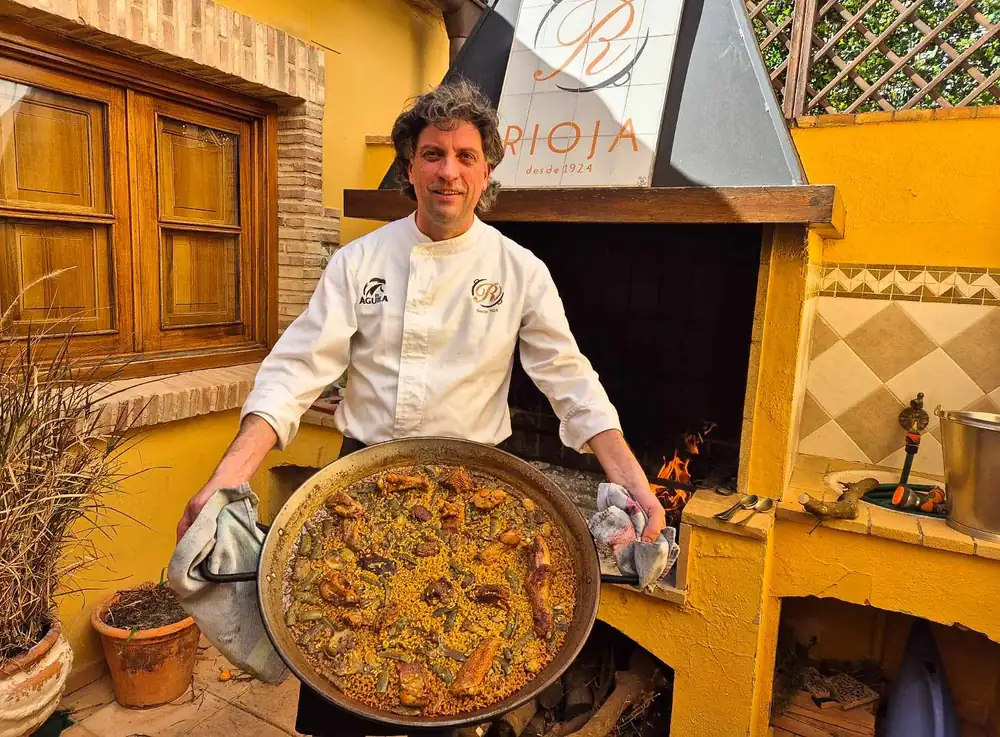
The best paella in the world?
Ferran Adrià, always with his insightful tautologies, said that elBulli was the best restaurant in the world "because everyone else says so." An irrefutable argument.
There is no shortage of objective arguments: it is the paella commemorated in the famous gastronomic edition of postage stamps, Quique Dacosta defines Rioja as "the Paco de Lucía of paella", it is a place of pilgrimage for great chefs such as Elena Arzak, Massimo Bottura and all those from his region…
It is, quite simply, considered by everyone to be the best in the world. And it has historical reasons for this: this year the Rioja restaurant celebrates a century in the hands of the same family, hers, and always making paella.
But although Vicent, by lineage, discretion and humility, is the kind of cook who always prefers to be in front of the wood and fire, far from the glitz of the food business, his fame has spilled out of his jacket and he has been forced to exhibit his paella in different parts of the planet, where he has repeatedly received tempting offers for large and succulent openings, such as in Dubai, America and Asia.
He has just returned from Japan, where, in addition to showcasing his paella to the Japanese public, he was invited by Ishida himself, of the legendary Mibu in Tokyo, to cook it in a unique way at his restaurant, the most exclusive in the country. He, however, has never taken the easy way out. “I only leave my home because everything that isn't given is lost; and after 100 years of culinary experience with paella at its core, I am committed to continuing my family's legacy.”
And if the prologue to this dazzling paella is the history and recognition of his fellow professionals (as well as artists, athletes, and various celebrities), the contemporary influence of Vicent has been decisive. He claims to have posed more than 130 questions to understand it in its most hidden corners. The reasons for everything; the whys. Unmasking the myths and finding the real explanations, to which he has dedicated himself (and continues to dedicate himself) alongside researchers and scientists.
“For example,” he tells me, “the famous issue of water. There was always this idea—false, I now know—that a traditional paella had to be made with water from Valencia, and many people even transported it to ensure success. It’s not true. I conducted a study, with chemists and a professional tasting panel, using various soft and hard waters, from Valencia and elsewhere, and there was no change whatsoever, neither physical-chemical nor organoleptic. None.” What does affect the paella (another of Rioja’s self-reflective questions) is the altitude at which it’s cooked, because altitude produces significant changes in the heat and cooking time.
In search of the platonic paella
Then there's Vicent's meticulousness (and erudition) in each of the steps, ingredients, and extensive knowledge that go into his Valencian paella. Because it's the sum of all these elements that makes it unique. We start with the firewood. Only orange wood, and it's been dried for two years. But that's not all: the wood is stored in a section of the Rioja estate in slightly separated layers to allow air to circulate.
Throughout the two years of preparation, the dryness and humidity must be managed, so a series of devices have been set up to protect the logs from the westerly winds and, if necessary, to water them. The firewood must be perfect because “paella isn't smoked, it's perfumed.”
And we get going in the traditional way; that is, in front of the fire, with all the mise en place prepared and with the appetizers from the Rioja restaurant before the paella: giant prawns from Dénia (boiled and grilled), sweet shrimp, three types of oysters, red tuna, foie gras… And, of course, champagne, because Rioja has a list with 150 references from small winemakers, in addition to the great houses and the best Spanish sparkling wines.
There goes Vicent, armed only with the original spatula his great-grandfather used, a utensil with a 100-year history in paella cooking. He starts with an empty paella pan, the firewood already burning, the second layer of damp salt from Santa Pola, and on top, extra virgin olive oil, the Serrana variety, from centuries-old, dry-farmed olive trees.
Time for the meats: free-range red-feathered chicken, aged for four days, and brown-coated rabbit with black eyes, aged for two days. Add the remaining salt. Brown the meat and add the liver (which we'll eat with bread as an appetizer) and the rabbit heart. Continue with the vegetables (all the vegetables have come from the Rioja family's organic farm since the establishment opened a century ago), and when everything is browned and cooked, make a circle in the center of the paella pan and add the paprika (homemade and sun-dried) and the grated tomato, including the skin. Caramelize.
Then the water. “We make the broth with the water, which will be ready in about 25 minutes over medium-low heat,” Vicent explains. We place a sprig of rosemary in the water for five minutes, then remove it. When the broth is almost ready, we add the La Mancha saffron, which has been diluted and infused (for two minutes) in a little of the broth. We add the lima beans and the finely chopped artichoke.
And the rice. Sènia DO Valencia Rice. We add fast-burning wood to the fire because we want a fierce, impetuous blaze, which we'll then reduce. After 15 minutes, we remove the wood and cook for three minutes to create the socarrat, which "should be elegant, not burnt."
What comes next…
Beyond the rice, a menu of high-quality products
While paella—always served in a very thin layer and eaten in the middle of the table with a wooden spoon—is the geometric centerpiece of everything in Rioja, the restaurant's fame also extends to its excellent seafood and produce, accompanied by a wine cellar that ranks among the best in Spain. Let's take a look.
Bluefin tuna tartare sprinkled with cured tuna mojama and lightly smoked with olive wood. Mediterranean hake cheeks (a delightful surprise). Pickled partridge. Flame-grilled white eggplant with porcini and turmeric cream and Marcona almonds. Tempura artichoke heart with porcini mushrooms, Iberian pancetta, and black truffle.
We also tried one of the house's old favorites—created in 1960 by Grandma Angelita—an artichoke stuffed with veal, pine nuts, cinnamon, and cloves, served with an artichoke consommé. Excellent wild sole meunière. Viceroy.
And then everything changes. The great sommelier - of wines, spirits and cigars - Manuela Romeralo, formerly of La Sucursal and all of Quique Dacosta's restaurants, World Champion of Habanos Sommelier in Cuba 2006, National Gastronomy Award for Best Sommelier 2008 and International Gastronomy Award for Best Sommelier 2010 by the International Academy of Gastronomy, among other distinctions, arrives and proposes an impossible Cohiba with 20 years resting in her private cigar cellar to accompany the magnificent Port at the end of the party.