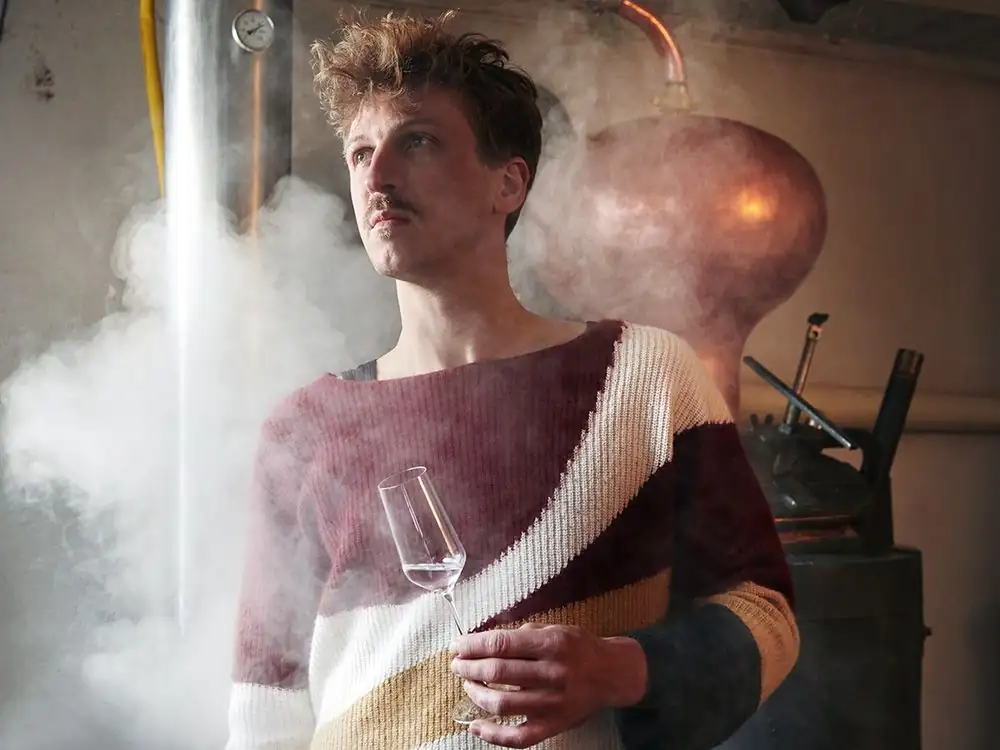
Johannes Kolonko: A portrait of the spirits producer
The sun is shining, and Johannes Kolonko is crouching in the shade of an old vineyard peach tree. On the still dew-damp grass, he gathers the raw material for his fruit brandies: fully ripened fruit that has fallen from the tree.
Plantation fruit and pesticides are not an option for Johannes Kolonko.
For his spirits, he's always on the lookout for old trees, taking unconventional routes and placing classified ads in the Badische Zeitung newspaper. "Often it's older people who respond to my ads and have had an old fruit tree in their garden for many years that's never been harvested," he says. "They're happy when I come and take their fruit." He drives his old VW T4 through small villages around Staufen im Breisgau to his fruit trees: plums in Grunern, blackcurrants in Ihringen, or butter pears in Heitersheim. Everywhere hang old, special varieties, which Johannes Kolonko harvests by hand, or he waits until they fall to the ground – a time-consuming task. The vineyard peaches bear fruit for up to eight weeks, with ripe peaches falling every day. For Johannes Kolonko, this means searching the ground under the trees almost daily to prevent rodents, insects, or rot. If a storm threatens, you'll find him under the fruit trees at four in the morning, wearing a headlamp. "I know why I do this; nobody sends me – I'm happy doing it." Once the crates are full, the work continues.
A lengthy process
He pre-sorts the fruit according to ripeness, leaving those that still need time to ripen further in a refrigerated trailer. Inside, crates of quince, peaches, apples, pears, and plums are stacked high. The ripe fruit is mashed and transferred to stainless steel barrels. Beforehand, each individual piece of fruit passes through Johannes Kolonko's hands, is checked for damage, and is pitted by hand. All the fruit ferments spontaneously; no yeast is added. Depending on the variety of fruit and the temperature, this can take between three weeks and four months. Only then does he distill on his old copper still from 1963, which he fires with wood for the first distillation. "The still holds 80 liters—a ridiculous amount compared to large distilleries," he says. They work with tons of fruit, which are mechanically shaken from the trees and processed all at once.
All stages of ripeness are blended, and added yeasts accelerate fermentation. Johannes Kolonko takes the time necessary to produce top quality. He lets the first distillate rest in small stainless steel barrels. He only begins the more elaborate production of the second distillate in the spring, because from June to December, Kolonko can be found outdoors gathering fruit. His oldest tree, an 80-year-old Gravensteiner, stands in his own orchard with 20 varieties of fruit, and it still bears apples today, having never come into contact with fertilizer or pesticides. Johannes Kolonko discovered wild mirabelle plums by chance during one of his outings in an old horse paddock. The grass there is left to its own devices, growing wild around the legs of the wiry fruit distiller, whose eyes scan the ground for the small fruits, no bigger than cherries. "It's like hunting for Easter eggs," he says, "I'm happy when I find some."
Johannes Kolonko's path to self-employment
When he went into business for himself in 2018, he didn't know if the effort would pay off. But he did know that he could create a truly unique brandy from fruit. Various top restaurants, such as "Nobelhart & Schmutzig" in Berlin, Felix Schneider's "etz" in Nuremberg, and "Sonnora" in Dreis, appreciate his work and his brandies. You don't have to be a fruit brandy connoisseur to understand what makes them so special. The aroma of the vineyard peach alone catapults you into a heaven of ripe fruit. Smooth, multifaceted, and not at all harsh on the palate, the brandies unfold the magic of transformation in the mouth. Johannes Kolonko's eyes light up when he talks about the fascinating metamorphosis of the fruit. The final brandies are stored in small glass demijohns and bottled to order. The last step of handwork takes place when the cork is in place. Johannes Kolonko signs and numbers each label and applies a touch of copper leaf with a brush – as unique as the brandy in the bottle.