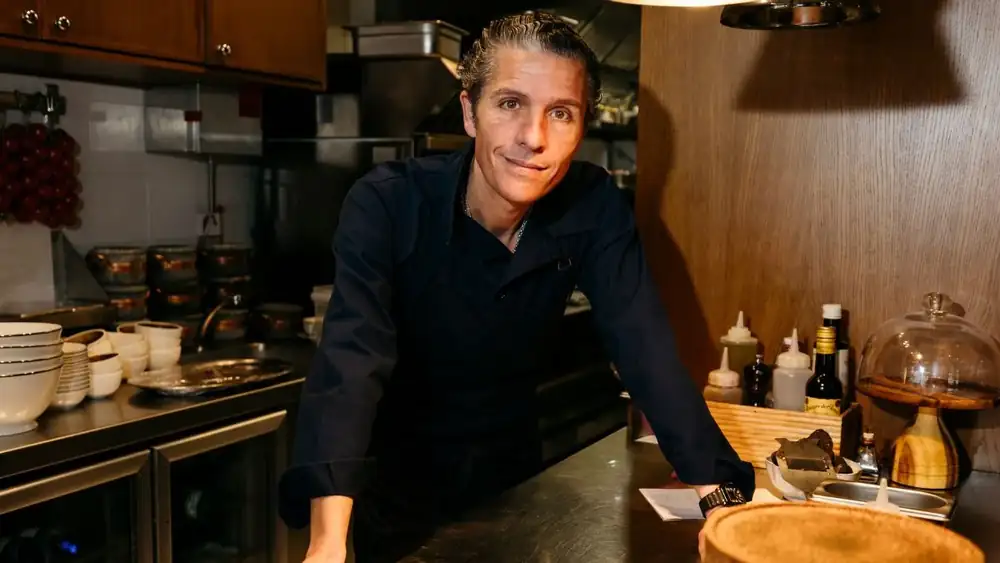
Egg Box: Enrique Valentí returns to the bar with a new bar in Chueca
There's something almost provocative about opening a bar after having made getting a table at your restaurant a minor mission.
It's called Caja de Huevos (Egg Box), it's located at number 35 Pelayo Street, and it bills itself as a "Refueling Bar." A name that already serves as a declaration of intent: you don't necessarily come here to sit for hours in front of a menu, but rather to come in, order something, have a drink, snack, share, and move on. Or stay. Because that's precisely the charm.
Valentí defines his new project in a much simpler way than any gastronomic label: “Caja de Huevos is more than a bar, but less than a restaurant.”
From the eatery to the bar
Just over a year ago, Valentí returned to Madrid after two decades in Barcelona to open Caja de Cerillas, a small restaurant with only 25 seats, conceived as a contemporary eatery. It was a personal project in which he decided to return to cooking everyday dishes and strip away layers from a career marked by restaurants, consulting, and gastronomic concepts.
The gamble paid off. Tapas included it in its list of Best New Restaurants 2026 and later awarded it the prize for best new opening of the year.
But if anyone expected Valentí's next step to be an even more sophisticated restaurant, the answer has been exactly the opposite.
Caja de Huevos lowers the volume of formality and raises the volume of the bar.
The new restaurant features an open kitchen, a dining area, and a prominent bar. It's larger than Caja de Cerillas and designed to operate at a more continuous pace. The tables, paper tablecloths, and even the egg cartons hanging from the ceiling contribute to a space where the concept is clear even before reading the menu.
“I’m in love with bars,” Valentí explains. And at Caja de Huevos, the bar isn’t just a place to wait for a beer: it’s practically the stage from which everything happens.
The egg as a starting point
The name is no joke. Neither is the menu. The heart of Caja de Huevos is what are known as "broken dishes," a collection of recipes built around a combination as recognizable as it is inexhaustible: eggs, potatoes, and something more.
The idea stems from one of Caja de Cerillas' most successful dishes: broken eggs with garlic prawns. Valentí takes that recipe, deconstructs it, and transforms it into the starting point for an entire bar. The menu features half a dozen variations: eggplant, tomato, and basil; chistorra sausage; guanciale with pecorino and pepper; Iberian ham; garlic lobster; and imperial caviar.
In other words, the broken egg dish can remain a popular recipe while also allowing for some more luxurious touches. The potatoes, of course, play a starring role. Valentí has even designed a kind of urn to keep them perfectly cooked before they reach the plate. Because behind the apparent simplicity of the concept lies a far less simple obsession: to do well what everyone thinks they know.
And that's where another of the ideas that runs through the chef's kitchen emerges. After years working in haute cuisine and on projects of different formats, Valentí has found much of his current culinary language in the revival of familiar flavors. At Caja de Cerillas, he brought this approach to home cooking; at Caja de Huevos, he takes it directly to the bar.
A menu for eating without too many formalities
Eggs are the star, but they're not the only attraction. The menu kicks off with a collection of appetizers and sharing plates, from smoked pickled mussels to cured tuna gummies with fried almonds. Then come bar classics like patatas bravas, sea bass salad, or a bonito toast with piparras peppers.
There's also room for the larder, with products like Móstoles ham hock, marinated pork crackling, or Joselito sobrasada, and for more substantial dishes such as roast sirloin with Béarnaise sauce, "leftovers from a pizza," or matchbox macaroni, a direct nod to its older sibling. The finale maintains the same spirit: cream-filled pastries and burnt custard with wild strawberries.
For drinks, beer, vermouth, and around 50 wines complete a menu that doesn't aim to be a formal gastronomic experience. The goal is much simpler: to eat well, drink well, and do so without too many instructions.
The return of BarBas
Although Caja de Huevos was born in Madrid, it also looks to the past. Valentí revives part of the philosophy of BarBas, the vermouth bar concept he opened in Barcelona in 2014. That was a bar with a popular inspiration, serving tapas, seafood, and fried food. Now, twelve years later, that idea reappears transformed.
It's not a nostalgic reconstruction of the bar as it once was. It's more of a reinterpretation. Because if anything has characterized Valentí's career, it's precisely this ability to create different concepts around the same understanding of cuisine. Hence, Caja de Huevos doesn't pretend to be a second Caja de Cerillas, nor its informal version.
It's something else entirely. An evolution that swaps the restaurant for the bar, the menu for tapas, and complicated reservations for spontaneity.
Matchbox and Eggbox are separated by only a few months of history, but they represent two very different ways of understanding Valentí's cuisine.
The first one was born from the idea of reviving everyday food, with a small dining room, limited production, and a cuisine based on memory and familiar dishes. Tapas recognized it precisely for that ability to revive tradition from a contemporary perspective.
The second part of something much more open: the bar as a meeting point. There's no intention here to make the concept solemn. In fact, Valentí insists that he wants it to be a fun place. The kind of place where you can pop in for a beer and some patatas bravas, stay for some huevos rotos, or treat yourself to caviar and champagne.
The average bill is expected to be around 35 euros in the dining area, although the format allows you to spend considerably less or considerably more depending on what you order.
And there's another important difference: it doesn't aim to operate on a reservation system like Caja de Cerillas. The idea is for Caja de Huevos to retain that bar feel, the kind you can just drop in to without much planning.
Madrid is once again the stage
There's more to these two consecutive openings. Valentí hasn't just returned to Madrid: he seems to have found the place here from which he wants to continue his career.
After some 20 years in Barcelona, where he worked on projects like Casa Paloma, Chez Coco, BarBas, Marea Alta, and Adobo, his return to his hometown began with Caja de Cerillas. Now he adds a second address to his Madrid map.
And he does so without straying too far from what has worked for him: cooking recognizable dishes, seeking a connection with the person sitting on the other side, and building concepts rather than restaurants.
If Caja de Cerillas was the return home, Caja de Huevos seems to be the next step: leaving home, going down to the street and finding the bar of old, although filtered through Valentí's lens.
Two boxes, two formats, and one shared obsession: that behind a seemingly simple dish there's something more. This time, literally, by breaking eggs.