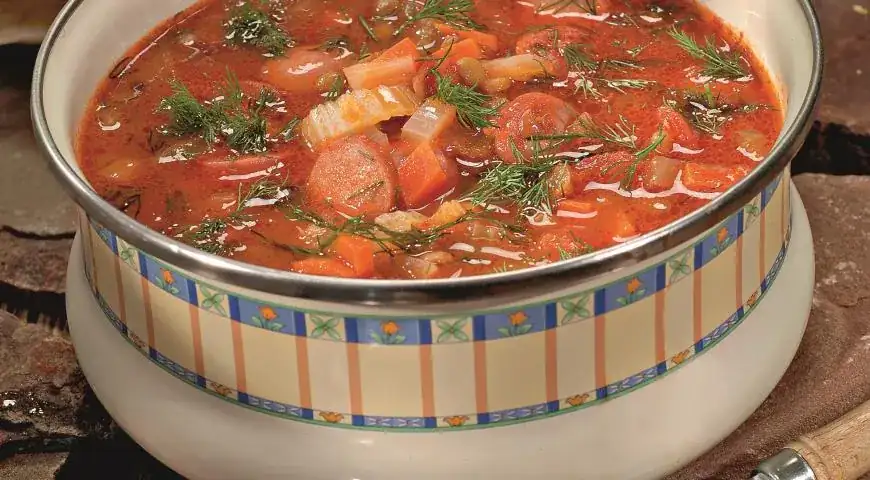
Hunter's Duck Stew
For soup, it is better to use duck legs, since the breast is a more refined part of the duck, and it is better to fry it rather than boil it.
- 8 duck legs
- 3 tablespoons of vegetable oil
- Onions
- 1 tsp. salt
- ground black pepper
- 2.5 liters of water
- 200 g bell pepper
- 800 g potatoes
- 250 g eggplants
- 200 g tomatoes
- 20 g cilantro
- 6 large prunes
- 1 red pepper pod
- Fry the duck legs in vegetable oil until golden brown. Add the onion, sliced into half rings, and fry for another 5-6 minutes. Season with salt and pepper, and add enough water to lightly cover the legs. Simmer for at least an hour.
- Pierce the meat with a toothpick. If it goes in easily, add coarsely sliced bell peppers, potatoes (small whole), eggplant (largely diced), and tomato quarters. Add water until it reaches halfway up the sides of the vegetables. Bring to a boil and season with salt. Cover and simmer for about 30 minutes, until the potatoes are tender.
- Finely chop the cilantro, remove the pits from the prunes and chop finely, cut the hot pepper into thin rings.
- When the potatoes are cooked, turn off the heat, add cilantro, prunes and pepper, cover and let sit for half an hour.
"Pokhlebka" isn't exactly a synonym for "soup." Once upon a time, before Peter the Great, "pokhlebka" was the name for liquid dishes in Russian cuisine. The word "soup" only appeared during the reign of Peter the Great, and initially...
To make duck soup, you don't need a whole bird: an excellent broth is made from the backbone and bones with the remains of meat left over from a roast or baked duck.
Oven-baked duck is the perfect New Year's dish. Experienced chef Dmitry Zotov shared with us how to prepare the duck for roasting, stuff it, and serve it with.
Homemade duck shulum will, of course, be different from shulum cooked over a campfire outdoors. After all, nothing can replace the aroma of a campfire. However, our recipe kills two birds with one stone—or rather, two ducks—it's suitable for both a campfire and a home stovetop. In both cases, the entire process takes place in a single cauldron, without any additional cookware. Hunters cook shulum from wild duck, for obvious reasons. You can also use a small domestic duck or part of one. However, you can use beef, lamb, or whatever you like for shulum. The most interesting thing is that the soup with the mysterious name shulum has no reliable history, although here and there it is described as a traditional nomadic soup dating back to ancient times. Some speak fondly of the Tatar-Mongol yoke, others of the Don Cossacks, the Kalmyk steppes, and the North Caucasus. Let's put it this way: while this soup may have a long history, its ancient origins bear no resemblance to modern versions. Where, pray tell, did ancient nomads get potatoes, tomatoes, and bell peppers—ingredients readily used in today's popular recipes? Nowhere. The soup was made from large quantities of meat and whatever roots were at hand. Today, we have plenty of delicious ingredients at our fingertips, so feel free to add them to your own shulum when making it at home.
This is a very hearty soup. Brutal. Hunter's. It's cooked in a cauldron right in the forest, from freshly hunted game. The bird is plucked, singed, and gutted. Any vegetables are used. The simplest ones. Without any pre-processing. Seriously, who would sauté onions in the forest?! We domesticated the soup – we used a regular duck (and even skinned it to make it less fatty), and added juniper for a forest flavor. The soup is very unusual, fragrant, and slightly sweet. And if your husband/brother/in-law proudly brings you the catch from the hunt – now you know what to do with it!