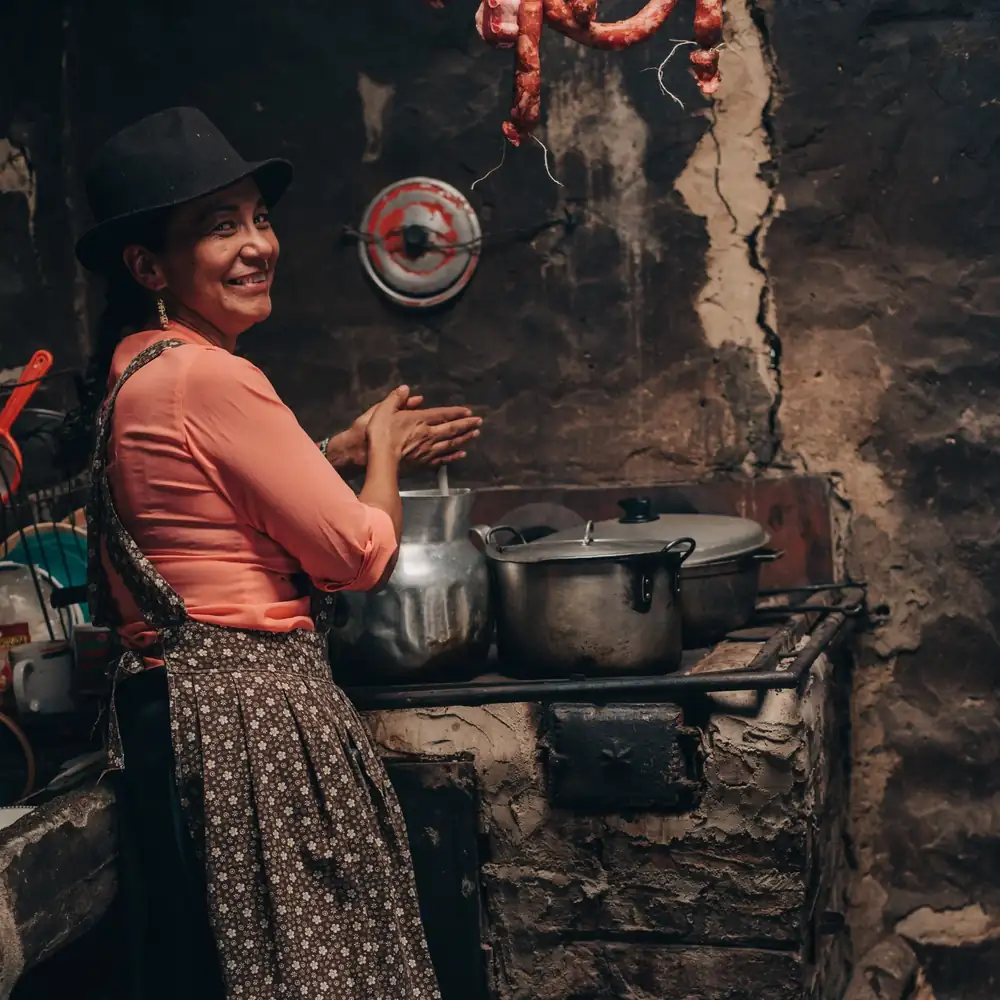
Kitchens of Boyacá, Colombia for you
Rescuing traditional Colombian cuisine involves documenting local recipes, techniques, and ingredients, but it is also essential to gather firsthand accounts from the traditional cooks who hold profound knowledge of this cultural heritage. I use the feminine form because women are the overwhelming majority.
The National Learning Service (SENA) of the National Center for Hospitality, Tourism, and Food of Colombia has been conducting research and publishing for several years to document the ancestral and traditional knowledge of Colombian cuisines. The book "Peasant Cuisines of Boyacá. Colombia pa' sumercé" (Colombia for you) is part of this project. "This publication comes at a historic moment for SENA. The institution has prioritized rural Colombia to strengthen the country's competitiveness through the peasant and grassroots economy," explains SENA's Director General, Jorge Eduardo Londoño Ulloa, in the prologue. He adds that "this work is part of the CampeSENA strategy, through which we aim to reach three million Colombians in rural areas to develop training programs, certify traditional practices, provide guidance, and offer economic resources."
The collection has previously showcased the rich gastronomy of Colombian departments such as Amazonas, Chocó, La Guajira, the archipelago of San Andrés, Providencia and Santa Catalina, and Meta. The projects, led by chef and researcher Ricardo Malagón, director of the Gastronomic Research Laboratory, bring together experts in social and natural sciences, the food industry, design, photography, botanical illustration, and gastronomy to document and contextualize the culinary heritage of each department. The Mariano Moreno School of Gastronomy and the Colombian Association of Food Banks (ABACO) also participate in the research.
These books not only seek to bear witness, but also to promote a generational exchange where young people learn from their elders; where community ties are strengthened in such a way as to ensure the transmission of culinary knowledge.
Peasant cuisines of Boyacá is a generous display of knowledge spearheaded by one ingredient: the potato. A food so vital that it transcends the boundaries of a mere harvest product to become, as researcher Angie Castro, a contributor to the work, points out, "an essential part of peasant culture in the land of 'sumercé' (a formal greeting), the hoe, and the ruana (a woolen shawl worn by peasant women in Boyacá)."
Corn, another protagonist
Corn also plays a starring role, prepared using ancestral techniques. One such method is moteo, a process in which dried corn kernels are boiled with wood ash or treated with lye to remove the husks and obtain the flowering corn, or mute. Charcoal or wood-burning stoves in homes impart smoky flavors, and in dishes prepared in the fields for farm laborers, clay pots lined with ferns are commonly served with chili peppers, guarapo (fermented corn beverage), or masato (fermented corn drink). Panela (unrefined cane sugar), fruits, and milk are transformed into desserts such as arequipe (dulce de leche), chicharrones de cuajada (curd boiled in panela syrup), bocadillo (guava paste), panelitas (panela fudge), arepas, and sweet breads.
Boyacá boasts a vast array of agricultural resources thanks to its extensive cultivated land and diverse soils. Indeed, reports from the Department of Agriculture this year indicate that the department has a total of 155,171 hectares planted with crops such as potatoes, sugarcane, fruit trees, coffee, corn, bulb onions, peas, cacao, carrots, green onions, greenhouse tomatoes, beans, barley, and wheat. This is in addition to other minor crops like chili peppers, cereals, legumes, fruiting and flowering vegetables, tubers, and wild fruits such as verjuice, wild grapes, myrtle, mortiño berries, and prickly pears.
Historic kitchen
The texts do not overlook the historical context of Boyacá's gastronomy, which maintained ancestral preparations with indigenous ingredients and assimilated the Spanish colonial tradition. “While Spanish cuisine tended towards breadmaking and wheat, the indigenous people consumed tender corn directly from the cob or in fermented forms such as chicha, mazamorra, and masato,” explains Ricardo Malagón. He goes back a couple of centuries to point out that “women carried out agricultural and culinary activities, while the men traveled about transporting cattle, horses, sheep, salt, and honey to neighboring towns. Pilgrimages between villages introduced piquetes, bundles of food wrapped in plantain leaves, as well as a new form of lodging called chicherías, houses adapted to receive people, horses, and any other animals that accompanied the caravan.”
Fascinating soups appear, preparations with corn, a sacred plant transformed through processes of peeling, grinding, or fermentation; the famous pre-Columbian preparation known as "indios," consisting of corn dough wrapped in corn husks. A product of the cultural clash between indigenous and colonial traditions, writings explore the sacred and the forbidden, worldview and religion, myths and legends, sounds and flavors, the meaning of many animals, and even the evolution of clothing.
The book opens up a debate about the impact of genetic modification on native seeds, championing native potatoes, of which more than 200 varieties are known in Boyacá, with names as evocative and endearing as Betina, Tucarreña, Arbolona Rosada, Corneta Botella, Quincha, Borrega Mora, Curritinga, Pepina, Tuquerreña Negra, Lizaraza, and Carriza. The texts conclude with soups and stews; sausages such as Génova, longaniza, and morcilla; head cheese; salchichón; and cábano; and baked goods, where the technique is simply kneading, loving, and nourishing. A lesson in life and knowledge.
Recipes with a face
But the true stars emerge with the recipes; a tribute in the form of texts and photographs to the women farmers and keepers of tradition who are the true custodians of this invaluable cultural heritage. Thirty-five recipes with their corresponding cooks and their proud families. A showcase of ingredients, techniques, anecdotes about the dishes, history, kitchen utensils, and the now indispensable QR codes to watch the preparations live, the result of the commendable audiovisual work of Colombian photographer José Luis Rivera and his team.
Help the Food Bank
The book costs 190,000 Colombian pesos (40 euros), which is donated to the Colombian Food Bank Campaign. It is delivered to homes within Colombia and is available in digital format internationally. A wonderful way to support a worthy cause and contribute to improving food security for thousands of vulnerable children.
The book's title is the perfect ending: "Sumercé" with an accent mark, a word that carries with it the echo of centuries of tradition and culture. Although it initially expressed respect for elders and close relatives, today it has become a symbol of affection, a way of addressing others with tenderness and consideration. Malagón points out: "We no longer use it as it was used before, which was 'vuestra merced,' a pompous term addressed to those of the realm. In this usage, it not only implies respect, but is a word of admiration and love. If someone calls you 'sumercé,' it's because they admire and love you."
So, thank you, sir.