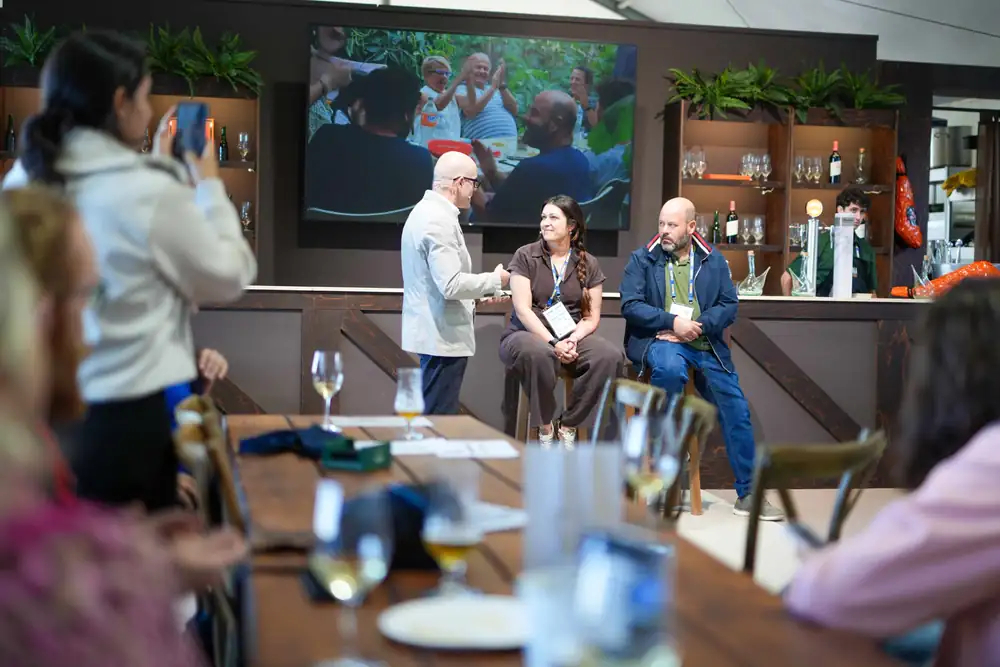
The profession of tavern keeper, under debate in the tavern forum
The second day of the San Sebastián Gastronomika Tavern Forum confirmed that this event, which focuses on the most popular and numerous restaurant businesses in Spain, has arrived at a crucial moment for the future of bars and eateries.
Miguel Ángel Laredo, owner and founder, along with his brothers, of the Laredo tavern in Madrid, spoke about the changes the hospitality industry is undergoing. “Taverns are starting to disappear; there’s no generational succession,” he warned. He explained that the arrival of foreign customers “has somewhat displaced the traditional clientele.” “They’re even making us change the way we cook,” he said, although he did appreciate that they’ve also moved up the opening hours.
Although he acknowledged that the opening hours of bars and restaurants are "a deterrent for younger generations," in his opinion, the most damaging factor is gentrification. "A new type of bar owner has emerged who no longer sees the business as their home, but as an investment. They offer (and customers seek) things that go beyond food and drink, such as decor or entertainment."
Another problem is the exponential increase in rental prices due to real estate speculation: “Our premises were bought by a Portuguese investment fund. We're trying to renew the lease, but we can't even talk to them; they're asking for exorbitant amounts. Another problem is housing for the waiters. I have 30 people on staff, and they're living farther away every day. Split shifts are no longer possible, and the staff are more tired commuting than they are on their shifts.”
The next speaker was chef Benito Gómez. Although recognized for the two Michelin stars of his restaurant Bardal (Ronda), Gómez has been a tavern owner for 20 years at the helm of Tragatá, a bar that began its journey in Ronda (currently it also has a location in Málaga) and where, he said, “I don’t make Andalusian or Catalan cuisine; I make my own food, which in any case is that of a Catalan based in Andalusia.”
Gómez addressed the same problem as Laredo, but from a chef's perspective. "Often, people can't even consider offering cuisine with a distinct identity in their bar; they just have to offer bao buns and hoisin sauce, which is what the customer expects." He alluded to the trend of "showcase" restaurants in places like Madrid or Marbella, "where everyone is gorgeous and the food doesn't matter," and also reflected on rising costs. "Before, someone with a successful bar could have a considerable profit margin. Now, costs are very high, margins are very small, and if we raise prices, customers accuse us of being too expensive."
El Pimpi Tavern Bar is an exception to the crisis that seems to be affecting many traditional bars. This establishment in the historic center of Malaga, located in a historic building, began its current history in 1971 and is packed every day. Elena Cobos, daughter of one of the founders and current manager of El Pimpi, spoke of 'The tavern as a cultural embassy'. She explained that the success of the evolution that has transformed a wine bar into a kind of embassy has been based on remaining true to its essence while also adapting to meet the demands of today's customers.
“The secret is being authentic; there’s no other formula. El Pimpi is Málaga, El Pimpi is about local produce. My father has vegetable gardens that supply El Pimpi with vegetables, like the famous tomatoes from Coín.” “To some extent, you have to go back to your roots, to avoid losing your identity,” he said. Another secret of El Pimpi is taking care of its employees. “Everyone complains, but we don’t have staffing problems; we have people who retire with us. We achieve this by paying fair wages, offering good working conditions, and providing training.”
Taverns have a thousand faces and speak a thousand languages. The Tavern Forum dedicated a look at the tradition and current state of the Portuguese tavern with the presentation 'Savor the Tavern,' promoted by AHRESP, Visit Portugal, Compete 2030, and the EU. The ambassadors of the tavern and 'petisco' (generally, dishes to share) were Catarina Nascimento, who worked for years at Diverxo before returning to Portugal, Rui Lima Santos, and Vitor Sobral. The three explained that taverns are contributing to the preservation of traditional cuisine by offering "a new perspective, faithful yet relaxed and creative, making the most of local products and presenting them in a way that is both delicious and visually appealing."
On the island of Tenerife, the most iconic expression of the tavern is the guachinche. Originally, these were rural estates with their own vineyards, where they were allowed to sell their wine at certain times of the year along with some homemade food. Those tasked with discussing the past and present of these rural taverns were Jéssica Martín, from Guachinche Ramón (La Orotava), and the Tenerife winemaker Tomás Mesa, in a presentation organized by Turismo de Tenerife.
“At a guachinche, everything is cooked in a cauldron,” said Jessica, who explained that these establishments are subject to special regulations that limit, for example, the types of drinks they can serve. “The clientele at guachinches has always been local, but in recent years we've been getting more and more foreigners,” she noted. Tomás Mesa pointed out that the quality of the wines is also evolving and getting better, “although they are family wines that have their own personality.”
The generational transition and the ability to maintain a century-old tavern over time was the topic of the presentation 'Multigenerational Taverns: How to Breathe New Life into a Century-Old Tavern', by Emiliano García. García is the owner of Casa Montaña, a Valencian bar and restaurant founded in 1836, which evolved from a shop that sold goods to sailors. For García, “the key to everything lies in passion and in living a life of continuous learning, because you have to walk the path of excellence, but being aware that you never truly arrive.”
Aspects such as product and service certifications, task specialization, staff training, and improving the quality of working conditions for employees and collaborators are, for Emiliano García, key to the company's success and modernization.
The day concluded with a roundtable discussion about bars committed to quality products, featuring Paco Aguilar (Taberna Belmonte, Granada), Carles Abellan from Bar Vint i Quatre in Barcelona, and Sacha Hormaechea. The event then wrapped up with a presentation on a type of bar that has helped preserve traditional, locally sourced cuisine: the roadside bar or tavern. The speaker was Raúl Barroso, the driving force behind Las Esparteras, a 24-hour roadside restaurant offering everything from breakfasts, tapas, and sandwiches to excellent roast lamb and suckling pig, all with a strong commitment to quality.
There was also time for the presentation and enjoyment of the 2021 Solera Carrasco Limited Edition hams; 20 unique pieces weighing over 10 kilos and cured for five years. As usual, chef David de Jorge acted as brand ambassador alongside the Tanacho brothers and Guillermo Carrasco.