Imagination to Power. Argentina's Most Disruptive Wines
“I was always attentive to revolutionary movements around the world, Unitarian and Federalist movements in Argentina, the Russian Revolution, the French Revolution, or the Civil War. Conflict is the way politics is resolved, and somehow that captivated me like a movie.
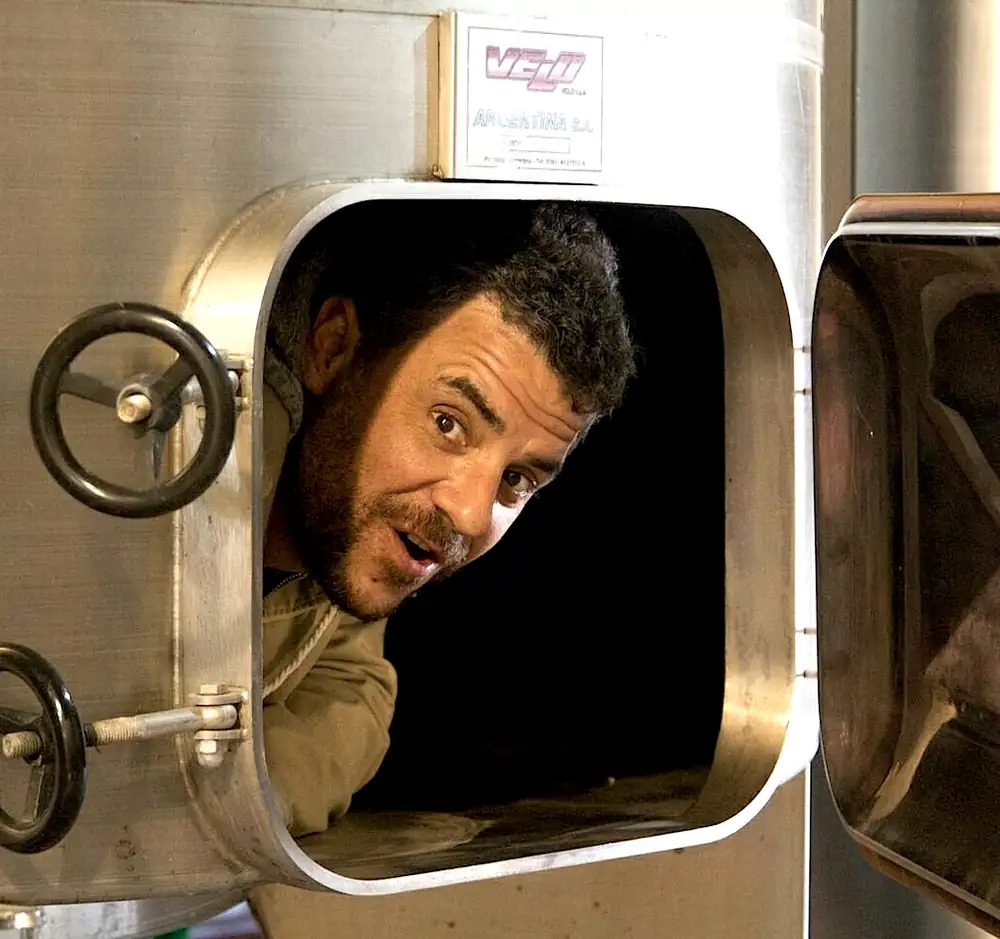
The speaker is Mauro Villarejo, owner of the winery and creator of the wines "Imagination to Power," taking one of the most powerful slogans of the French May. His project, born after the crisis that shook Argentina in 2001, transformed the Buenos Aires political scientist and urban anthropologist into a Mendoza winemaker. Gathering what he could salvage from the harsh end of convertibility, he established a ten-hectare estate in Agrelo, Luján de Cuyo, with a winery built a few years later, which now boasts over twenty years of history. His vision of terroir is deeply rooted in the people who work on his project.
“I chose Mendoza basically because it’s the province I’ve loved since I was a child; my father is from there, and my mother was born in San Juan. Today I work with Marcelo Richard, who is my cousin and the winemaker for the project. For me, wine is inseparable from the winemaker, and people are also inseparable from the terroir. You analyze the soils, classify them, the types of irrigation, the veracity of the vines, the pruning—everything is measurable and can be categorized scientifically. But wine depends largely on the people involved, because they will change the characteristics and taste of the wines. For example, if you add a pianist, a writer, a cook, or an anthropologist, you’re sure to get a completely different wine, because it will be made differently, and that affects the wine’s flavor. A few years ago, I started studying to become a sommelier—I think I’m the first winemaker to do so—and that changed my perspective a lot.”
A die-hard Independiente fan, inspired by the dialectic of political movements—on the football pitch, in the university hallways, at Cemento, at the Paracultural, in the library of the Colegio Nacional Buenos Aires—when he came to wine he already loved Althusser, Conan Doyle, and Foucault. There was no way his wines wouldn't have a touch of urban and cultural movement, nor would they fail to reflect his anthropological perspective, the same perspective that would ultimately influence how he viewed the ten hectares of vineyards and what to do with them year after year.
Initially, Mauro created more classic wines inspired by the Bordeaux style so popular in the Parker-influenced world. It's the Bo-Bo dialectic, combining the bohemian and the bourgeois, which for a long time perfectly encapsulated the tradition of concentrated wines from Luján de Cuyo. But over time, and thanks also to the innovative new trends that have swept through Argentina for the last five years, something began to stir, finally bursting in with the cry, "I need something different!" And so, in 2019, La Imaginación al poder (Imagination to Power) was born, a wine experience that breaks with everything he had been doing and proposes stepping outside the established structure that dictates how a vineyard should be viewed or how wine should be made.
Just as the Dogma movement in the nineties sought to return to the roots of cinema, the winery established new principles that broke free from inherited dogma in winemaking. Inspired by the world's first orange trees, forgotten grape varieties, and a completely different approach to grape selection, it all became the challenging task of reshaping possibilities. This included drinking young wine from an old vine, or attempting to create styles that didn't yet exist on the market. Imagination is the guiding force, because what can be imagined, can be built.
Few revolutionary movements have been as creative as May '68. Slogans were painted on the walls of the streets, in a time before Twitter and WhatsApp; it was a revolution written through slogans that captured the spirit of the era. The thought and imagination of the youth made it clear that all arbitrariness had its limit: the patience of the oppressed. The slogans breathed the freedom and romanticism of taking ownership of one's own kingdom, decorating it with one's desires and ideas. Now, what is the bridge that brings that revolution to our glasses? What is the invisible line that connects the French May with the wines of Imagination to Power?
“On one hand, I had the craft, the calculation, the science, the order, and on the other, chaos, the bohemian artistic spirit, art, music, prose. I began to understand wine as a reading. When I see the grape and when I confront it, I can't help but look at it through a conceptual lens. I wanted to drink wine the way I like it, straight from the tank, fresh and raw. Then I began to see the vineyard differently. I thought, why can't I harvest the grapes like a baby? I want midwives harvesting, goldsmiths, carpenters. What I call 'the wine gang' emerged, which is now an entity; it's all the friends, family, artists, loved ones, and close friends who come to harvest with us. We start early in the morning, in silence or with music, we chat, and there's hard work under the sun. When we finish, the food and the wine invite us to celebrate. All of that somehow finds its way into the wine.”
And he continues. “That’s how LIAP (an acronym for Imagination to Power) came about, with the possibility of mastering every detail of the harvest and the grape picking, but through the eyes and influence of friends, family, and loved ones. To be independent is to be free, to express one’s own common sense and create wines that are independent in their style, their flavor, and the concept behind them. I make one wine thinking of a beach, another of home and the fire, another of a long table with friends, another of a romantic dinner, or the one my children or my father like. And the micro-scale is fantastic because these are wines that won’t be repeated.”
The first conceptual breakthroughs were Noir de Blanc and Orange de Noir. The former, a red wine created with Chardonnay grapes infused with the skins of an 80-year-old Merlot vine, the jewel of the estate. The orange, made from red grapes, was the white-vinified pulp of that same Merlot, macerated with the Chardonnay skins. This experiment led to wines like Power Malbec and Power Merlot, high-end wines due to the exceptional quality of the grapes, but which don't adhere to the classic approach for these varietals. Neither is oaked; instead, they have a raw yet very drinkable style, a balance achieved through the harvest dates and the avoidance of over-extraction. Two homages to iconic films appeared with Naranjo Mecánico and V de Vonarda, because wine is about its flavor but also about its context, the way it is paired. And for Mauro, wine can be paired with art just as it is paired with a dish.
The Cabernet Sauvignons are vying for attention separately and sometimes in a blend in the bottle; he calls them Los CaBernícolas. But without a doubt, a turning point was the Les Criollites wine, made from grapes that were thrown away, that no one saw as desirable, and that thanks to the extremely small scale, were given a chance: a special micro-vinification, the search bunch by bunch, the destemming by hand, and the constant monitoring of a wine that wants to redefine a collective identity.
“I don’t like the word ‘criollas,’ but it was the term chosen for the discarded grapes. The wine is called Les Criollites, as if to indicate that ‘criolla’ isn’t a single variety, but rather a collective of native grapes, a gender-neutral group of white, red, and rosé varieties. I believe we achieved a high-flying wine that is the result of European-American fusion. With very varied harvest times, we sacrificed concentration and found delicacy. A low-alcohol, aromatic, and very drinkable wine.”
Thus, the urban anthropologist who before 2000 observed work crews and analyzed survey data now looks at the vineyard and harvests the finest Chardonnay four different times, leaving it to ferment on the lees—something that for many would be heresy, but which, when tasted under the name Chardo con Pólvora (Chardo with Gunpowder), makes perfect sense. In fact, the invitation is to drink it like a whisky, in a lowball glass with ice.
“Wine is an experience; what I pair it with is sometimes less important than who I'm drinking it with. For me, the pandemic was a turning point. I stopped thinking of pairing wine solely with food; people started drinking alone, and the company changed. What am I going to watch, what am I going to read, and what am I going to listen to? Wine left one realm and entered another; it became nomadic, existential, dialectical. Now, for example, we want to do an event at Al Fondo Bar where, together with bartender Santiago Migliano and sommelier Pablo Garriga, we co-created the Orange Royale, which is a cocktail with Orange de Noir, Scotch whisky, Angostura bitters, and lemon oil. Some people are amazed and love this madness, but personally, I really enjoy it when they don't understand it and I have the opportunity to explain the invention.”
How does the spirit of May in France translate into a bottle? Nobody knows. Perhaps wine is a vehicle for a message, but it's also a conceptual statement, given how it's made and the energy it carries within itself. “It's absurd; the smallest batch has 154 bottles and the largest 2,756, but at the same time, that's magical and romantic. And how does that mesh with the market?... I don't know, but we feel that anything is possible. We dream of things, like an epistemological anarchy, a utopia that we know is impossible but that we still like to dream about. If you ask me for an ideal, I believe there should be a wine for everyone, and if I think about the future, I'd like to involve more generations, so we can be nomads and replicate what we're doing in other countries,” the winemaker concludes.
Photographs provided by Mauro Villarejo.