Peace thrives in its cuisine
La Paz is the third vertex of the triangle formed by the great Andean cuisines: Ecuador, Peru and Bolivia.
I arrived in La Paz two days before General Zúñiga's failed coup and left a day and a half after the charade, once the confusion and the ensuing exodus had subsided. The uncertainty led to restaurant closures and the public scrambling for shelter, fuel, and food, just in case the self-proclaimed visionary wasn't alone. Beyond that, it was four days of rediscovering a cuisine that never ceases to amaze. Six or seven years had passed since my absence, and now I see a city in the midst of transformation, and a restaurant scene that continues to grow. Life in La Paz is shifting southward—at this altitude, 100 meters is enough to make a difference, and 400 meters, even more so—and the change is especially evident in Calacoto, now the capital's commercial and leisure center. Where once there were only Gustu and the Hotel Casa Grande, today a network of office towers, hotels, and restaurants surrounds and often occupies the area's old houses, clearly extending towards nearby Achumani.
La Paz is today the third vertex of the triangle formed by the three main Andean cuisines: Ecuador, Peru, and Bolivia. There are other countries influenced by the Andes, such as Chile, Argentina, and Colombia, but they also have their own distinct realities. I feel that La Paz's cuisine is the Andean cuisine that I've seen grow the fastest in the last decade.
The consequences of Gustu's creation and work were quickly apparent here. Starting with the markets, where the recovery and promotion of local produce is a reality that seemed far less likely just twelve years ago. Many things have happened since Gustu was founded, built on the determination, hard work, drive, and commitment of Danish chef Kamilla Seidler and Venezuelan chef Michelangelo Cestari, spurred on by the unwavering dedication of Claus Mayer, founder of the Melting Pot Foundation, whose core principle of local sourcing was a cornerstone of his philosophy. The restaurant was born with the mandate to use only one product grown, raised, or manufactured outside of the country's borders. It seemed an impossible undertaking, but this unwavering commitment marked the beginning of change.
Nothing would have been the same without that vision and the grit and strength displayed by Kamila and Michelangelo. We spent New Year's Eve together in Lima, visiting markets and restaurants, and I was with them at the restaurant's opening, still waiting for the kitchen equipment to clear the bureaucratic hurdles. I continued to visit whenever the opportunity arose, to watch a project stubbornly determined to fight against the current and the lack of resources grow. It was a time of open arms to foreign influences and a wary, reserved gaze toward what was our own; a stingy and biased attitude toward local produce prevailed. Twelve years have passed, and Gustu, supported by the social school that the restaurant fostered, was crucial in igniting the spark of change. How fortunate Bolivia was to have those two young professionals. I wish that similar initiatives had spread to every country in the region.
The focus shifted somewhat towards the pantry, but above all, the door to the kitchen was opened. The first generation of Gustu already had an impact on the then-precarious restaurant scene in the city. I remember from that time Propiedad Pública, by Gabriela Prudencio, in the San Miguel neighborhood, and Sebastián Quiroga and María Claudia Chura, still finalizing the Ali Pacha project, which they would open after I left. The former cooked Italian food with local products, and the latter was born with the intention of banishing animal products from his cuisine. It wasn't strange or bizarre; Andean cuisines, eminently agrarian and focused on subsistence, have always been unabashedly plant-based.
The saga hasn't stopped. On one hand, there's Manqa, the brand born out of the social schools that grew up around Gustu in El Alto, the district surrounding La Paz's airport. Manqa has two locations, one downtown and the other in Calacoto, within El Bosque, a space that houses more or less trendy restaurants and kitchens. At Manqa, they handle the kitchen aspects better than customer service (by the way, they don't clean a table with spray, even manually, when there are customers eating at the next one). Another Gustu graduate, Dennis Llusco, runs the kitchen at the two La Rufina locations, of which she is a partner, also downtown and in Calacoto. Since opening, she has focused her work on traditional cuisine: peanut soup, anticuchos (so different from the Peruvian ones), rellenos, mondongo, oxtail stew, chairo…
Dennis met Valentina Arteaga at Gustu, whom I later found as the owner and head chef of Phayawi, a dazzling two-story restaurant, also dedicated to Bolivian cuisine, in the Achumani area. The best part of this story is that its clientele is local: professionals, executives, and office workers from the area, or simply neighbors who come for the warmth of the fricassee, the peanut soup—with a touch of turmeric that, she tells me, comes from Tarija—the paila-cooked beef, or the "false rabbit" dish. The same is true of La Rufina in Calacoto: locals there and tourists in its downtown dining room.
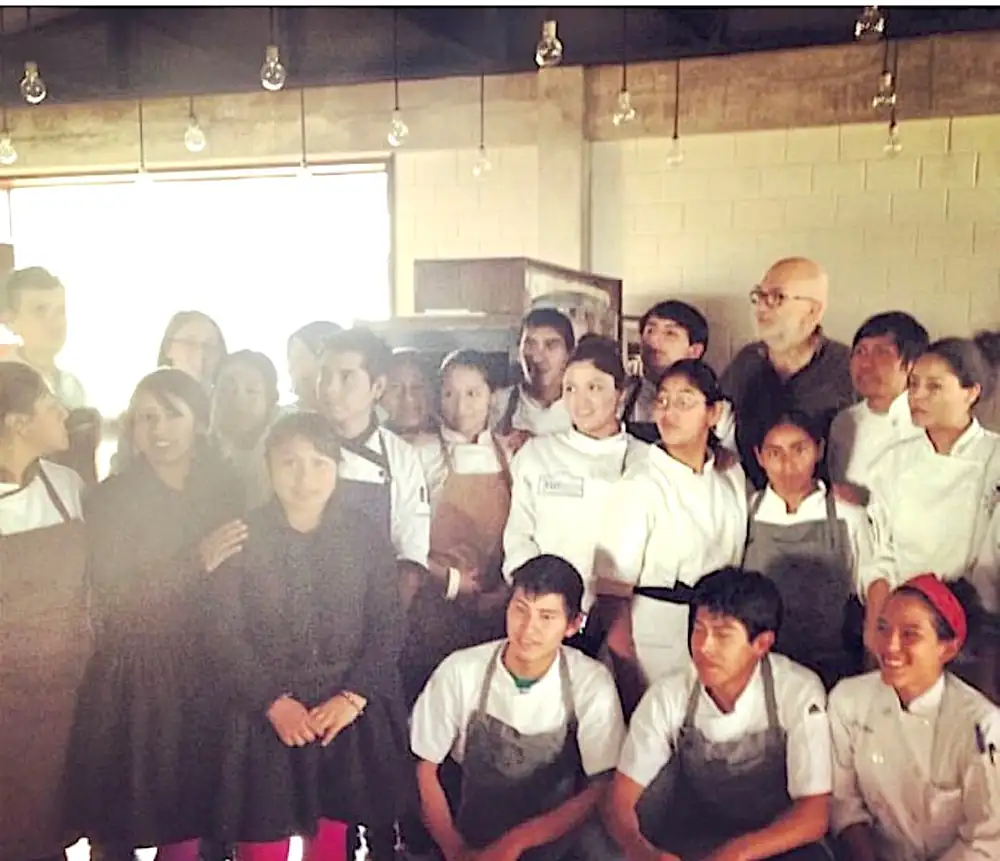
The encounter with Valentina offers a moving gift. Before leaving, she shows me a faded, poorly lit photo. It was taken in 2013 with the rudimentary camera of a cell phone from that era, and it shows me with a group of students from the Gustu school to whom I had just given a talk. Valentina, the first one standing on the left in the photo, tells me that during the talk I told them that when I returned ten years later, I hoped to see some of them running restaurants focused on Bolivian cuisine and ingredients, and others practicing different cuisines, but always with local products. It was eleven years instead of ten, but my love affair with local pantries and kitchens, which Gastón Acurio's drive transformed into a personal obsession—with him I understood the importance of the producer and the true role of the product; Pedro Miguel Schiaffino and Héctor Solís would later insist on the same path—came true. Valentina and Dennis own their own restaurants, as do Gabriela Prudencio, Sebastián Quiroga, and María Claudia Chura. Together, they help showcase Bolivian cuisine.
I don't know if Mauricio López, the creator of Ancestral, comes from the same school, but I couldn't ask him. I went the night of the attempted robbery and found it closed. I also didn't get to experience Marsia Taha's work at Gustu. I dropped by one evening when there were two customers at a table and another at the bar, but the head waitress told me they were full and couldn't serve me. The next morning they explained that they were catering an event at an embassy and had deployed so many staff that they were only serving tables with pre-booked reservations. The explanation, true or not, is simpler than denying the obvious. This restaurant school has gaps in its training.
There was more. The coffees from Origen Café Eco de las Aves—I liked their high-altitude honey coffee—the lavish investment (with good results) of El Cielo, the bar located on the 39th floor of the Green Tower, the singani and wines from Tarija, the Cinti Valley and Samaipata, which deserve more attention than they receive.