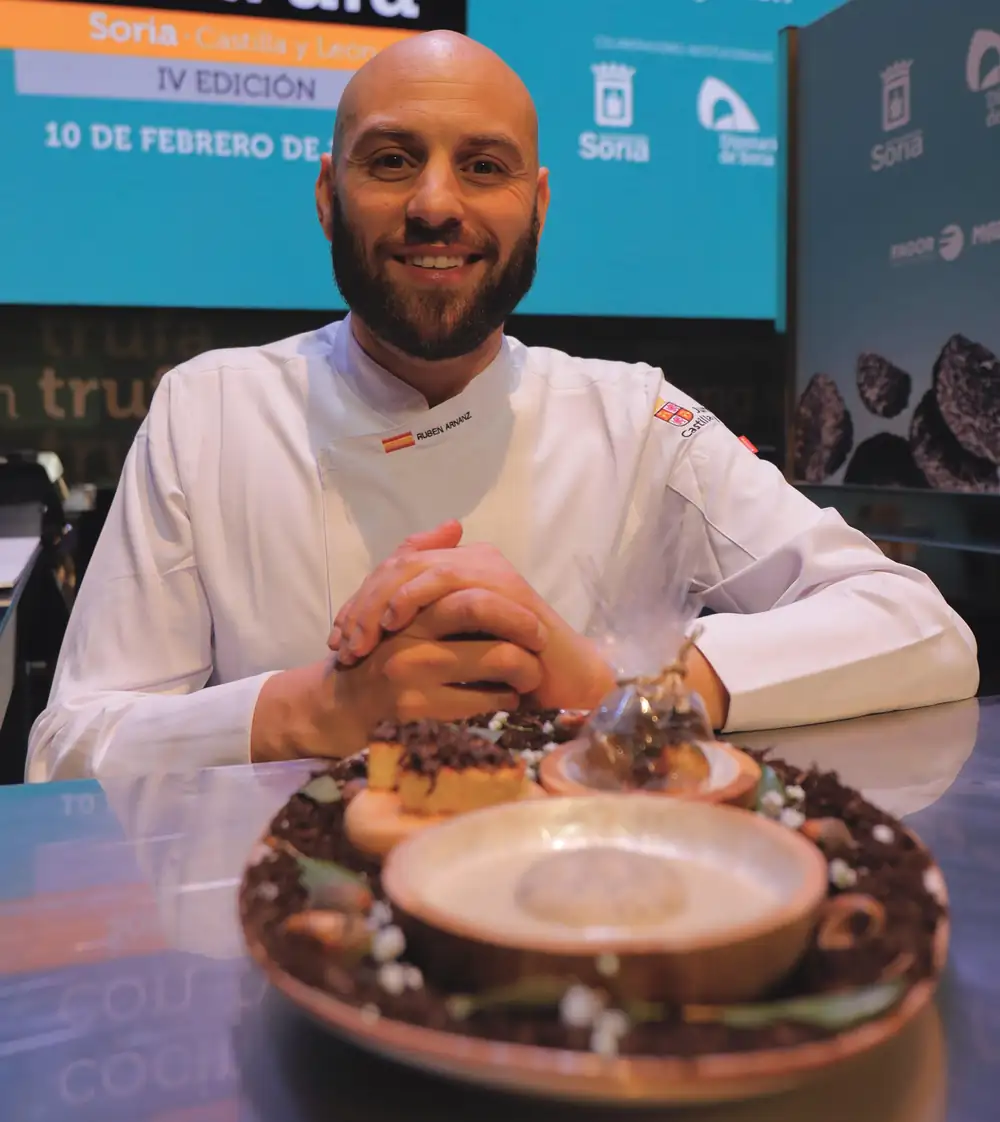
Rubén Arnanz, world king of truffles
An imposing aroma of black truffle (Tuber melanosporum) filled the Palace of the Audience of Soria, where a quality committee was preparing to prepare the 100-gram batches with which the eight teams would have to compete in the IV International Cooking with Truffle Competition, organized by the Junta de Castilla y León to promote its use within and outside our borders.
Once the prize packages were drawn, the two cooking shifts were organized for the teams from Bulgaria, Argentina, Italy, Mexico, New Zealand, Thailand, South Africa, and Spain. Their mission was to present the jury, presided over by Alberto Chicote (Omeraki, Madrid) and composed, among others, of chef Alberto Molinero (Erre de Roca*, Miranda de Ebro), with a dish featuring truffles as the main ingredient.
Also part of the panel were Reyes López, head of external relations for the Gourmets Group and director of Club de Gourmets magazine; Ángel Parada, vice president of the Royal Academy of Gastronomy; and Javier Pérez Andrés, a journalist specializing in wine, agri-food, and tourism, as well as myself, the director of 7Caníbales. There was also a well-informed public jury, knowledgeable about the most prized culinary treasure of their region.
It wasn't enough to simply grate or slice the mushroom onto the dish, a mistake some contestants made; they had to integrate it, a difficult task because its aromas—its main quality—disappear above 70 degrees Celsius. The three who reached the podium—Rubén Arnanz (Spain), Fernando Paquini (Mexico), and Zennon Christian (New Zealand)—understood this concept well.
Chicote, accustomed to judging in numerous competitions, highlighted that it was the first time he had seen the professional jury's and the popular jury's verdict coincide in the top three finishers.
The winner, who was crowned World Truffle Champion and received a €4,000 prize, received a double endorsement for his dish "A Stroll Through the Forests of Soria," a tribute from the Segovian chef to this region. The dish featured a pig's snout royal (the first animals used in the search for truffles), acorns, and black truffle, accompanied by a brioche made with Soria butter and truffle. He explained his creation on a card made from waste found in the mountains.
A dish that its creator described as "elegant and sophisticated," presented on a bed of soil and dried leaves. With the card made from recycled materials, he also wanted to raise awareness about the risks our forests face due to human activity.
Rubén Arnanz told me that what attracts him most to Tuber melanosporum is its versatility, and he insists that it "shouldn't be relegated to a topping or used as an accessory" because "it can be the star." He acknowledges that there is "a significant prejudice regarding its cost" (reaching a thousand euros per kilo this season), but points out that, as with saffron, the small amount required for a dish doesn't significantly increase its price.
The judges also liked the presentation and flavor of Mexican Fernando Paquini, who took home the 2,000 euros second prize with his truffled corn sponge covered with carrot and beetroot jelly sheet and truffle foam.
Third place went to a combination of truffle, hazelnuts, wheat and salsify from New Zealander Zennon Christian, which earned him one thousand euros.
Among the attractions of this competition, whose objective is for participants to become ambassadors for the Soria black truffle in Spain and abroad, is the opportunity to discover how this fungus functions in other cuisines where it is not commonly found, such as Mexican—where it is scarce and of inferior quality, according to Paquini—or Thai, which is abundant in other flavors and favors spiciness. The contestants demonstrated that it is possible to incorporate it into their culinary repertoire, although it requires skillful preparation. This competition, along with the days the chefs spend in Soria beforehand, contributes to this mission and, consequently, to increased exports.
All participants were sponsored by restaurants in Soria (La Galiana, Trashumante, La Chistera, El Baluarte, Parador de Soria, Santo Domingo, Casa Arévalo and La Cepa), where they were able to practice their dishes and whose kitchen teams assisted them with both staff and raw materials during the competition day.
During these days, the people of Soria, immersed in an intense and colorful Carnival as well as in the black truffle season, were able to taste these eight proposals in the aforementioned establishments.
There was also an educational truffle tasting and a truffle market, but, in the middle of the season for this culinary and economic jewel for Castilla y León - where there are 2,000 hectares dedicated to its cultivation and an average of five tons are produced per year, according to the Junta's data - the activities multiply.
Authorities and individuals are increasingly aware of the importance of mushroom tourism and mycological gastronomy, with outstanding restaurants in the field such as La Lobita* (Navaleno) or Baluarte* (Soria).
While this competition is one of the central events in the province of Soria during the winter truffle season—in fact, it has become an annual event instead of a biennial one—the 21st Abejar Truffle Fair, one of the oldest and most important in Spain in terms of national and international visitors and exhibitors, will be held on February 17th and 18th. The numbers speak for themselves: this village of 300 inhabitants welcomes up to 10,000 people during those days.
Another way to promote its knowledge and use is the creation of menus offered by 22 restaurants in the province until the end of the melanosporum season, at the end of March.
However, both in Soria and in the rest of the Autonomous Community they are aware of the threats - the growing expansion of the lower quality Chinese truffle, or synthetic oils, experts point out, among others - and they want to promote measures such as establishing a guarantee brand.
Also, advance research, dissemination to differentiate types (there are more than one hundred varieties of truffles), qualities and optimal conditions for consumption (differentiating a green one from a ripe one) and in the reproduction of mycorrhizal forests to increase and improve harvests.