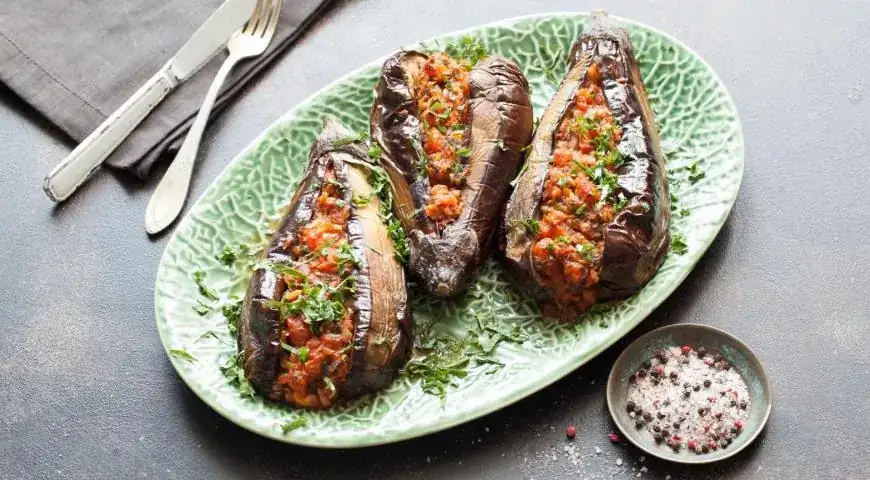
Imam Bayildi Eggplant
Imam bayildi, made with eggplant, is traditionally prepared in Turkish, Bulgarian, Armenian, Greek, and other Balkan cuisines. The name literally translates as "the imam fainted." The exact cause of his collapse varies widely.
- Eggplant
- Red onion
- Garlic
- Parsley
- Green sweet pepper
- Tomato
- Granulated sugar
- Cumin
- Tomato paste
- Olive oil
- Salt
- Ground black pepper
- Preheat oven to 220°C. Line a baking sheet with foil or parchment paper and brush with olive oil.
- Using a vegetable peeler, trim some of the eggplant skin to create wide strips. Score the eggplants lengthwise, but don't cut all the way through. Season the eggplants inside and out with salt, then place them in a colander and let them sit for 30 minutes.
- Place the eggplants on a baking sheet and bake for 20 minutes.
- Peel and finely chop the onion and garlic. Chop the parsley. Remove the seeds and membranes from the bell pepper and dice. Cut the tomatoes crosswise and place in a bowl. Pour boiling water over them for 2 minutes, then rinse with cold water. Peel and finely chop the flesh.
- Heat 2 tablespoons of olive oil in a frying pan and sauté the onion until soft. Add the pepper and garlic and continue to sauté for another 7–10 minutes. Season with salt and pepper. Add the tomatoes and tomato paste, cumin, and parsley. Add sugar if needed. Simmer for 5 minutes and remove from heat.
- Reduce the oven temperature to 180°C. Place the eggplants in a baking dish and fill with the tomato mixture. Drizzle with olive oil, add 2 tablespoons of water to the dish, and bake for 40–45 minutes.
- By the end of cooking, the eggplants should be almost flat, and the liquid in the pan should have almost evaporated. Serve the eggplants warm or completely cooled.
Eggplants, or "blue ones" as they're called in the south, aren't just tasty, they're also a very healthy vegetable: they're rich in B vitamins, potassium, and zinc, and eggplant juice has antibacterial properties.
Baking eggplant with tomatoes and cheese in the oven using this recipe is incredibly easy, and the result is a healthy, mouth-watering, and delicious dish. And the aroma you'll smell in the kitchen as the vegetables roast in the pot is simply indescribable! You'll see: during this time, your loved ones will be asking more than once what you're cooking for dinner. Yes, we insist, this dish is perfect for an evening meal: it's easy to digest, yet leaves a pleasant feeling of satiety that will allow you to fall asleep quickly and rest peacefully until morning. Of course, eggplant with tomatoes and cheese can also be served as a side dish with meat, but its flavor is especially distinctive when eaten on its own.
Eggplant originates from India. It was brought to Europe by the Moors, who brought it to Andalusia in the Middle Ages. From the Mediterranean, eggplants, or blue ones as we call them, also made their way to Russia. From midsummer to early fall, be sure to enjoy and cook local eggplants!
Delicious Georgian eggplant can be served as a standalone dish or as a side dish to grilled meats (like shashlik). Essentially, it's a warm salad that combines hot and cold ingredients. The eggplants and tomatoes are fried separately, and a thick dressing (or marinade) is made from crushed peppers, garlic, and vinegar. The result is so delicious that even if you've previously been lukewarm about eggplant, you'll feel compelled to reconsider your culinary preferences.
Eggplant in tomato sauce pairs well with lamb, according to experts. And connoisseurs know it also goes well with beef and pork, and, frankly, eggplant in tomato sauce with garlic and herbs is delicious on its own, without the need for meat or fish. For some, it's a complete vegetarian dish; for others, it's a great appetizer that whets the appetite. No matter when you prepare this dish, it smells like summer, sets the mood, and is incredibly filling. Just looking at it, your hand automatically reaches for a soft lavash and a glass of chilled white wine.
Once you've tried imam bayildi, you won't just faint like that imam, you'll become a slave to this dish. That's what's believed. However, the story surrounding the imam is rather murky. There are several versions. Only one claims he fainted from the aroma and taste of this eggplant dish. Another version claims he was stunned by the price of the ingredients and the amount of oil used to prepare it. A third version claims the imam simply overate—but this also confirms the gastronomic value of this wonderful Eastern appetizer. In the traditional version, imam bayildi is made with eggplants stuffed with other vegetables—peppers, tomatoes, and onions. We present a signature version of imam bayildi from a renowned restaurateur. And the presentation is appropriately restaurant-quality. All the ingredients are individually fried in a generous amount of vegetable oil, preserving their appearance and combining into a harmonious composition. It's not only delicious, but also beautiful.