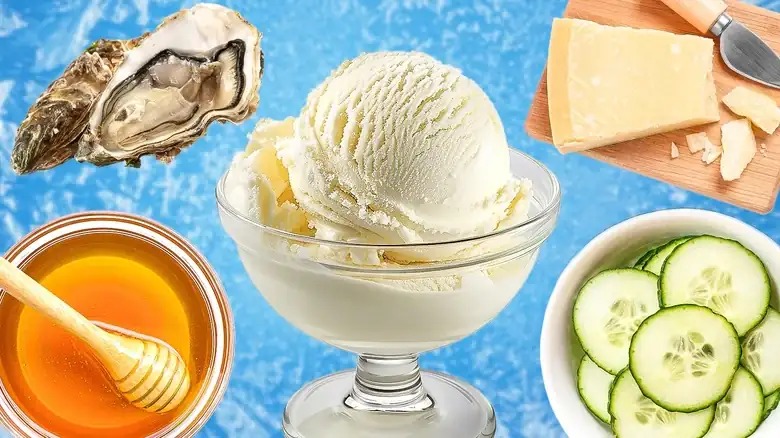
10 Once Popular Ice Cream Flavors You Never See Today
Ice cream is a beloved treat around the world, including in the U.S., which is second only to China in the ranking of the world's most ice cream consuming countries .
By the 18th century, wealthy people in Europe and North America were enjoying ice cream flavors that are still around today, like fruit flavors and that old classic standard, vanilla. But ice cream also had a wilder side. From the 17th-19th centuries, you could often just as easily get a scoop of vanilla as a vegetable or even sea-creature flavored one.
Some ice cream flavors have stood the test of time, while others have fallen into obscurity or been discontinued, which may soon be the fate of chocolate chip ice cream . Luckily, there's a trend of re-creating many bygone ice cream flavors, so you may still be able to try them, even if you can't buy them at your local grocery store. Some might pique your curiosity, but will any pique your appetite?
Parmesan ice cream
In countries like France, England, and the U.S., in the 1700's, popular ice cream flavors could be sweet or savory. One frequently mentioned 18th-century savory ice cream flavor you'll come across is parmesan cheese. The recipe can be found in the 1789 cookbook "The Complete Confectioner " by Frederick Nutt, as well as an earlier French recipe book, "Le Cannameliste Français," published in 1768. Parmesan ice cream may be unusual today, but its ingredients are still easy to find: eggs, heavy cream, simple syrup (cane sugar heated and dissolved in water), and of course parmesan cheese. The cheese should be freshly grated, since additives in store-bought grated parmesan cheese make it hard to melt. Parmesan ice cream may seem odd or unappealing, but a lot of adventurous modern-day cooks who've tried it say it's actually delicious! The taste is often described
Tutti frutti
"Tutti frutti" translates to "all fruits" in Italian. This phrase has many potential meanings, including a mix of candied fruits, but most of us probably associate it with an ice cream flavor, even if we've never tasted said flavor. Tutti frutti ice cream is a fruit-flavored ice cream spotted with colorful candied fruits, as well as nuts in some cases. The first known mention of tutti frutti ice cream is an English recipe from 1860, but its popularity peaked in the mid-20th century, when it was a favorite in ice cream parlors and in grocery stores' frozen food sections. Over time, though, the candied fruit treat lost its popularity and its spot on store shelves. You can still find tutti frutti in ice cream parlors and stores in certain Asian countries, including India. But for most of us, if you want to taste tutti frutti ice cream today, you'll probably have to m
Water buffalo milk and camphor ice cream
There are two sure things about the history of ice cream. First, no one really knows who invented ice cream. And second, Marco Polo didn't bring ice cream to Europe from China. But there's a grain of truth to the Marco Polo story: mixing ice and a dairy product was probably invented in China. Records show a special frozen treat made of ice mixed with flour, camphor, and water buffalo milk (some sources also add goat's milk) that dates to the Tang Dynasty (618-907 CE). Unlike most of the other flavors on our list, it's hard to imagine how this frozen treat tasted, especially since it seems like no modern food historian or intrepid food blogger has tried to recreate it. But there are ways to get some insights. Edible camphor is still common in Indian and Chinese cuisines today. The flavor has been described woodsy and sharp, similar to the taste of menthol. You can i
Cucumber ice cream
Another savory ice cream flavor, cucumber ice cream is usually associated with Agnes Marshall, a woman known as the "Queen of Ices". In 19th century England, Marshall rose to fame for her cooking school and cookbooks which featured a number of ice cream recipes. The treat was often still associated with the wealthy, but as the 19th century continued and technology advanced, it became more democratized. Marshall was a part of that — she also invented and sold ice cream-making supplies, including an early version of an ice cream maker. She sold molds that corresponded to different ice cream flavors as well, making the end result take the shape of the ingredient that flavored it — a very trendy way to serve ice cream in the 1800's.Although she didn't invent cucumber ice cream, Marshall certainly championed and popularized it, featuring numerous variants of the reci
Jell-o Pudding Pops
Forgotten ice cream flavors aren't just a thing of the distant past. Officially launched in 1981, Jell-o Pudding Pops quickly became a popular treat, and their commercials, featuring spokesman Bill Cosby, were just as iconic as the Pops themselves. You might think Jell-o Pudding Pops' sales suffered due to the horrible truths that came out about Cosby. But interestingly, the real reason Jell-o Pudding Pops were discontinued can be chalked up to infrastructure and a decline in quality. The creamy, delicious Pops always sold well, but the company found it hard to turn a profit on them because they cost so much to make. In 2004, the company turned over production to the experts at Popsicle, letting the company use the name, too. But those of us who were around during this time know that the new pops tasted like a watery imitation of the original. That's when sales plu
Honey and nectar shaved ice
Unlike the other ice creams on our list, honey and nectar drizzled over ice or snow doesn't include dairy. But it would be hard not to include this bygone frozen treat, since it was a favorite of the legendary Alexander the Great himself. The famous conqueror's beloved dessert may seem simple, but until the late 19th century CE, ice was often a hard ingredient to come by if you weren't in a place where it occurred naturally. This means that ice with nectar and honey was actually a luxury treat. In fact, Alexander wasn't the only person of wealth and power to enjoy this frozen delicacy. Ice with honey (but no nectar) was also something Emperor Nero and other wealthy and powerful Romans enjoyed centuries later. When it comes to frozen desserts, ice with honey has largely fallen by the wayside today, in favor of far more complex flavors. But this Ancient World delica
Ambergris ice cream
Although mentions of ice cream date back even earlier, the first printed ice cream recipe comes from 1665. Written by Anne Fanshawe, the wife of England's then-ambassador to Spain, the recipe calls for cream flavored with mace, orange water, or ambergris. The latter choice is especially unusual today. While ambergris was a popular way but pricey way to season different foods (including, apparently, desserts), it was also used in making things like perfume, which is still the case today. Ambergris is a pungent, musky substance that is a mixture of the indigestible remains of giant squid found in some sperm whales' stomachs, combined with the whale's excrement. When the solid mass exits the whale, it floats to the surface of the ocean and is brined in sea water and heated by the sun until it washes to shore or is found by someone. Ambergris is understandably p
Artichoke ice cream
The British Museum calls the 18th century "the heyday for ice cream", saying that there were more flavors on the menu in London at that time than there are in most ice cream parlors today. Artichoke was among them, but when you look at one of the most commonly cited artichoke ice cream recipes, it turns out that the vegetable alone wasn't the star of the show. In the 1768 cook book "Le Cannaméliste Français," author Joseph Gilliers also includes flavorful ingredients like pistachios and candied orange. This probably means the overall flavor wasn't only artichoke or even a blend of artichoke and cream. Today, you can't find it on grocery store shelves, but artichoke ice cream is pretty popular among artisanal ice cream makers and intrepid home chefs. Like their ancestral 18th century ancestral, modern artichoke ice creams also frequently feature other flavorful ingredie
The Choco Taco
Like tutti frutti, the Choco Taco is grim proof that a catchy rhyming name, unusual texture, and delicious taste do not guarantee ice cream immortality. First released on the market in 1984, this ice cream version of a taco (complete with a crunchy, ice cream cone-like "taco" shell partially covered in chocolate and nuts) quickly became a favorite and was one of the best things you could get from a store or an ice cream truck. But in 2022, fellow Choco Taco loving millennials were shocked when Klondike (owned by conglomerate Unilever) announced that it was discontinuing the treat. Like many food shortage or discontinuation explanations of the past few years, this one was a bit vague. The company claimed there was too much demand for its other products, so the Choco Taco had to go. Fans were heartbroken over the discontinued ice cream flavor. Reddit co-founder Al
Oyster ice cream
The marriage of seafood and ice cream seems like a weird one to most of us today. But in the 1800's, when oysters were an extremely popular dish in America and England, and ice cream was becoming accessible to the masses, maybe it was just a logical endgame. If you look up "oyster ice cream", you'll often come across articles claiming it was a favorite of George Washington as well as James and Dolly Madison; that it was served at the White House, and even at the first Thanksgiving. You'll read that it was Mark Twain's favorite ice cream flavor and that he even included a mention of it in Tom Sawyer. These claims have inspired many modern-day chefs to try to re-create the recipe. But in a 2016 Vice article, journalist Alex Swerdloff investigated and couldn't find any truth to them. The only confirmed historical mention of oyster ice cream is in one of the f