
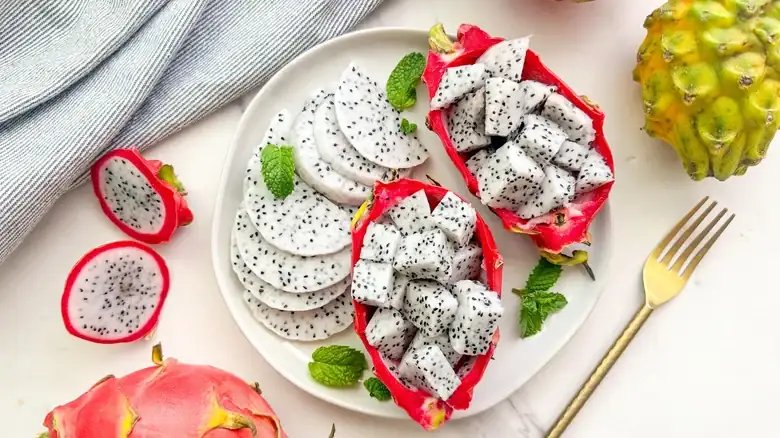
Cómo cortar y preparar mejor una fruta del dragón
La Madre Naturaleza acertó de lleno al crear la pitahaya. Su impresionante exterior rosa o amarillo y su interior moteado en blanco y negro convierte a esta fruta única en una verdadera joya.
Dragon fruit, also known as pitaya or strawberry pear, grows on certain cacti in tropical regions such as Southeast Asia, Central and South America, the Caribbean, and some warm areas of the United States. Because it thrives in warm climates, dragon fruit's peak season is summer and early fall.
If you've never seen this beautiful fruit, now's the time. You'll usually find it next to yellow starfruit, purple or yellow passionfruit, red rambutan, or jackfruit in a less visible section of the supermarket. You can also buy it frozen or in powder form, which makes it easy to add to smoothies and take advantage of its many health benefits.
There are three main varieties of dragon fruit. The most common type, Hylocereus undatus, is pink on the outside, with white flesh and small black seeds inside. The second type, Hylocereus costaricensis, is very similar on the outside, but its flesh is dark pink with black seeds. Finally, there is the yellow pitaya, Hylocereus megalanthus. It is usually smaller, has white flesh, and slightly larger black seeds.
When choosing a pitaya, the first thing to look for is one with a uniformly colored peel, pink, yellow, or deep red. The peel should be free of blemishes, imperfections, or wrinkles. When squeezed, it should give slightly, like a melon or an avocado.
Luckily, you don't need any special tools to cut a dragon fruit. You'll just need a bowl to wash it in, a teaspoon of salt, a cutting board, a sharp chef's knife or serrated knife, and a large spoon to scoop out the pulp.
Dragon fruit is incredibly versatile and can be a great addition to many types of snacks and meals. Smoothies are a common way to incorporate this prized fruit. Simply blend it with a frozen banana, berries, water or coconut milk, and a handful of greens for a delicious and hydrating drink.
Add diced dragon fruit to fruit salads along with mangoes, berries, and pineapple for a refreshing side dish or dessert. Make a creative salsa with diced tomatoes, jalapeño, cilantro, and red onion. It can be used to make sauces to drizzle over desserts or grilled meats.