Qué diferencia al flan de la crème brûlée
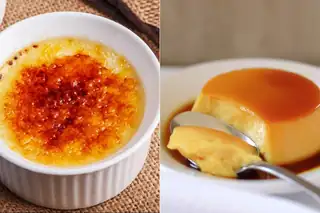
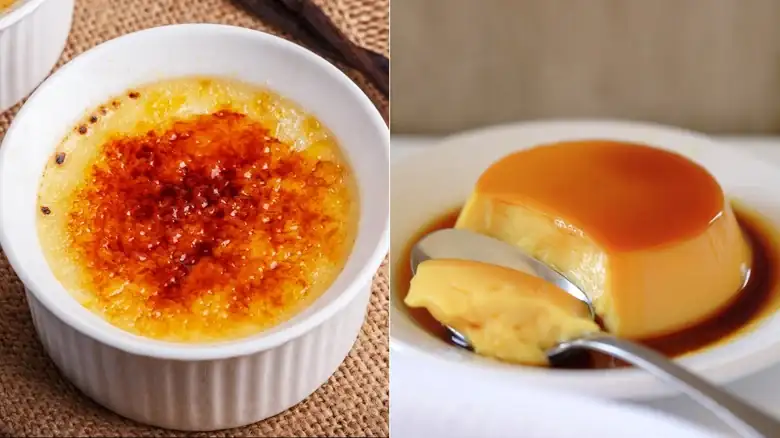
Ambas son natillas sofisticadas, pero el flan lleva claras y caramelo líquido, mientras que la crème brûlée suele hacerse solo con yemas y tiene costra de azúcar.
The presentation is the most striking difference: crème brûlée has a crisp, caramelized sugar crust, while flan is bathed in a delicate caramel sauce. Crème brûlée is creamier and less firm, while flan, made with egg whites and sometimes gelatin, is firmer and wobbly. Both are cooked in a bain-marie.
Flan takes longer to prepare because it requires a caramel coating and a long cooling period before serving. Crème brûlée, on the other hand, only needs to cool for about 30 minutes before the sugar is added and caramelized. Furthermore, it's served in the same dish it's baked in, while flan is turned out onto a plate so the caramel coats it.
The origins of crème brûlée are disputed: England, Spain, and France all claim it as their own. The first mention appears in "Le Cuisinier Royal et Bourgeois," a French cookbook by François Massialot, when the dessert didn't yet have its caramelized sugar crust. Trinity College, Cambridge, claims the dessert originated there, and Catalans maintain that crema catalana, flavored with cinnamon and citrus and topped with caramelized sugar, is the original version. Whatever the truth may be, crème brûlée crossed the Atlantic, and it's said that Thomas Jefferson enjoyed it at the White House during his presidency.
Flan has a much older lineage. The Romans mixed cream and eggs to prepare tyropatinam, sweetened with honey. They also made a savory version, such as eel flan, which was served as a main course. After the fall of the Roman Empire, recipes for a flat cake called flado, with a caramel topping, circulated throughout medieval Europe, and from there it reached the Americas thanks to its popularity in Spain. In Latin America, vanilla was added, and today it's difficult to find a Mexican restaurant in the United States without flan.
The biggest difference lies in the variety. Crème brûlée is most commonly vanilla-flavored, though some variations use a different topping instead of cream. Flan, on the other hand, comes in flavors like orange, chocolate, coffee, coconut, strawberry, and even pumpkin, and is served with melted caramel or dulce de leche. Crème brûlée remains a sophisticated dessert, and nothing beats the taste of freshly caramelized sugar.