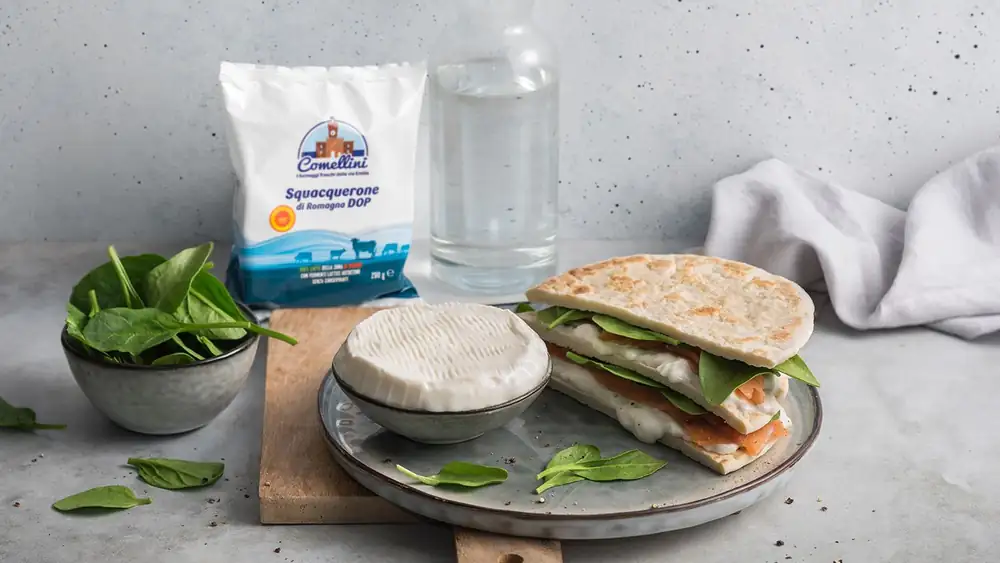
A taste of vacation with Squacquerone di Romagna PDO
Squacquerone di Romagna DOP stands for fine gastronomic traditions, passion for the land, craftsmanship, authenticity, and good living.
That's why, in order to be labeled Squacquerone di Romagna DOP, this fresh cheese with a delicate sweet-tart flavor and a squacquerone-like texture must have been produced in Emilia Romagna, specifically in the provinces of Ravenna, Forlì-Cesena, Rimini, Bologna, and part of the province of Ferrara. Producers in these areas are proud of their specialty and are committed to achieving the best possible results while preserving the most genuine and authentic traditions. This is why they must adhere to strict Production Regulations that require the use of whole cow's milk collected within the relevant geographical area and milked only from specific certified cattle breeds, fed primarily on fodder from the same area. And when this milk is combined with native lactic ferments, rennet, and salt, it turns into a very fresh cow's milk cheese, and that's how it should be eaten: a beautiful pearly white, a milky aroma with a herbaceous note, and a creamy, soft consistency—not consistency—that melts on the plate and squats (that's why it's called that!).
Squacquerone di Romagna DOP from Castel San Pietro Terme
One of the most delicious "squaquaron"—in the Romagna dialect—is produced by the Comellini family, who began making their own fresh cheese over fifty years ago, taking over an old dairy in this area that has been a symbol of well-being and good living. In Castel San Pietro Terme, in the province of Bologna, the ancient sulfur spring has been known to have beneficial effects on both people and livestock since the Middle Ages. It was here, with this positive energy, that the Comellinis wanted to set out. So much so that today the town, dubbed the "slow city," is even a symbol of a slow lifestyle, of traditions worth preserving, of beautiful landscapes to lose oneself in, and of authentic products to discover—and rediscover.
Over the years, that small dairy has become a modern cheese factory with cutting-edge technology, but the family care and craftsmanship remain unchanged. This is why Comellini Squacquerone di Romagna PDO is so delicious, earning the first Alma Caseus prize for best cow's milk cheese in the Gran Mercato category. In 2019, it was awarded the Dino Villani prize for "Excellent Artisan Product" by the Italian Academy of Cuisine.
That taste of fresh grass
This delicious cheese originates in the fields and is deeply rooted in the land and its farming: where the cows feed primarily on alfalfa, rich in protein and flavor, the milk is also nutritious and has an unmistakable aroma and a distinct herbaceous note. And with approximately 30,000 kilograms of this freshly milked milk, entirely Italian and mostly sourced from eight select farms just a few kilometers from the company, a controlled supply chain, rigorous procedures, and constant checks, Comellini prepares its fresh products from the Via Emilia every day.
In addition to Squacquerone di Romagna DOP, it goes without saying, there's also Casatella, a homemade cheese (hence its name) with a creamy texture and a sweet, light flavor, excellent with honey and jams; Stracchino degli Angeli, delicate and firm, good in risotto and on warm bread, originally made with the milk of cows returning from summer pastures when they were tired after the walk, stracche in dialect—that's why it's called that; Castel San Pietro cheese, made only there, a small caciotta with a soft center and a buttery aroma; and also ricotta and milk mousse.
And then there's the entire Lactose-Free line, which also includes Squacquerone, with its delicate flavor, more digestible, and ideal for those with lactose intolerances. This range is made with vegetable rennet obtained from wild cardoon, a vegetable similar to the artichoke, and is therefore also suitable for vegetarians!
The kiss with piadina (and more)
Squacquerone di Romagna PDO has a sweet, slightly tart flavor with herbaceous notes that pair perfectly with piadina, tigelle, gnocco fritto, and crescentine, as well as bread, vegetables, honey, mustard, and fillings. Squacquerone is rich in live lactic acid bacteria, which give it its characteristic, creamy consistency. If it feels firmer when opened, it's because it still needs to mature for a few more days. Store it in a sealed container and enjoy after a couple of days.
Have you ever experienced it like this?
Spread on a warm piadina with rocket and raw ham (a true classic of local piadina shops!)
In the omelette with spinach (a spoonful is enough)
In piadina with gratinated vegetables or with walnuts and rocket.
In erbazzone or in savory vegetable pie
In the piadina with caramelized figs and a drop of balsamic vinegar.
In a sandwich with prawns and almonds or with slices of smoked salmon.
Squacquerone di Romagna DOP: it is said of it that…
Widely present in regional cookbooks, in the treatises of writers and gastronomes, from Massimo Alberini to Fernanda Gosetti, from Icilio Missiroli to Alfredo Panzini, Squacquerone di Romagna PDO is said to have “an uncontrollable consistency,” “tends to lose its shape on the plate,” “soft, creamy, delicate, sweet, very fresh, squacquerato,” “a caress for the palate,” “a kind of soft cheese that farmers in Romagna make in the winter,” and then an evocation of its marriage with piadina: “what a delight to divide the beautiful piada into its squares, split them in half and spread each part with that lovely soft cheese that in Romagna is called squaquaron.” He continues, “the reassembled square is briefly exposed to the heat of the embers and then greedily bitten into: the good cheese has almost completely melted, forms strings and comes out from every side, filling the mouth with a buttery flavor, mixed with the good taste of the piada.”
But Cardinal Carlo Bellisomi, Bishop of Cesena, was already fond of this fresh and “delicious” cheese, and in February 1800 he wrote a letter (most likely the first historical testimony on the name of this dairy product) in which he requested news as soon as possible of the squacqueroni cheeses, which had not yet reached his table!
The recipe for the “exotic” erbazzone
It's a savory pie typical of Emilia Romagna, also called "scarpazzone," and is traditionally made with two discs of shortcrust pastry and a filling of chard, pancetta, and Parmesan cheese. Our version is more summery and spicy, with Squacquerone di Romagna DOP, curry, and ginger.
Ingredients for 8 portions 600 g chard 400 g flour 300 g Squacquerone di Romagna Dop 1 egg yolk curry and ginger powder extra virgin olive oil – salt – pepper.
Method: Mix the flour with 30 g of oil, about 200 g of warm water, and a pinch of salt; let the dough rest, covered, for 30 minutes.
Clean the chard and sauté it in a pan with a drizzle of oil, salt, pepper and a pinch of curry and ginger for about 15 minutes, until all the water released has dried up.
Divide the dough into two pieces and roll out one half to a thickness of about 2-3 mm, creating a disc. Place it in a 30 cm diameter cake pan lined with baking paper and fill with the squacquerone cheese, either spread or distribute it in small heaps. Top with the stewed and well-drained chard and a pinch of curry and ginger, if desired.
Roll out the remaining pastry to 2-3 mm thick, prick it with a fork and place it on top of the filling, folding the edges over to seal. Brush it with the egg yolk beaten with a drop of water and bake at 200°C for 25-30 minutes.
Remove from the oven and serve warm.