La historia de los Alpes
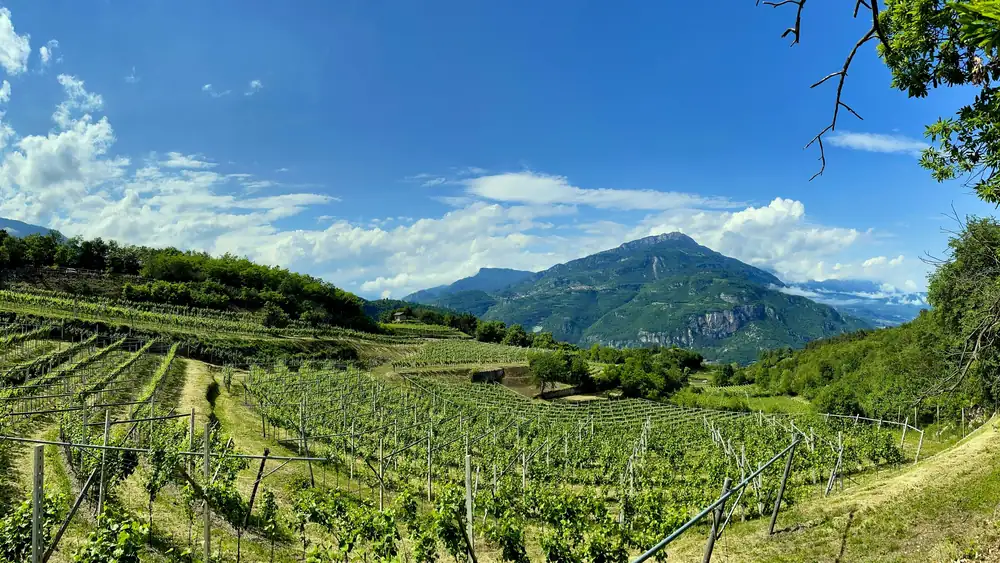
La Vallagarina, donde todo comenzó, el Valle del Adige, la Grave Friulana, la Marca Trevigiana y la Valpolicella Classica. La bodega de Albino Armani abarca toda la región del Triveneto, cultivando aproximadamente 370 hectáreas de viñedos que tienen mucho en común, empezando por la presencia de las montañas.
The Vallagarina, where it all began, the Adige Valley, the Grave Friulana, the Marca Trevigiana, and the Valpolicella Classica. Albino Armani's winery spans the entire Triveneto region, cultivating approximately 370 hectares of vineyards that have much in common, starting with the presence of the mountains. The story begins in 1607, when Domenico Armani signed a document, still preserved in the Historical Archives of Trento, in which his father Simone handed him the land with "trees and vines." Over four centuries later, Albino Armani received the estate from his father Antonio and, in the late 1980s, revolutionized its structure, beginning to bottle the excellent native wines of the Adige Valley. He was driven by the desire to restore identity and dignity to this transit region, where grapes have always been grown, but were used to strengthen the wines of nearby, more commercially known areas, and where the typical grape varieties had been replaced by easier and more profitable international varieties.
Today, Albino Armani manages to combine significant production with respect for the mountain farming culture, built on resilience and people who approach their work with dedication and ethics, beyond passing fads. How does he do it? He answers: "I'm from this valley. Like a stone, like a plant, I'm tied to this land. I don't know anywhere else except to return, it's natural. Here, from the silence of small things, we learn to stay in our place, to do what we must do. The time of the vine and wine is a time extended, sometimes by years, by generations."
And speaking of generations, since the beginning of 2020, Albino's son, Federico, has joined him at the helm of the company, always with the invaluable support of his mother Egle, the final piece of a family driven every day by the desire to reflect their production choices in the glass, founded on centuries-old traditions, consistency, method, and great respect for the Alpine territory and its ancient native varieties.
What's new at Vinitaly
Today, high-altitude vineyards are increasingly sought after by producers to escape the effects of global warming, but Albino has been cultivating them for decades; what drove him to this choice? "The mountains give him the opportunity to make wines the way we like them," answers Federico. "Even though he produces over 30 labels of all types, my father is a white winemaker at heart and has always sought out terroirs that can give him significant acidity and verticality, even when making red wines, as is the case with Valpolicella." This concept is well expressed by one of the new wines presented at the latest Vinitaly, the Trento DOC Clé Riserva 2016 Dosaggio Zero, aged for 60 months on the lees and produced in just 1,000 bottles. "For a few years, Federico, our winemaker Marco Campostrini, and I have been preserving bottles of Clé from previous vintages to understand their evolution," explains Albino Armani. "Tasting the 2014 and 2015 vintages, it was clear how the long maturation significantly enhanced Clé's already established quality." Clé's Chardonnay and Pinot Noir grapes, in equal proportions, grow on the Brentonico Plateau and the valley slopes, at altitudes approaching 600 meters above sea level, on lean, basaltic soils rich in gravel. These provide the perfect conditions for creating a sparkling wine with great personality, with crisp acidity and crisp aromas; the choice of zero dosage further enhances its authentic expression of the terroir.
The vines speak
Alongside the production of sparkling wines from renowned areas like Trento and the Marca Trevigiana, we also produce Friuli Ribolla Gialla Brut Millesimato from Lestans in the Grave Friulana area. "This is another way to showcase the region," explains Federico. "The seven hectares of vineyards in the Grave area, on the banks of streams where fragments of rock, torn from the mountainside and slowly transformed into the round, white stones (called claps in Friulian) that characterize the gravelly soils, are perfect for producing complex and elegant sparkling wines, because they give us a Ribolla that plays much more strongly on acidity. This is our most challenging project, because consumers are accustomed to a different type of Ribolla, but my father has never been influenced by trends or market demands." One of the company's strengths is letting the grape varieties speak for themselves and how they can change their expression depending on their terroir: "Just think that we make five different types of Pinot Grigio, each of which reflects a different place and a specific winemaking method," adds Federico.
The rarest native grape varieties are also featured, some of which have been saved by Albino Armani and bottled as a single varietal. "Over the past thirty years, in collaboration with leading research institutions such as the Fondazione Mach in San Michele all'Adige, my father has recovered and safeguarded local ancestral varieties, which until a few years ago were at risk of extinction," emphasizes Federico. The company has dedicated a vineyard in Dolcè to these grapes, the Conservatoria, which includes 13 native and endangered grape varieties from the Trentino and Veneto Vallagarina. Some of these have already been successfully recovered and returned to enthusiasts, such as Foja Tonda, the dialect name for the historic Casetta grape, native to the Adige Valley, anciently cultivated in the areas of Dolcè, Ala, and Avio. Abandoned over time in favor of more sought-after and productive varieties—the "international" ones, which gained increasing popularity in the 1960s and 1970s, leading to a significant transformation of the region—the grape variety was rediscovered and promoted by Albino Armani: since 2002, it has been reinstated among the varieties permitted for cultivation, and since 2007, it has had its own DOC, Terra dei Forti. Another grape variety rescued from oblivion is Nera dei Baisi, now bottled as a single varietal by Albino Armani: another voice that speaks of a fascinating territory, just waiting to be rediscovered.