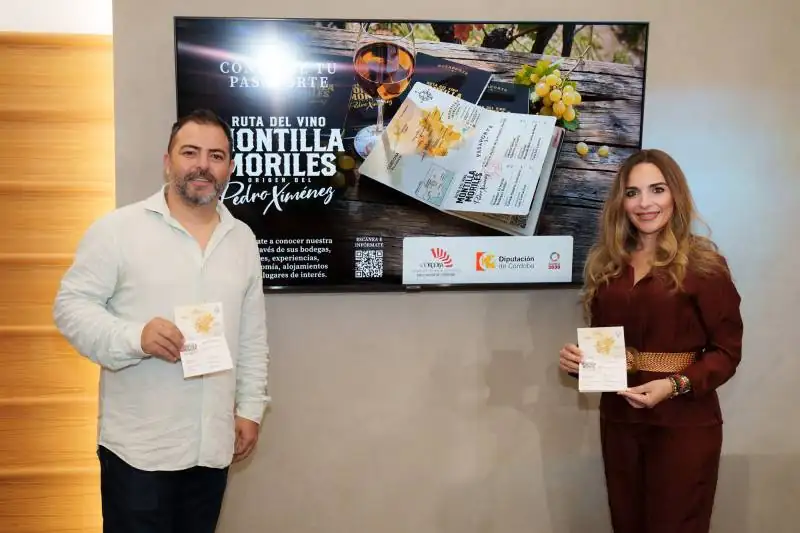
The Montilla-Moriles Wine Route launches a tourist passport to explore its territory
The initiative brings together 58 partners in five routes with stamps and prizes to distribute the visits across several municipalities.
Tuesday, September 15, 2026
The Montilla-Moriles Wine Route has launched a Tourist Passport to encourage visitors and residents to explore the region through its wineries, wine presses, restaurants, taverns, accommodations, cultural attractions, and other wine-related experiences. The initiative, promoted by the Association for the Promotion of Wine Tourism (AVINTUR) in collaboration with the Provincial Council of Córdoba through the Provincial Tourism Board, brings together the route's 58 public and private partners in five different itineraries and will remain active until December 31, 2027.
The project has resulted in 2,500 passports, divided into five different versions, with 500 of each. Visitors can pick one up at any of the participating establishments and complete the included visits at their own pace. Each stop is stamped, and once the route is finished, visitors have the opportunity to win prizes related to the journey.
The competition has two levels. Completing one of the five passports allows participants to win a first prize from the Montilla-Moriles Wine Route. Those who manage to complete all five will also be eligible for an additional prize that includes wines and other products from the region. Each passport includes a QR code that provides access to a digital platform where participants can find information about the initiative, participating establishments, prizes, and the official rules.
The distribution of the 58 members across the five passports, according to the organizers, is based on a strategy designed to mix different types of establishments, experiences, and municipalities. The aim is to encourage visitors to explore various locations within the Montilla-Moriles region, rather than concentrating their time in a single spot. This way, a single itinerary can include wineries and wine presses alongside restaurants, taverns, accommodations, museums, tourist offices, scenic landscapes, and other attractions linked to the area.
Rafa Cabello, manager of the Montilla-Moriles Wine Route, states that the idea is not to offer just another promotional tool, but rather a useful resource for getting to know the destination as a whole. “We didn't want it to be just another brochure, but a living document,” he points out. Cabello adds that the distribution of members among the five passports has been designed so that each itinerary includes different towns and attractions, and so that those who complete the routes get to know the members of the route firsthand.
The initiative also aims to ensure that the first visit isn't the last. Cabello maintains that the passport is designed to provide reasons to return and continue collecting stamps over time. This same idea extends to local visitors. "Often, the region is very close by, yet we don't fully explore it," says the manager, who summarizes the project's philosophy with another phrase: "The greatest reward of this passport is getting to know the region."
From the Provincial Council of Córdoba, the Delegate for Tourism and Vice President of the Provincial Tourism Board, Narci Ruiz, points out that the format allows each visitor to create their own itinerary while exploring wineries, wine presses, restaurants, accommodations, and other attractions. Ruiz adds that the initiative helps to distribute the tourism and economic impact among different municipalities and businesses in the area. She also emphasizes that it is not only aimed at those arriving from outside the province, but also at the residents of Córdoba themselves, whom she encourages to discover nearby attractions.
The vice president of the Montilla-Moriles Wine Route and mayor of Moriles, Paqui Alcántara, frames the Tourist Passport within the collaborative work of the municipalities that are part of the project. Alcántara affirms that for these municipalities, the continued commitment to the route and to new ways of connecting the region with visitors is a priority. In her opinion, the new passport reinforces this line of work and offers an additional reason to maintain institutional involvement.
Representatives from private establishments participating in the route also took part in the presentation, including Antonio López of Bodegas del Monte and Rafael Gavilán of Taberna La Montillana. López argued that these kinds of initiatives can help bring wine culture to new audiences from a broader perspective. “We also need to change our perspective on wine consumption and show everything that goes into a bottle: the landscape, the production process, the economic impact it has, and the value of its origin,” he stated.
The representative from Bodegas del Monte adds that this approach to wine can help younger audiences discover and appreciate contemporary wines and, from there, understand the oenological heritage represented by wines that are twenty, thirty, or even one hundred years old. With this combination of visits, stamps, and awards, the Montilla-Moriles Wine Route aims to transform each trip into a gateway to a broader offering that unites wine, gastronomy, heritage, and landscapes in various municipalities throughout the region.