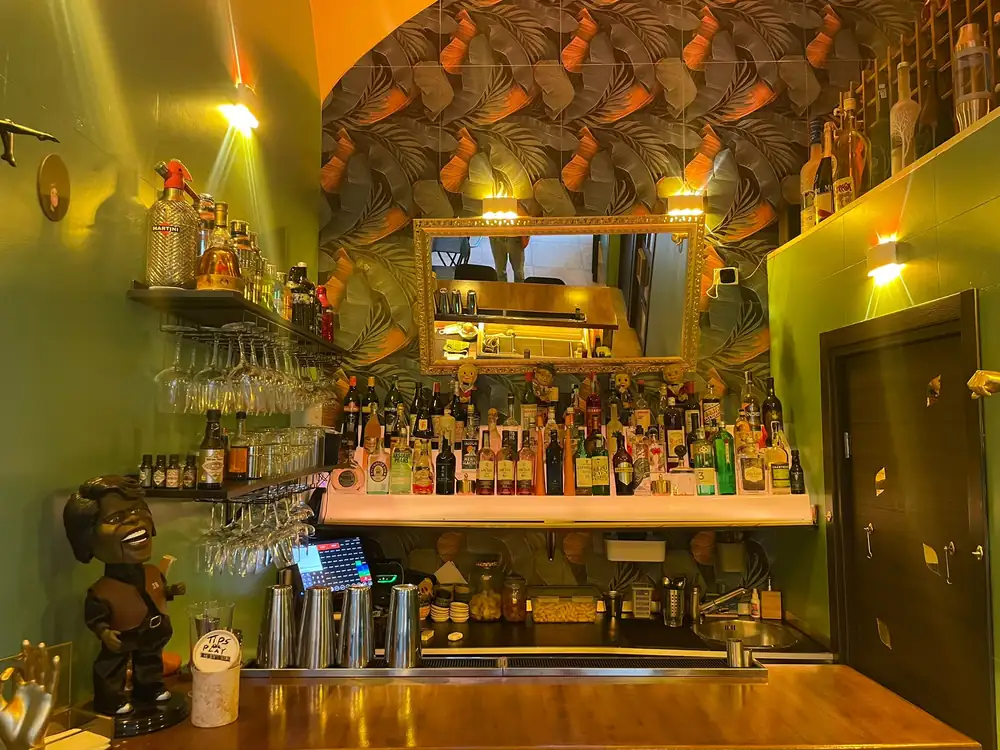
In Naples, an 18-square-meter bar built around the Martini
Every bartender has an obsession, and let's face it, it's probably that very obsession that makes them a bartender—a fixed, almost obsessive thought that only finds peace when perfection is achieved.
So much so that, when he decided to open his own bar less than three months ago, the initial plan was to call it the Silver Bullet, as the Martini cocktail was known in the 1970s and '80s, and transform it into a niche venue for enthusiasts and connoisseurs of this great classic. "The initial idea was to create a bar dedicated exclusively to Martinis. Then, knowing the market and especially the area, right in the center of Naples, I said to myself: 'Alberto, don't be so rigid.' Something like this requires a lot of strength, so I decided to expand the offerings, and, after 27 years, I also wanted to break away a bit from my past and put my name on it. It's something I really like about the American tradition of the 1960s and '70s, where bars and restaurants were named after their owners."
Alberto's Bar occupies approximately 18 square meters, a gem for connoisseurs, with a few seats outside. This small space was also chosen for the operation's economic sustainability, just steps from Via Toledo and Piazza Dante. "In recent years, my work had focused primarily on consulting, startups, and business start-ups, after many years in hospitality. At a certain point, however, a bartender felt the urge to own something of his own. A favorable circumstance arose: there was the opportunity to take over this space, which had the right size and conditions for what I had in mind. I invested my savings to build a space that today I manage practically 360 degrees."
A return to the bar, then, but also a shift in perspective for Alberto Ferraro, from consultant to entrepreneur, with all the responsibilities that entails: purchasing, preparation, service, and management of the establishment. The small size has inevitably affected the project as well. There's no room for a proper laboratory, nor even for a vast bottle rack. "The selection is precise, built around what's actually needed. Some bottles, including French vermouths that are often difficult to find in Italy, are part of my private collection that I kept at home."
Even the ambiance follows a personal logic. The place was designed as a sort of room in my home—"it feels like my bedroom"—with objects collected over the years and during travels, and a painting of him at work, a gift from Sorrento painter Camilla Venanzio. The same approach is echoed in the drinks list. "My way of working definitely has a strong classical foundation. Everything comes from the classics and their twists. I also do small homemade creations, as I don't have space for a workshop. I work with sous vide, a roner, and very simple techniques. The focus is primarily on flavors; I'd like to have six signature dishes in total, with very distinct, recognizable, and, if possible, new flavors."
Among the cocktails already featured is Paradox, a sort of bestseller, a sour crafted from a combination of raspberry, salted caramel, and tomato water, shaken and served in a tumbler. "These are flavors that are already associated in the kitchen, but in the bar world they represent a less common combination." Then there's Mariachi Breakfast, born from a memory of London and his interpretation of Salvatore Calabrese's famous Breakfast Martini. Here, orange marmalade gives way to a homemade preparation of Calabrian chili peppers, accompanied by an exotic lychee liqueur, vodka citron, and lemon juice. "It's a sour, shaken and served straight up in a glass, with a play on sweetness, acidity, and spiciness." The third signature drink is a gimlet with eucalyptus essential oils, stirred and strained, in which the balsamic component becomes the drink's defining characteristic. Finally, there's the Melting Pot, shaken and served in a short glass, combining cachaça, mezcal, limoncello, orgeat, and fresh celery juice. Alongside the cocktails, there's also a selection of wines from France, Australia, Argentina, and Slovenia, as well as a selection of Champagne.
It's far from a random choice: Alberto's Bar doesn't offer Italian wines or the more common soft drinks. "My business plan is calculated: in 17-18 square meters, to generate revenue, you need to increase the price and quality, so signature cocktails start at €10 and classics start at €8." The goal, therefore, isn't to compete on customer numbers or the typical turnover of a street bar, but to build a more stable clientele, willing to spend a little more for a specific offering. Wine, in this sense, plays an almost as central role as the cocktail. "I want customers to be able to find bottles by the glass that they would normally only find in a wine bar or on a more structured menu." Completing the service is a snack selection of select chips, spiced peanuts, stuffed olives, and salami in oil prepared by Ferraro himself. "I serve an aperitivo in the most classic sense of the word, almost like a hotel. It should be something that accompanies dinner, not replaces it." Among the offerings are olives stuffed with Trentino blue cheese and a small trio of olives with various fillings, often used in Martini cocktails. Even the salami in oil is prepared on-site, following established traceability procedures. These are simple details, but for Ferraro, they have a precise meaning and are part of the bar's identity. "After 27 years in the business, I've realized that we are waiters. The bartender is a waiter; he serves, we serve." Understanding the customer, interpreting their tastes, serving them what they want, and, if possible, surprising them without complicating the experience. "Because, in the end, you don't need everything. You need something that makes you want to come back."