The New Golden Age of Indonesian Bars: A Tour of Bali and Labuan Bajo
Bali and Labuan Bajo have always had great places to drink. What's changed is the seriousness with which Indonesia's best bars are treating what goes into the glass.
Amber - Ubud, Bali
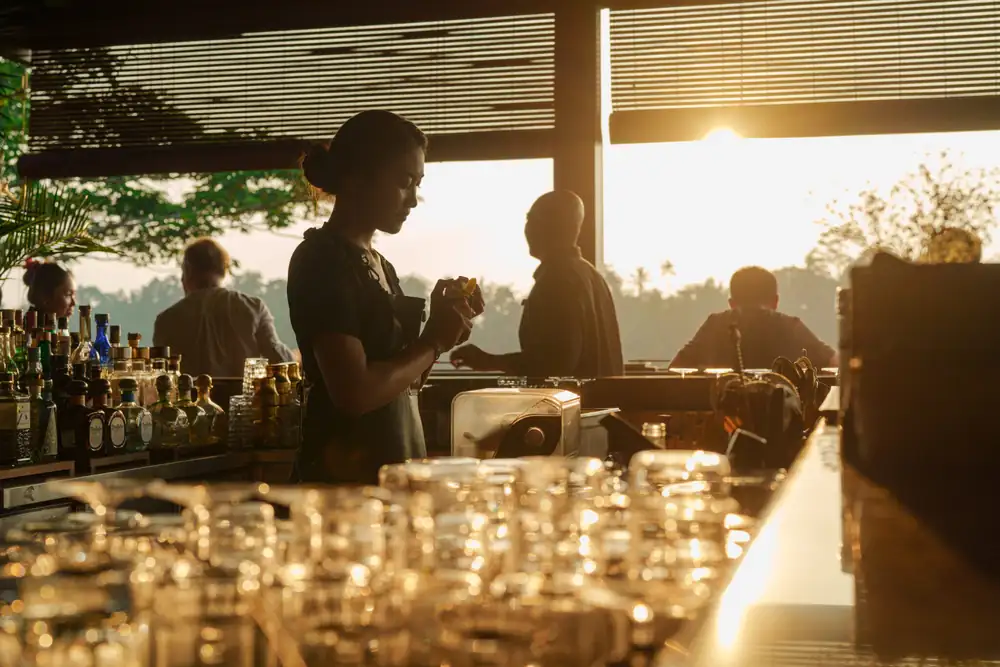
Ambar means "sky" in Sanskrit, a fitting name for a bar perched on a cliff next to the lobby of Mandapa, the address of the Ritz-Carlton Reserve. The outdoor wooden terrace overlooks the Ayung River and a dense forest canopy, and the sunset views are impressive enough to risk distracting from the real attraction: one of Bali's most serious cocktail programs.
The approach is rooted in the deep spiritual and medicinal history of the region's botanicals—appropriate, considering that Ubud derives from the Balinese word ubad, meaning medicine. Head bartender Adi San treats this heritage as context and vocation. This hyperlocal sensibility permeates everything we find at Ambar. The Taru Pramana drinks list draws directly from indigenous healing traditions, crafting drinks around ingredients like ginger, betel leaf, and temulawak, a rhizome with centuries of history in Balinese jamu. The resulting menu is concrete and distinctive, with a strong sense of belonging.
The same philosophy extends to the coconut-aged cocktails, served tableside straight from the shell, accompanied by live jazz as the light fades. Among the signature cocktails, none is more personal than My Grandma, Adi San's tribute to his grandmother. "The inspiration comes from ngingang," he explains, "the Balinese tradition of chewing betel leaves, a ritual my grandmother still performs today." The drink blends rum, dry vermouth, betel, turmeric, wild honey, homemade Andaliman liqueur, citrus, coconut, water, and salt. Each ingredient is a thread of memory. "That's what this movement is really about: not just flavor, but culture, emotion, and stories poured into a glass."
Ambar's commitment to the environment made it a natural host for Spirits of the Ubud Jungle, a collaborative event in February 2026. Five high-end Asian bars worked with locally sourced ingredients, crafting cocktails that clearly showed a direction: Bali has quietly become one of Asia's most serious drinking destinations.
Kawi - Ubud, Bali
Kawi was founded by three friends—Christian, Kong, and Elaine—and seats just fifteen. We're in Kedewatan, deliberately far from the excess of Balinese beach clubs and resorts. The atmosphere is dark, minimalist, almost cavernous, with lighting focused on what really matters: the drinks. The menu explores lesser-known Balinese ingredients with skill and curiosity. Tejakula arak appears frequently: in Pisang with dried banana, Fernet Branca, and vanilla, or in Teh, along with Laphroaig 10, whey, and Balinese black tea.
Among the most popular is the Lapis Legit, inspired by Indonesian layer cake. A rich, bitter, and smoky cocktail, it's crafted with brown butter bourbon, plum-infused grappa, coconut water, Empirical Ayuk, PX sherry, chocolate bitters, and a house-made spiced tincture. "Kawi," explains Christian Tseng, "is a deliberately atypical bar, dedicated to reinterpreting the flavors of Indonesian childhood in a nostalgic yet innovative way."
The St. Regis Bar - Nusa Dua, Bali
The St. Regis Bar in Nusa Dua exudes an old-world elegance: dark woods, leather armchairs, and warm lighting. A legacy that dates back to 1934, when Fernand Petiot created the Bloody Mary.
Every evening, a sunset ritual takes place: a champagne glass is opened with an Indonesian kris, while traditional fire dances are performed outside and jazz music accompanies the scene.
The drink program is led by Giri Asta, known for his precision, sustainability, and his ability to reinterpret the St. Regis identity with a Balinese twist. His globally award-winning Hennessy Harmony cocktail pays homage to Canang Sari, a Balinese daily offering that symbolizes gratitude. It features Hennessy XO, pineapple-orange shrub, pomegranate juice, pandan syrup, rose, and lime, and is served in a recycled bottle.
"At the St. Regis Bar," says head bartender Giri Asta, "every cocktail is a journey in the glass. We serve more than just fine spirits; we serve the stories of life. Every sip is a journey guided by the Balinese philosophy of Tri Hita Karana, which celebrates the harmony between humanity, nature, and the divine."
The Bulgari Bar - Bulgari Resort Bali
Opened in 2006 on a cliff 150 meters above the Indian Ocean, the Bulgari Resort Bali combines Balinese architecture and Italian design. The bar is also open to outside guests. The elliptical bar is reminiscent of Milan, while a large, naturally shaped central stone dominates the space. The terrace overlooks the ocean, offering spectacular views.
Here too, the sunset aperitivo has become a ritual: Negronis, Spritzes, and Americanos accompany a shared moment of relaxation as the sun sets. The nearby restaurant blends Italian cuisine with local ingredients: Kintamani vanilla, Plaga tomatoes, and Balinese spices. Crispy suckling pig with orange sauce is the signature dish of this cultural encounter.
As Carlo Bevilacqua, general manager of the Bulgari Resort Bali, explains, "It's crucial for us that Il Ristorante – Niko Romito and the Bulgari Bar are complete and functional spaces, while also helping to create a harmonious rhythm throughout the resort. Guests seamlessly transition from one moment to the next, from day to night, without feeling like they're being forced. It's precisely this continuity that defines the overall experience."
MAIGA! TA'AKTANA, Labuan Bajo
Labuan Bajo, on Flores Island, is a more remote destination, famous for its Komodo dragons. MAIGA! is a swim-up bar, opened in 2024, perched above the sea near Komodo National Park.
The name means "come and drink" in the local dialect. The project combines design, mixology, and marine biology, including a coral reef restoration program.
The menu is divided into Sea Nomad and Land Dweller, featuring ingredients such as Flores coffee and sopi, a local volcanic spirit. The signature cocktail, MOSO, is inspired by the region's spiderweb rice fields. It features sopi infused with star fruit, pineapple-tangerine cordial, lime, toasted rice syrup, and aquafaba. Each cocktail contributes to the coral restoration project. The bar also hosts guest bartending programs to develop local skills. "Luxury should be a catalyst for good," says general manager Peter-Paul Kleiss.
ENGLISH VERSION
The New Golden Age of the Island Bar: Bali and Labuan Bajo.
Bali and Labuan Bajo have always had good places to drink. What has changed is the seriousness with which their best bars are approaching what goes into the glass. A new generation of Indonesian bartenders is drawing on the ingredients growing around them — Balinese vanilla, Kintamani tangerine, Flores coffee, centuries-old Karangasem arak — and building a cocktail culture that is distinctly local. What follows is an accounting of six exceptional bars across both destinations. These six Indonesian bars tell a story that extends well beyond the glass. Across Ubud's river valleys, Nusa Dua's terraces, and Labuan Bajo's overwater decks, a generation of bartenders is doing something quietly radical: treating the landscapes around them not as backdrop, but as ingredient.
Amber - Ubud, Bali
Ambar means "sky" in Sanskrit, a name that earns its keep for a bar perched on a clifftop beside the lobby of Mandapa, a Ritz-Carlton Reserve. The outdoor wooden deck looks out over the Ayung River and a dense forest canopy, and the golden hour view is impressive enough to almost obscure the venue's real claim on your attention: one of the more serious cocktail programs in Bali. The approach here is rooted in the deep spiritual and medicinal history of the region's botanicals — fitting, given that Ubud itself takes its name from the Balinese word ubad, meaning medicine, a lineage that Head Bartender Adi San treats as both context and calling.
That hyperlocal sensibility runs through everything Ambar does. The bar's Taru Pramana collection draws directly on indigenous healing traditions, building drinks around ingredients like ginger, betel leaf, and temulawak — a rhizome with centuries of history in Balinese jamu. The menu that results is grounded and specific, with a strong sense of where it comes from. The same philosophy extends to Ambar's signature coconut-aged cocktails, served tableside from the vessel itself, accompanied by loose live jazz as the light fades.
Among Ambar's signature cocktails, none carries more personal weight than My Grandma — Adi San's heartfelt tribute to his grandmother. “The inspiration comes from ngingang,”Adi explains, “the Balinese tradition of chewing betel leaves, a ritual she still practices today.” The drink weaves rum, dry vermouth, betel leaf, turmeric, wild honey, homemade Andaliman liqueur, citrus, coconut, water, and salt into a classic structure — each ingredient a thread of memory. “For me, this is what the movement is really about,” he says. “Not just flavor, but culture, emotion, and the stories we carry — poured into a glass.”
That environmental commitment made Ambar a natural host for Spirits of the Ubud Jungle, a collaborative event held across two evenings in late February 2026. Rather than arriving with prepared menus, five of Asia's most respected bars — Singapore's Fura, Hong Kong's COA, Jakarta's Carrots, Seoul's Le Chamber, and Hanoi's Workshop 14 — were handed a black box format and a set of foraged local ingredients, and asked to improvise. What emerged across those evenings was both a compelling snapshot of where bartending in the region is heading, and a persuasive argument that Bali has quietly become one of Asia's more serious drinking destinations — a place where contemporary craft and ancient roots are not in tension, but in conversation. “Overlooking the Ayung Valley, Ambar Ubud Bar is where Balinese tradition comes to life in the glass. Each Taru Pramana cocktail draws from sacred botanicals and ancient wisdom, crafted into an experience you won't forget”, Adi San, head bartender Ambar, says.
Kawi - Ubud, Bali
Kawi was founded by three friends, Christian, Kong, and Elaine, and its fifteen seats sit in Kedewatan at a deliberate distance from the beach club spectacle and resort excess that dominate so much of Bali's drinking scene. The room is dark and spare — almost cave-like — with focused lighting that puts the only thing that really matters front and centre: the drink.
The menu moves through Bali's lesser-known ingredient landscape with the ease of people who have done serious homework and genuinely want to bring you along. Tejakula arak — distilled in a coastal village on Bali's northern tip — appears repeatedly: infused with dried banana and paired with Fernet Branca and Balinese vanilla in the Pisang, and as the backbone of the Teh, which draws in Laphroaig 10, whey, and Balinese black tea.
Among the bar's most-ordered drinks is Lapis Legit (or Thousand Layer Cake), inspired by the rich Indonesian cake of the same name served during celebrations. This boozy, bittersweet, and smoky cocktail is built around 15 ml of brown butter bourbon (bourbon fat-washed overnight with brown butter), 15 ml of prune-infused grappa (dried prunes steeped in grappa for three days), and 20 ml of coconut water. To that go 5 ml each of Empirical Ayuk and PX sherry, a dash of chocolate bitters, and a bar spoon of spikuk tincture — a house-made infusion of cinnamon, clove, cardamom, and nutmeg left in vodka for three days. “Kawi is a deliberately atypical Bali bar, no sunset views, loud parties, or tourist swarms, dedicated to celebrating Balinese and Indonesian culture, by reinterpreting Indonesian childhood favourites into nostalgic yet innovative cocktails such as lapis legit, tipak cantok, and bika ambon”, Christian Tseng, co-founder Kawi.
The St. Regis Bar, Nusa Dua, Bali
The St. Regis Bar in Nusa Dua carries itself with old-world assurance: dark timber, deep leather armchairs, and lighting warm enough to suggest the day has already peaked and is softening into evening. The St. Regis has been in this business since Fernand Petiot walked into the New York original in 1934 with a tomato-juice recipe that would become the Bloody Mary, and the Bali outpost wears that inheritance with due seriousness.
Each evening brings the nightfall ritual: a sommelier sabering Champagne with an Indonesian Kris — the sacred double-edged dagger —the brave are welcome to try it themselves. Outside, a traditional Balinese fire dance unfolds on the resort's grand staircase as the sky goes orange. Live jazz runs underneath it all like a warm current, while bartenders move through the crowd with Bloody Marys calibrated to the hour.
The drinks program is led by Head Bartender Giri Asta, whose path to the bar began, improbably, in housekeeping. He found his calling in 2016, and has since built a reputation on precision, a genuine commitment to sustainability, and a facility for folding the St. Regis brand's polished heritage into something that feels distinctly Balinese.
That reputation was cemented at the Hennessy MyWay 2024 global competition, where Giri was named a Global Top 3 Finalist and won the Best Service Ritual award. His winning cocktail, the Hennessy Harmony, is on the menu at the St. Regis Bar. Conceived as a tribute to the Canang Sari — the small daily offering that sits at the heart of Balinese spiritual life, a gesture of beauty and gratitude — the drink brings together Hennessy X.O, a pineapple-orange shrub, pomegranate juice, pandan rose syrup, and fresh lime juice. True to Giri's zero-waste approach, it arrives in a recycled Hennessy bottle resting on a piece of upcycled wood. “At The St. Regis Bar - for Giri Asta, Head Bartender, St Regis Bar -, a cocktail is a journey in every glass. We serve more than fine spirits; we serve the stories of life. Each sip is a journey guided by the Balinese philosophy of Tri Hita Karana—celebrating harmony between humanity, nature, and the divine".
The Bvlgari Bar at Bvlgari Resort Bali
Bvlgari Resort Bali opened in September 2006 on a clifftop 150 metres above the Indian Ocean — its second property after Milano, and arguably its most dramatic setting. The 59 villas sit across grounds where traditional Balinese architecture and sharp Italian design coexist more naturally than you might expect.
The Bvlgari Bar is the one part of the resort that doesn't require a room key. While the villas are firmly for guests, the bar opens to anyone willing to make the journey out to the Jimbaran peninsula. There's an elliptical counter that quietly references the original Bvlgari bar in Milano, and a vast stone in the middle of the room, pulled from the ground after an earthquake in North Sulawesi and shaped over years by river currents, that somehow works better as a centrepiece than anything designed for the purpose could. The terrace hangs over the cliff edge, and the view — volcanic rock dropping straight into the Indian Ocean.
The Bvlgari Bar has built its evenings around the magical Balinese sunsets, and the aperitivo hour has quietly become a ritual for guests and visitors alike. Negronis, Americanos, Spritzes — the drinks are good, but what you're really there for is that collective pause when the sun finally goes. The terrace fills up, the conversation dies down, and for a few minutes nobody's in a hurry to be anywhere else. "The Bvlgari Bar, in its own way, has become one of the island's most recognised settings, particularly at sunset, where the atmosphere settles into something special." — General Manager Carlo Bevilacqua.
Dinner shifts to the nearby Il Ristorante - Niko Romito, and the menu does something genuinely interesting: it's Italian at heart, but built around what Bali actually grows. Kintamani vanilla, Plaga tomatoes, local peppers, herbs from the resort's own garden — they find their way into dishes alongside the kind of classics, like spaghetti e pomodoro, that don't need improving. The crispy Balinese suckling pork with orange caramel sauce is the dish that best captures what happens when the two cultures meet. “What is important for us is that Il Ristorante – Niko Romito and The Bvlgari Bar feel complete on its own, while still contributing to a broader rhythm across the resort. Guests move naturally from one moment to another, from day into evening, without feeling a transition that is forced. It is this continuity that defines the overall experience”, Carlo Bevilacqua, General Manager, Bvlgari Resort Bali explains.
MAIGA!, TA'AKTANA, a Luxury Collection Resort & Spa, Labuan Bajo
Labuan Bajo perches at the western edge of Flores — an hour's flight from Bali, near enough to fold into an Indonesian itinerary but far enough to feel genuinely off the beaten path. Komodo dragons draw most visitors. A bar keeps them talking.
MAIGA! is an overwater bar at TA'AKTANA resort, opened in 2024 on the boundary of Komodo National Park, suspended above the Flores Sea. The name comes from the local Manggarai dialect — "come drink" — and the concept emerged from an unlikely collaboration between architects, bartenders, and marine biologists. The result is equal parts cocktail destination and working coral reef restoration project.
Bar manager Ferdinand Samuel, head bartender Gabriel Sebastian, and General Manager Peter-Paul Kleiss shaped a menu divided into two collections: "Sea Nomad" and "Land Dweller." Flores coffee and Sopi — a craft spirit carrying genuine volcanic terroir — anchor the drink list, grounding it in a specific place rather than a generic tropical mood. The room itself follows the same logic: natural timber, polished metal, deep seating, and an unbroken panorama of sea and island that functions less like scenery and more like atmosphere.
The signature cocktail is MOSO, named for the Lingko rice fields of the region — terraced landscapes that form spider-web geometries visible from above, ancient and precise. The drink is earthy, fruity, and sweet-sour, built on Sopi infused with starfruit (45 ml), shaken with pineapple tangerine cordial (30 ml), lime juice (12.5 ml), toasted rice syrup (10 ml), and aquafaba (15 ml), then strained into a coupette and finished with the TA'AKTANA rice powder logo. Ferdinand Samuel describes it as a tribute to the farmers and harvests sustaining the land — each sip evoking the Manggarai countryside at peak harvest.
Every signature cocktail ordered triggers a contribution to the resort's reef restoration programme, managed by an in-house marine biologist. On calm days, coral colonies are visible growing back beneath the deck. The bar also runs "Cheers to Community," a guest bartender programme that brings international talent to Labuan Bajo for takeover nights and masterclasses, building local skills that outlast any single visit.
As Peter-Paul Kleiss, General Manager, TA’AKTANA, puts it, MAIGA! is designed to be "a sanctuary where guests can enjoy a sophisticated evening while knowing they are contributing to the longevity and professional empowerment of the vibrant community we call home. At MAIGA! and TA’AKTANA, we believe that luxury should be a catalyst for good”.