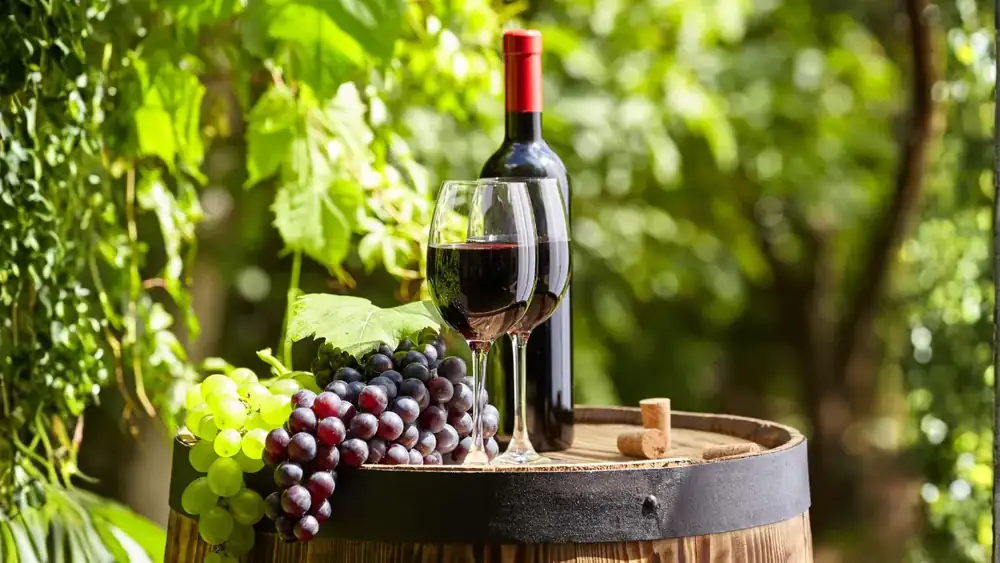
Chilean wine: From the glass to the kitchen
It's September, our month of celebrations begins, and there's one star that can't be missing from our table: Chilean wine.
And today, September 4th, we celebrate National Wine Day, a date that seeks to highlight a tradition with over 500 years of history in our country. So today I want to talk about wine, but from my favorite place: the kitchen.
Because wine isn't just for filling a glass. It can also be incorporated into our recipes and become a fundamental part of a dish. A single bottle can accompany our food and even be an integral part of it.
What are the most typical wines of Chile?
In our country there is a tremendous diversity of valleys and grape varieties, but there are some varieties that are especially representative.
When we talk about red wines, the first one that probably comes to mind is Cabernet Sauvignon, one of the most widely planted and renowned varieties in our country. It's a structured wine, ideal for pairing with meats, rich dishes, and also for cooking.
Then we have Carménère, which has a very particular history in Chile and has practically become our flagship grape variety. It's a more approachable wine, with fruity and spicy notes, that pairs very well with meats, roasted vegetables, and spiced dishes.
We also find Merlot and Syrah, two varieties that offer different styles and can be very interesting to accompany meals.
And if we turn to white wines, Sauvignon Blanc is one of the stars. Fresh, aromatic, and with good acidity, it pairs beautifully with fish, seafood, salads, and lighter dishes.
We also have Chardonnay, which depending on its production can be fresher and more mineral or creamier and with woody notes.
We cannot leave out the country's wine.
There is one grape variety that deserves special mention when we talk about Chilean wine: País.
It is one of the oldest grape varieties found in Chile, introduced during the Spanish colonial period. For centuries it was very prevalent in the country's viticulture, especially in the vineyards of the central and southern regions.
It is a wine that has regained prominence today, especially thanks to small producers who have recovered old vineyards and traditional methods of production.
The country typically produces lighter, fresher, and fruitier wines, although this depends heavily on the growing region and winemaking process. And it has something truly beautiful about it: it speaks to Chile's rural and agricultural history.
That's why, when we talk about Chilean wine, it doesn't all have to be Cabernet Sauvignon or Carménère. We can also look towards those heritage grape varieties that are part of our history and that are currently experiencing a kind of renaissance.
And the great thing is that we don't just have to think about which wine to pair with each dish. We can also ask ourselves: What wine can I pair with my dish?
And that's where the fun begins.
For starters: Caramelized onions in wine.
Let's start with something perfect for a snack: caramelized onions with red wine.
We slice the onion thinly and put it in a pan with a little olive oil and butter.
We cook it slowly, over medium-low heat, until it is very soft and golden brown.
Add a tablespoon of sugar or honey, a pinch of salt, and then stir in red wine. It can be Cabernet Sauvignon or Carménère.
We let it reduce slowly until the wine concentrates and the onions become shiny, sweet and full of flavor.
And how do we serve them? On toast, with goat cheese, brie, blue cheese, or even a good creamy cheese.
Add some walnuts on top and you have a spectacular snack.
And we can also prepare the onions in advance and store them in the refrigerator.
The main course: Silver or wine-braised rib.
And now let's get to the main course.
Because if there's one thing I love about September, it's those dishes that arrive at the table steaming hot, plentiful, and practically fall apart when you touch them.
We can make a silver or a ribeye steak with red wine, either in the oven or in a pot.
First we sear the meat very well so that it takes on color.
We remove it and, in the same pot, we cook onion, carrot and garlic.
We add the meat back in and add red wine. We can use Cabernet Sauvignon or Carménère and supplement with broth.
We add bay leaf, pepper and some herbs like thyme or rosemary.
And now comes the important part: slow cooking.
The wine reduces, mixes with the juices from the meat and vegetables, and ends up forming an incredible sauce.
If we bake it in the oven, we can cook it slowly, covered, until the meat is very tender.
And if we make it in a pot, exactly the same: low heat and patience.
We serve it with mashed potatoes, golden potatoes, rice, or roasted vegetables.
And here's a tip: when cooking, you don't necessarily need to use an expensive bottle of wine. Use a wine you enjoy drinking. If the wine tastes good in the glass, it will also enhance the flavors of the food.
To finish: Pears in wine
And now for dessert.
Because wine can also be sweet.
A classic dish that I love is pears poached in red wine.
We peel the pears, leaving the stem, and put them in a pot.
We add red wine, sugar, cinnamon, orange peel and, if we want, some spices like cloves or anise.
We cook them slowly, turning them over occasionally, until they are tender.
Meanwhile, the wine reduces and transforms into a spiced syrup.
We can serve them warm or cold, with vanilla ice cream, cream, mascarpone, or simply on their own.
And so we have a complete menu where wine appears from the first bite to dessert.
Caramelized onions in wine for snacking.
Silver or wine-braised rib for the bottom.
And pears poached in wine to finish.
Plans for this weekend
And if after hearing this you're still in the mood to celebrate wine, there are several options in Santiago this weekend.
Wines from Chile at MUT
This Saturday, September 5th, and Sunday, September 6th, the Tobalaba Urban Market (MUT) will host a celebration featuring wineries from different regions of Chile. There will be tastings, samplings, and workshops, with wines representing the northern, central, and southern regions of the country. The event runs from 12:00 PM to 9:00 PM on both days.
National Wine Day: Between neighborhoods.
Another option is Entre Barrios, which this weekend connects Barrio Italia and Plaza Ñuñoa with activities related to wine, gastronomy, and local culture. It's a great choice for those who want to combine wine, food, and a stroll through the city.
Celebration in Viña Cousiño Macul
This Saturday, September 5th, Viña Cousiño Macul will host a celebration from 12:00 PM to 5:00 PM. The experience includes a tasting of four wine lines, food—including anticuchos and empanadas de pino—, a self-guided tour, and the sale of bottles with discounts of up to 50%.
So there are options: we can stay in the city, tour vineyards, do a tasting, or simply open a bottle at home and cook.
Because that's ultimately the beauty of wine: it's not just about drinking it, but about everything that can happen around a bottle. A conversation, a meal, a recipe, a celebration. And in September, in Chile, we have plenty of excuses for that. Cheers to Chilean wine!
You can also read this on Radio Imagina. TV earthquake! Coté López is once again linked to an unexpected marital breakup.