Narrow or plump? Experts searched for the ideal wine glass
The aim of the event, called Glass Tasting by Květná 1794, was to compare how nine different glasses, blown and handmade by glassmakers from Květná, change the aroma, taste and overall appearance of wine.
Article
The aim of the event, called Glass Tasting by Květná 1794, was to compare how nine different glasses, blown and handmade by glassmakers from Květná, change the aroma, taste and overall appearance of wine. The intention was to choose one universal glass from these nine that would suit most white and red varieties.
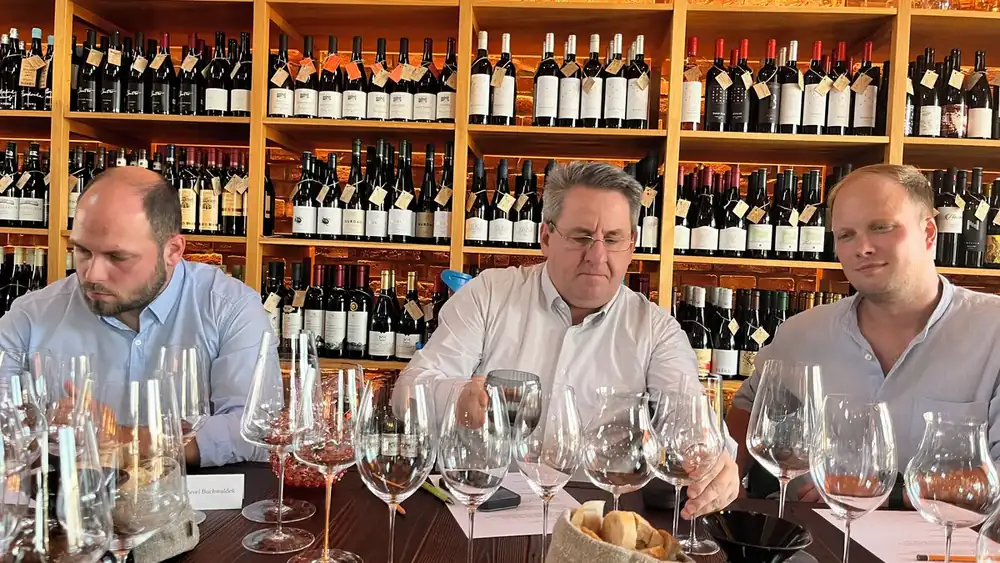
Sommelier Libor Nazarčuk, winemaker Zbyněk Žiška and chef Pavel Buchwaldek sat at one table, intently swirling their glasses, their noses buried deep inside their goblets. They poured wines of three typical Moravian varieties – Riesling, Pálava and Frankovka – alternately into glasses of all shapes.
"The aroma is completely lost in a wide glass," Nazarchuk evaluates one of the samples and immediately tries how the same wine would taste in a narrower glass with a slightly wider neck. "The wine seems more delicate here," Nazarchuk added, writing down his notes on the prepared form. "Interestingly, the wider the lower glass, the drier the wine seems," the sommelier returns to one of the nine glasses.
Other leading domestic experts participated in the testing: winemaker Miloš Michlovský, oenologist and university teacher Mojmír Baroň, sommelier Ivo Dvořák, and chefs Martin Štangl and Jan Horák.
The entire testing was methodically managed by national sommelier Klára Kollárová. “We leave it up to you how much wine you pour and into which glass, but we definitely want you to be brave and try as many as possible and then choose the one that tastes best to you,” she encouraged the experts present. “Sometimes it can be surprising how a wine can paradoxically taste better from a different glass than from the one you would choose at first glance,” explained Kollárová.
The glassworks wants to use the results in further production. “This was the first time we held a Glass Tasting in this format, and I myself expected some of the results to turn out differently. It was all the more interesting for me to watch the carefulness and responsibility with which the committee approached the evaluation. We did not want to confirm a preconceived idea, but to get real professional feedback with which we can continue to work,” explained Dušan Svoboda, co-owner of the Květná 1794 glassworks and owner of the Pear Mill. “The experts present ultimately identified our Telesto Universal as the absolute winner, the ideal glass,” added Svoboda.
Winning glasses
"According to experts, the winning model with a compact, tapered shape gave the wine enough space to open, but at the same time retained its aroma. For the Wlašský Riesling, this glass supported the freshness and minerality. On the contrary, for the significantly more fragrant Pálava, it helped to concentrate the aroma without letting its sweet floral tones prevail," specified Klára Kollárová.
According to her, it is important for people who want to truly enjoy wine to choose quality glasses. The way a person drinks from a given shape of glass also plays a role. "The width and shape of the rim affect how quickly the wine flows into the mouth, how much you have to tilt your head and where exactly it lands on the tongue. The glass, which sommeliers, chefs and winemakers have agreed could serve as a universal one, conducts the wine so precisely and in a controlled manner that the acid, fruitiness and sweetness are in perfect balance," described Kollárová.
But for the red Frankovka, a different glass, with a chubbier shape, proved to be better. "This helps to open up the fruity and spicy notes while smoothing out the perception of the acid and tannins. Thanks to it, the wine appears fuller and has more layers without losing its freshness," explained Klára Kollárová.
According to her, universal glasses are important and practical, for example, for winemakers in the cellar or for sommeliers during service. "A good glass is not only evaluated by how the wine tastes in it, but also by how it holds up, how balanced it is and how naturally it is drunk from it," said Kollárová.