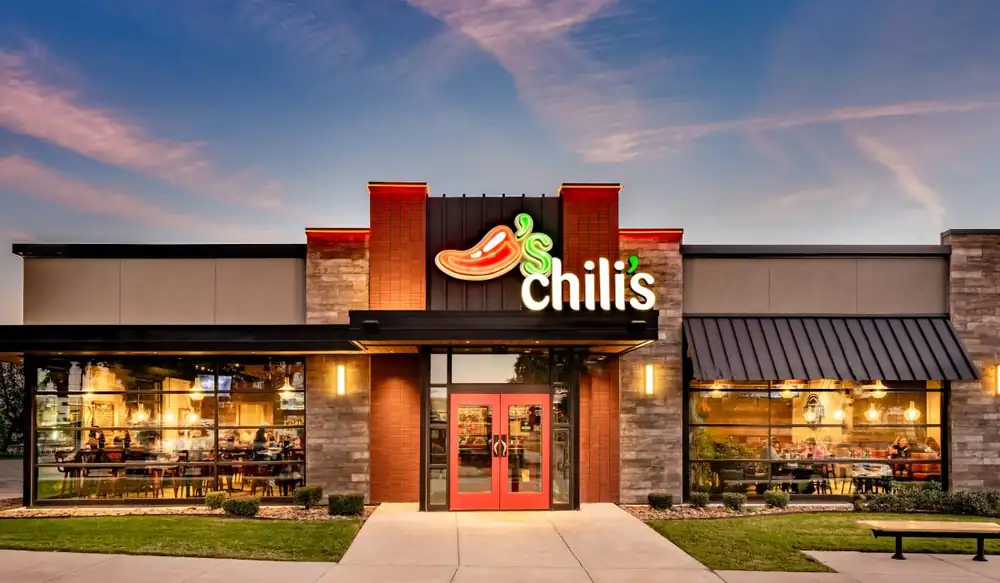
Chili’s Turnaround Clears Way for New Restaurant Growth
Chili’s is ready to grow its restaurant count again.
“Right now, in those early restaurants, we are getting a 3 percent to 5 percent sales lift, and that is on top of the fantastic momentum that we have in the brand that we’ve been talking about,”
After spending the past several years repairing its existing business, the casual-dining giant plans to reach 2–3 percent annual unit growth and open as many as 30 restaurants per year by fiscal 2029. The company has identified more than 300 trade areas where it believes the brand can add locations, providing what CFO Mika Ware described as visibility into a decade of development.
Chili’s is considering several paths for expansion. The company will continue building in major suburbs, but it has also identified openings in smaller communities, existing markets that can support infill development, and areas on the edges of growing metropolitan regions.
Conversions offer another route. Chili’s could repurpose individual restaurant properties or acquire a small regional chain for its real estate if the economics are favorable. Ware said that tactic could prove useful in densely developed markets such as the Northeast, where suitable sites are more difficult to find.
The pipeline is already forming. Chili’s has approved 15 restaurants for fiscal 2028 and another 15 for fiscal 2029. An additional 46 deals are in progress.
New restaurants are expected to cost between $5 million and $6 million. The company believes those investments can produce attractive returns based on Chili’s current average unit volumes of $5 million and restaurant-level operating margins exceeding 18 percent. Locations constructed during the past three to five years have opened strongly and continued to outperform the brand’s averages.
Chili’s plans to maintain discipline as development accelerates. Ware said the company does not want pressure to meet a numerical target to lead it toward weaker sites. The pace must also allow the chain to recruit and prepare enough general managers and team members to support each opening.
The company’s internal development programs are expected to supply much of that restaurant talent. RISE prepares newer managers interested in becoming general managers, and LEAD trains general managers who could advance to director of operations positions. Most new restaurant leaders are expected to come from inside the company, although Chili’s recent performance has also helped it attract outside candidates.
The development opportunity spans the country. Chili’s sees room for additional restaurants in established states such as Texas, Florida, and California, as well as underdeveloped territories in the Pacific Northwest, Southeast, and Midwest.
Texas and Florida continue to benefit from population growth and new real estate development. Eight restaurants are already in the pipeline across those states. Chili’s also sees whitespace in Washington, where it has a limited streetside presence compared with competing casual-dining brands.
The company recently acquired 10 franchised locations in Alabama and has identified five additional sites in the state. Chili’s owns development rights across all 50 states, giving the company flexibility to build in territories that were historically controlled by franchisees.
Restaurant reimaging will create another source of growth.
Chili’s completed 11 remodels during fiscal 2026 and has 70 projects in progress for fiscal 2027. The company plans to renovate roughly 10 percent of its system annually beginning in fiscal 2028, equal to approximately 110 restaurants per year.
The first 16 completed projects carried an average cost of $600,000 per location. That figure included $100,000 for bar renovations that will only be required at an estimated 20 percent of the chain’s restaurants. The other 80 percent should cost closer to $500,000 per project.
“Right now, in those early restaurants, we are getting a 3 percent to 5 percent sales lift, and that is on top of the fantastic momentum that we have in the brand that we’ve been talking about,” Ware said.
The remodel program carries particular importance because 75 percent of Chili’s customers dine inside its restaurants. The company wants those locations to feel current, clean, and properly maintained after years of delayed repairs.
Brinker spent more than $100 million addressing leaky roofs, plumbing failures, wood rot, and other deferred maintenance across the Chili’s portfolio. CEO Kevin Hochman said the estate is now in its best condition, allowing capital to move from basic repairs toward restaurant upgrades that can drive sales.
The new growth plan arrives after a turnaround that lifted Chili’s average unit volumes from slightly more than $3 million to $5 million over three years. Restaurant operating margins improved 660 basis points, and Brinker revenue climbed from $4.1 billion to $5.8 billion.
Brinker projects annual revenue growth of 4–6 percent and double-digit earnings-per-share growth over the coming three years. Those targets assume 2–3 percent annual same-store sales growth in addition to the planned unit expansion.
The company sees further restaurant-level margin opportunity as sales rise. Only 20 percent of Chili’s restaurants currently produce more than $6 million in annual sales, but those high-volume locations deliver operating margins approximately 400 basis points above the system average.
Increasing capacity inside existing restaurants will support that effort. Weekly customer counts have risen from 3,400 per restaurant in 2023 to 4,200 this year. Chili’s is targeting 4,300, which would contribute an estimated 2 percent to same-store sales. The chain previously served as many as 5,200 customers per restaurant each week in the same buildings.
Chili’s plans to remove operational bottlenecks through redesigned server handhelds, smarter kitchen display systems, more accurate wait times, simplified inventory procedures, and easier takeout ordering and pickup. Only 40 percent of restaurants currently meet the chain’s ticket-time goals of 10 minutes at lunch and 12 minutes at dinner. Chili’s wants to raise that figure to 65 percent.
Marketing and value will continue feeding traffic into that expanded capacity. The chain plans to keep supporting its Better Than Fast Food campaign, the $10.99 3 For Me platform, and the $6 Margarita of the Month. Chili’s has renovated roughly 60 percent of its menu and sees further potential in chicken sandwiches, salads, kids meals, and beverages.
“We now have multiple growth engines. Not only do we have same-store sales, but now we have reimages and new units,” Ware said.