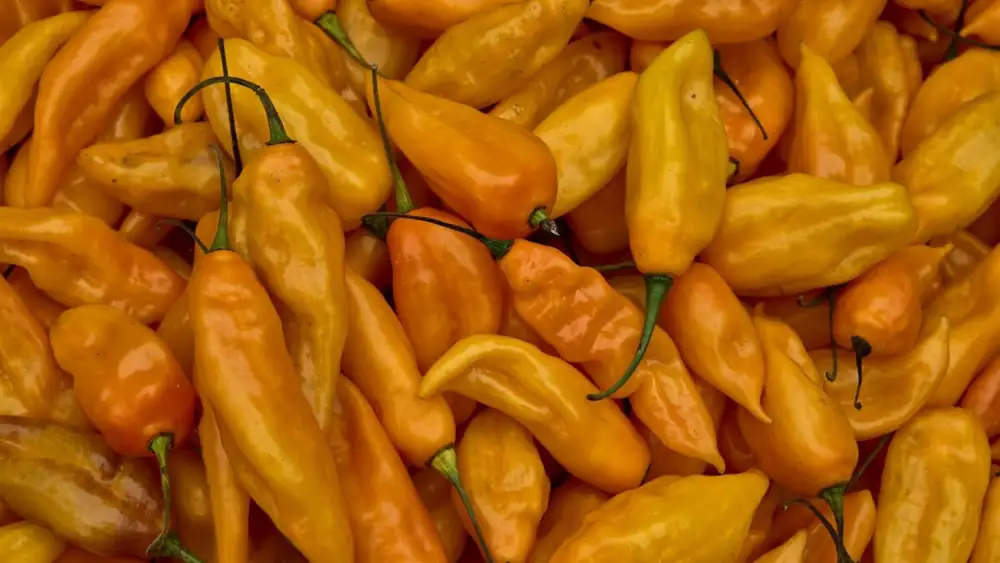
Ají Amarillo, el ají peruano “suave”, la estrella del ceviche
Perú es un país que se expresa a través de sus paisajes y sabores: un mosaico de Andes, costas y la Amazonía salvaje, donde cada región conserva su propia identidad culinaria, unidas por un hilo conductor: el ají.
Peru is a country that speaks through its landscapes and flavors: a mosaic of Andes, coasts, and the wild Amazon, where each region preserves its own culinary identity, united by a common thread: chili pepper. This South American country boasts dozens of varieties, but if we had to choose one undisputed star, capable of best representing its gastronomic soul, it would undoubtedly be ají amarillo, the Peruvian yellow chili pepper. In every corner of Lima, an unmistakable aroma emanates from this raw material: sweet, fruity, and yet pungent, so distinctive that it's impossible not to recognize it instantly.
The ancient origins of ají amarillo
The roots of ají amarillo (yellow ají) reach deep into the distant past. Archaeological finds in the El Brujo complex, in the areas of Huaca Prieta and Paredones, testify that chili pepper consumption in Peru dates back to the Archaic period, when various Capsicum varieties, including ají limo and rocoto, were already being used during community celebrations and social gatherings. But a significant surge occurred with the Incas, a pre-Columbian civilization that created the largest empire in South America: they developed large-scale cultivation, moving labor from the coastal areas to the Andean regions to increase production.
With the arrival of European colonizers in the 16th century, this raw material was intertwined with new cultures and, above all, many other new flavors, giving rise to a fusion that still characterizes Peruvian republican cuisine, as well as Bolivian and Ecuadorian cuisine.
The main characteristics: spiciness and smell
Arriving in Peru, you can't help but be intrigued by the land's stark contrasts: on one side, the blue ocean, on the other, the peaks of the Andes, all enhanced by the explosion of color that fills the air amidst the markets and local clothing. And in this South American postcard setting, suddenly, a distinctive aroma begins to fill the air, pungent yet sweet, which will stay with you throughout your journey. It's ají amarillo, a true must-try, to be experienced with all your senses. Its aroma is immediately captivating, but the eye also deserves its share: indeed, it presents itself as a deep yellow, which turns a vibrant orange as it ripens.
From an organoleptic standpoint, ají amarillo is distinguished by a fruity and complex aroma, far removed from the typical "aggressiveness" of other chili peppers better known in America and Europe. To quantify the spiciness of a product, we must take a step back and introduce the Scoville scale, the measurement system specifically designed for these cases: developed in the last century, it quantifies the concentration of capsaicin, the active ingredient in chili peppers that stimulates the burning receptors. The heat level of ají amarillo falls between 40,000 and 50,000 units, a medium-high level that, curiously, is perceived much more gently without overpowering the other flavors of the dish. For example, the hottest chili pepper in the world is Pepper X, with a heat level of 2,693,000 SHU.
Nor should we forget its nutritional value: like many Peruvian ajís, it is rich in vitamin C, which is beneficial for the immune system, and – of course – the aforementioned capsaicin, which, in addition to being responsible for the spiciness, has anti-inflammatory and analgesic properties that can promote blood circulation.
The use of ají amarillo in Peruvian cuisine
Peru is much larger than you might imagine: just to give you an idea, it's about four times the size of Italy. Yet, despite its enormous size, ají amarillo manages to permeate every regional cuisine, infusing every corner of the country with its unmistakable aroma. It's no surprise, then, that it's the soul of some of the most beloved dishes, such as papa a la huancaína, which owes much of its character to this chili pepper.
Made with boiled potatoes, cheese, and milk, this appetizer—usually the star of family celebrations—is complemented by a creamy ají amarillo sauce, lending it bold, distinctive flavors. No less iconic is ají de gallina: a shredded chicken stew wrapped in a golden sauce, where yellow chili peppers meet nutmeg, Parmesan cheese, and softened bread. The result is a velvety, enveloping texture, a favorite at home and on the menus of fine dining restaurants.
And then there's Peru's signature dish, a UNESCO World Heritage Site: ceviche. Its origins are lost in time and remain partly shrouded in mystery, but many historical accounts trace its roots to the Mochica culture, a pre-Inca people who inhabited Peru's northern coast over two thousand years ago. Fishermen, according to tradition, would cut up freshly caught fish and eat it raw, marinated in the juice of local fruits such as tumbo.
During the Inca era, maceration was enriched with chicha, an ancient traditional drink, and it was precisely in this process of constant transformation that ají amarillo found its place, later joining the lime and onion introduced after the arrival of the Spanish, who in turn had imported them from Asia. It is, in short, a dish that bears the entire gastronomic history of the country sewn into it, and ají amarillo is an integral part of it: it is used in leche de tigre, the lime-based marinade in which the raw fish rests, giving it the golden color and warm, fruity note that make ceviche recognizable at first bite.
L'ají amarillo nel mondo
In recent years, the success of Peruvian cuisine has spread beyond national borders, bringing ají amarillo with it. In Europe, it is increasingly found on contemporary restaurant menus, thanks to the growing popularity of dishes like tiradito—a type of carpaccio—and ceviche, now available in many cities even far from Lima.
Part of this international success is thanks to chefs who have brought Peru to the world: Luis Arévalo, who helped popularize Peruvian gastronomic tradition on the international scene, and Nobuyuki Matsuhisa, who integrated ingredients like ají amarillo into his celebrated Japanese-South American fusion cuisine.
Thanks to its delicate flavor, ají amarillo lends itself to extremely versatile uses even outside of traditional Peruvian cuisine: it pairs well with white meats, poke, fish, vegetables, fruit, and even Asian soups like ramen. It finds its place in mayonnaise, romesco sauces, sweet and sour or fruity sauces, and brown stocks, where it adds warmth and that characteristic yellow-orange hue. It's not uncommon to see it used as a topping on sushi, fries, or burgers, a sign of how an ingredient born in the Andes has managed to conquer cuisines and palates far from its homeland.