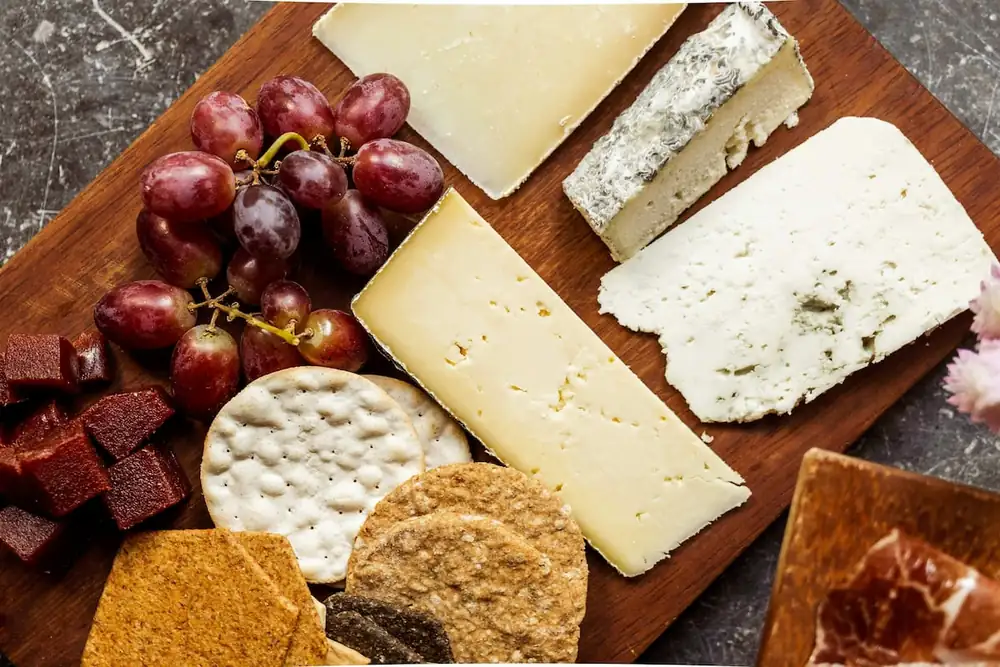
Which cheeses to choose? How much to prepare? What types of bread and wine? Our guide to a 100% successful cheese board
A cheese board remains a simple option for a late-night aperitif or a shared dinner.
Mix up the shapes and textures to avoid a uniform platter: a tomme next to a creamy brie, a blue cheese opposite a fresh goat cheese, a large whole wheel next to a partially cut cheese. Arrange the cheeses from mildest to strongest in a clockwise direction and leave enough space between them for easy serving.
Which cheeses to choose, and what quantities to plan for?
Ideally, you should offer a variety of cheeses to diversify the flavors and textures. A well-balanced cheese board is often more appealing than a collection of individual cheeses. Five or six varieties are generally sufficient, as beyond that, the differences become less noticeable. Prioritize regional products such as PDO or PGI cheeses, which guarantee a recognized origin and production methods.
When it comes to portion sizes, it's simply a matter of knowing what you're aiming for: at the end of a meal, allow 70 to 90g per person; for an aperitif, 80 to 120g per person; and for a proper cheese and wine pairing, plan on 150 to 250g per person. Your cheesemonger can adjust these quantities according to the number of guests and the varieties chosen.
What types of bread should be served with cheeses?
Country bread, crusty baguette, artisanal crackers or walnut bread: each option gives a different interpretation of the cheese.
Some associations that work particularly well:
- Walnut bread with Tomme cheese.
- Fig or raisin bread with blue cheese.
- Baguette with brie or camembert cheese.
- Seeded bread with goat or sheep cheeses.
What side dishes should be served with the cheese?
Once the cheeses are in place, think about the little extras that will enhance the platter. Essential: a few grapes, fresh figs, or walnuts will introduce different colors and textures without overwhelming the whole thing.
If you have space, you can complement the serving dishes with some products that play on the balance of flavors: thinly sliced pear, pomegranate, cranberries, dried apricots or exotic fruits.
Alongside, a light honey, fig jam or chutney can also accompany the most intense cheeses.
Tips before serving
Take the cheeses out of the refrigerator about an hour in advance. Right after plating, cut a few portions to make serving easier.
Consider white wines as well: some pairings work better than with red. A port or a sweet wine can also create beautiful combinations.
Which wines should I choose to accompany cheeses?
For the Revue du Vin de France, Olivier Poussier, the world's best sommelier, gave some unusual suggestions to try.
"With cheeses, we think that red wine, being tannic, will balance things out, that it will counteract the richness of the cheese. But chemically, physically speaking, it doesn't work that way," he explains. "You certainly get a sensation of contrast in the mouth, but you very quickly run up against uncontrollable, unpleasant bitterness."
Thus, with Tomme de Savoie cheese, "If it's young, I would unhesitatingly choose a white wine." As for Beaufort, Comté, and Appenzeller cheeses: "Yellow wines are better suited to cheeses that are more mature, over twenty-four months old." Once the Comté is quite old, a yellow wine will be produced.
Champagne to enhance the bloomy crusts
Regarding bloomy rind cheeses like Brie de Meaux, Brie de Melun, Fougerus, Coulommiers, Neufchâtel de Normandie, Carré de l'Est, etc., Olivier Poussier warns: "Let's start with the basics: to truly appreciate their flavors, you have to know how to remove the rind, which most people don't do. Yet it adds a harshness, a soapy quality when paired with wine. It's often a recipe for disaster." His wine recommendation: Champagne!
For this exceptional sommelier, mimolette was a wonderful discovery in his encounter with wine: "When it is young or stewed, it pairs very well with a fruity red. But as soon as it is twenty-four or thirty-six months old, it demands a white wine pairing. This can be a Vin Jaune, but also a great Champagne."