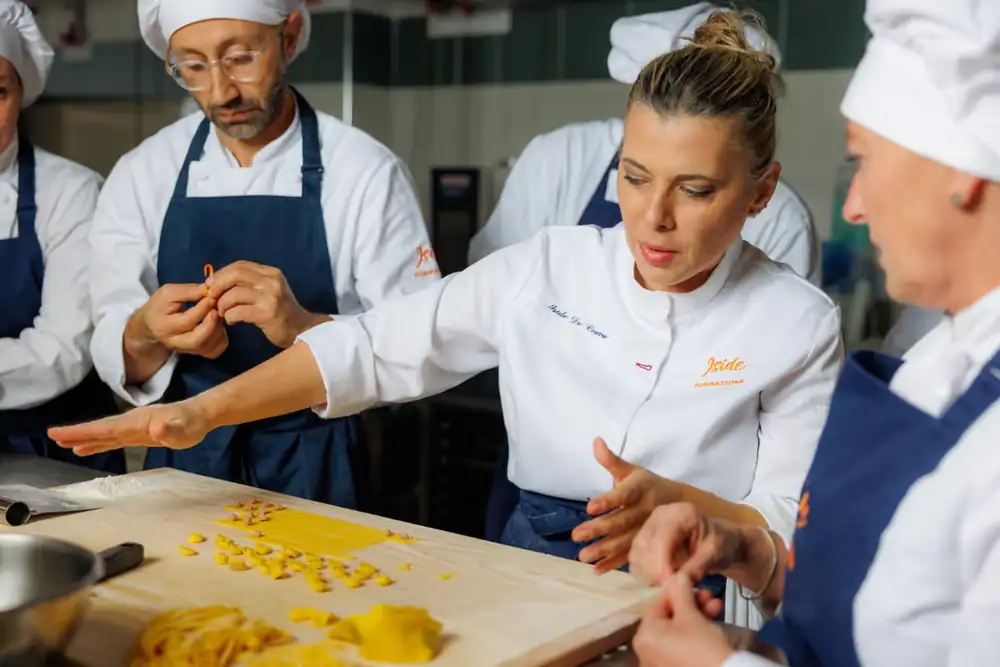
Chef Iside De Cesare opens a cooking school beneath her Michelin-starred restaurant
In Trevinano, in the Upper Tuscia region, in the spaces beneath the Michelin-starred restaurant La Parolina, Iside De Cesare's new Cooking Academy is taking shape.
A school born from over twenty years of experience
"It's a natural evolution of what I've done so far," Iside says, explaining this new project. The project will not only focus on teaching techniques and preparation, but will also include the opportunity to gain a concrete understanding of the ingredients' journey and the work that goes into preparing them before they reach the kitchen. The opportunity to transform the Trevinano premises into a true school also came about thanks to a call for proposals linked to the National Recovery and Resilience Plan (PNRR). For the chef, it was an opportunity to bring together over twenty years of experience in the field and more than ten years of teaching in one place.
Rebuilding the relationship between generations
But behind the Academy's creation lies a broader reflection on the relationship between generations. According to the chef, one of the most important aspects of this phase of her career is the opportunity to rebuild the mentoring relationship that has progressively weakened over the years. "Something has broken between the generations, and mentoring, in my opinion, is fundamental," she explains. The goal, therefore, is not only to offer a space for those who want to learn the trade, but also to rekindle a dialogue between those who have gained experience and those who are now entering the restaurant world.
In this sense, Iside De Cesare seems to embody what might be described as a professional foster mother, the figure every young chef should—or perhaps would like—to encounter when dreaming of a career in the kitchen: someone capable not only of teaching a technique, but of accompanying, correcting, guiding, and, above all, demonstrating what lies beyond the immediate result. It is precisely that mentoring role that, according to the chef, has progressively weakened over the transition from generation to generation, and which the new Academy aims to restore.
How professional courses work
Iside Formazione therefore starts from this awareness: updating training systems, listening to the new generations, and, at the same time, preserving the wealth of experience accumulated. The professional courses will begin in January and are aimed at those already working in the restaurant industry, those who have attended a hotel management school and want to complete their training, as well as those who, despite having no experience, are keenly interested in entering the workforce. The course lasts approximately two months, eight hours a day, and combines theory and practice.
The curriculum is deliberately designed to be professionally aligned: students are taught to experience the school as a working environment, starting with the basics and gradually moving on to more complex aspects. A significant portion of the curriculum is dedicated to restaurant pastry making. This isn't a course designed to train pastry chefs, but rather a segment designed to provide chefs with the tools necessary to understand and manage this aspect of the kitchen. The pastry-making module can also be taken separately, even by those with previous culinary training elsewhere.
The teaching team and the program
The teaching team will be composed of several professionals. Iside De Cesare will be the resident chef and coordinator, supported by a dozen teachers already involved in the project, with the possibility of further expanding the group. The chef will also directly supervise certain areas of the training, particularly those related to dough, pasta, bread making, and pastry making, in addition to overseeing the daily teaching. The program, however, will not be limited to cooking in the strict sense. The first part includes elements of product science, tradition, and food cost, with the aim of providing students with a more comprehensive understanding of working in the restaurant industry.
There is also space for amateur courses
Alongside the professional courses, there will be amateur courses, open to both Italians and foreigners. These will be shorter courses, organized into four sessions or single, single-topic lessons, with an approach that starts with the raw material and technique and moves on to preparation.