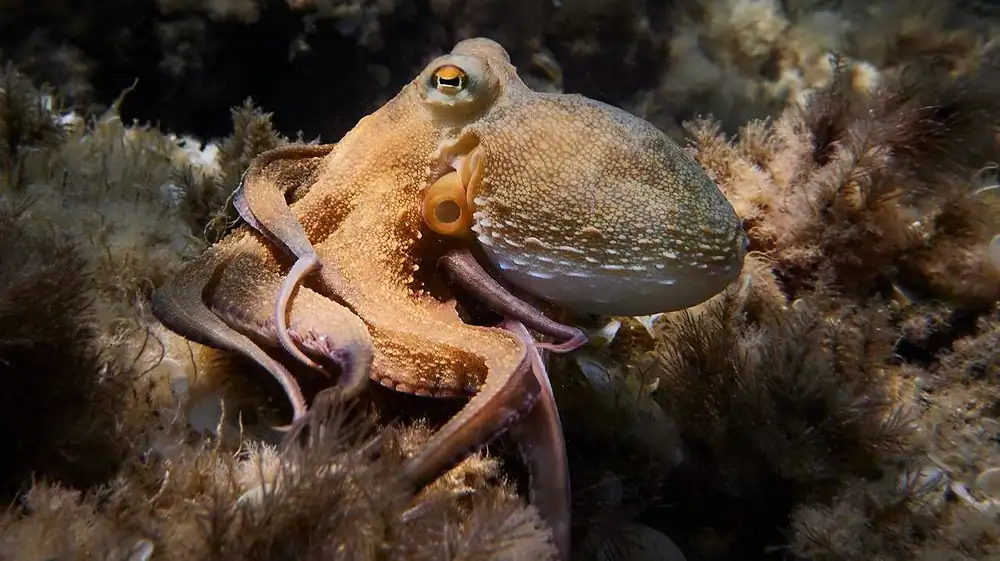
Octopuses vs. Blue Crab: Experimentation Has Begun
After the initial announcements and the resulting hilarity online ("to eat octopuses, we'll free the people of Bari"), the Octo-Blu project officially begins its journey aboard a patrol boat off the coast of Cesenatico, where day-old octopuses and a female housed at the University of Bologna are released into the Adriatic Sea.
The hope is to finally put a stop to the uncontrolled spread of this invasive species, which has seriously undermined the balance of the local marine ecosystem and caused serious economic repercussions for fishing and aquaculture, destroying juveniles and reducing commercial clam production by over 70% in some areas.
Octopuses vs. blue crabs
The blue crab has demonstrated an extraordinary ability to adapt to different temperatures and salinity levels and has found an optimal reproductive environment, as demonstrated for example in the Sacca di Goro, where a single female can produce between two and three million eggs. Precisely for this reason, the octopus can act as a valuable biological control tool: if it can intercept a female blue crab as she moves offshore to spawn, it eliminates millions of potential invaders.
Furthermore, the octopus develops extremely rapidly, reaching half a kilo in weight in just a few months, unlike competitors like the sea bass, which take nearly three years. With a highly accelerated metabolism, it requires constant feeding and can consume over 20% of its body weight per day. Crustaceans form the basis of its diet, and scientific research conducted in the previous two years of biological studies has confirmed that female octopuses almost double their egg production when they feed primarily on crabs.
Despite the predominantly sandy seabeds of Emilia-Romagna, octopus is a constant presence in the Upper Adriatic, although catches have declined sharply over the last decade compared to 2010, when local production exceeded 500 tonnes annually.
The project's scientific coordinator, Professor Oliviero Mordenti of the Department of Veterinary Medical Sciences at the University of Bologna, explains the importance and ecological significance of the research: "The Octo-Blu experimental project has allowed us to gather valuable information on the behavior and biology of the blue crab present in our range, as well as identify a potential strategy to combat its spread. The octopus, in fact, is a predator capable of helping to control more abundant species and is therefore a species of significant ecological interest, playing an important role in regulating marine food chains."
The field trial, which began with the releases in June and continued in August near the submerged artificial reefs with the logistical support of the Riccione Nautical Club and the Cesenatico Port Authority, saw the active participation of regional institutions, with the Regional Councilor for Agriculture and Fisheries, Alessio Mammi, emphasizing the financial and strategic commitment of the Region, which has already allocated a total of €4.5 million to support the affected businesses.
The councilor himself provides the numbers: "(...) Since 2023, we have allocated €3.5 million in regional resources to support fishing and aquaculture businesses affected by the proliferation of blue crabs, which have destroyed juvenile fish and, in some areas, reduced commercial-sized clam production by over 70%. These resources are in addition to an additional €1.5 million in 2026 and the call for proposals launched this year for disaster relief, to compensate for the loss of income caused by the destruction of juvenile fish and the drastic reduction in clam production. These resources have also been used over the past three years to support the harvesting, disposal, and marketing of blue crabs."
The experts who conducted the release and scientific monitoring operations are confident that biological research can provide long-term, structural solutions. However, in a serious emergency like the current one, openness to new scientific collaborations is essential, as Mammi concludes: "The goal is to try to deploy all available tools to combat the blue crab, protect the balance of our marine ecosystem, and support fishing and aquaculture businesses in Emilia-Romagna. For this reason, we are willing to support other university or research center projects that move in this direction."