The use of organic mulch in vineyards increases soil biodiversity and mitigates its degradation
Applying a layer of natural materials—such as straw, compost, or shredded pruning waste—to the soil around the vines improves nutrient quality and protects the soil from long-term deterioration.
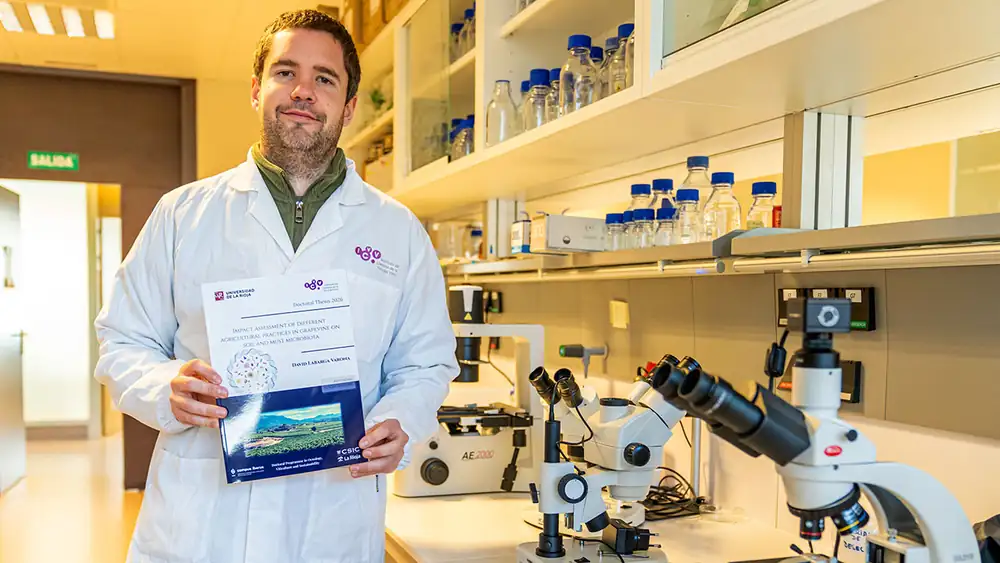
The technique analyzed by the Spanish researcher—also known as mulching—works similarly to a natural blanket on the soil. These organic mulches in the vineyard increase soil biodiversity and, in the long term, mitigate its degradation. Labarga Varona's study also analyzes the effect of other agricultural practices—such as the use of different rootstocks or irrigation with ionized water—on the microorganisms (bacteria and fungi) in the soil and must.
Developed at the Institute of Vine and Wine Sciences (ICVV) - within the framework of the Doctoral Program in Oenology, Viticulture and Sustainability of the Department of Agriculture and Food of the University of La Rioja - the thesis entitled "Study of the impact of different agricultural practices in vine on the soil microbiota and must" was directed by the renowned scientist Alicia Pou Mir, a teacher at the CSIC, and obtained the outstanding "cum laude" grade with international mention to the title.
Viticulture, an activity of great economic, social, and cultural importance, faces challenges such as climate change, soil degradation, and biodiversity loss. In this context, microbial communities play a key role in vine health and the final quality of the wine. However, many emerging agricultural practices have been implemented without a detailed assessment of their microbiological impact.
"The microbiota is not an isolated element, but the cornerstone of vineyard health and wine quality. It plays a critical role in regulating plant nutrition, protecting it against pathogens, and actively participating in defining the organoleptic characteristics of the must and wine," explains Labarga.
This thesis analyzes how different vineyard management strategies influence the microorganisms present in the soil, the rhizosphere (the zone in contact with the roots), and the must. It evaluates three practices within the framework of organic and regenerative agriculture: the application of organic mulches (straw, pruning waste, and post-mushroom cultivation substrate) versus conventional treatments; the use of five different rootstocks (1103P, R110, 140Ru, 41B, and 161-49C) under irrigated and drought conditions; and irrigation with ozonated water.
The research was conducted between 2019 and 2024 in vineyards within the Rioja Qualified Designation of Origin, located in Logroño, Aldeanueva de Ebro, and Arenzana de Abajo. A total of 246 samples of soil, rhizosphere, and must were collected, and their DNA was analyzed using advanced genetic sequencing techniques to identify both the microorganisms present and their functions.
The main advantage of its use is the comprehensive improvement of the ecosystem by increasing soil biodiversity and mitigating its degradation.” DAVID LABARGA, author of the research.
Changes in microbial diversity were observed starting in the third year, indicating that their effects may be slow and cumulative. Furthermore, these mulches help regulate other key factors such as soil temperature and moisture.
Rootstocks, microbiota and irrigation with ozonated water.
In the rootstock trial, irrigation was the main modulating factor of bacterial communities. Under drought conditions, differences associated with the rootstock genotype appeared, highlighting its importance in scenarios of water stress and adaptation to climate change.
"There is no one rootstock that is absolutely better than another," explains the researcher, "but rather each one exerts a moderate and characteristic impact on the rhizosphere microbiota; in stressful situations, the plant seems to select or promote specific microbial taxa and functions that help it adapt and survive those adverse conditions."
However, irrigation with ozonated water did not produce significant changes in soil microorganisms, raising doubts about its potential as a sustainable strategy from a microbiological point of view.
The results show that the vintage and vineyard location are the factors that most influence the composition of bacteria and fungi, more so than the agricultural practices studied. Even so, specific effects were detected, especially in the soil and rhizosphere.
Sustainability in the face of climate change
This study shows that the impact of these strategies within organic farming on vineyard microbiota is variable and largely dependent on the environmental context. Furthermore, many effects only become evident after several years of implementation, reinforcing the need to evaluate these strategies in the medium and long term.
Integrating the microbiological dimension into decision-making can contribute to designing more sustainable and resilient viticultural systems. "Understanding the vineyard as a whole, where the soil, the plant, and microorganisms are interconnected, is vital to ensuring the sustainability of the crop in the face of challenges such as climate change," concludes Labarga.
To read the full research, those interested can access it HERE.
The research was funded through a national project (RTI2018-095748-R-I00), a European project (Prima-MiDiVine project 1564), and ERDF funds (PR-12-19; PR-06-20; PR-09-21; PR-07-22; PR-12-23). The wineries Campo Viejo, D. Mateos, Domeco Jarauta, and Enocuatro SL collaborated by providing their vineyards for experimentation.
For the development of his thesis, Labarga carried out two stays in centers of international prestige – University of Reims Champagne-Ardenne (URCA) and Freie Universität Berlin – and had a predoctoral contract FPI/CAR-UR 2022.