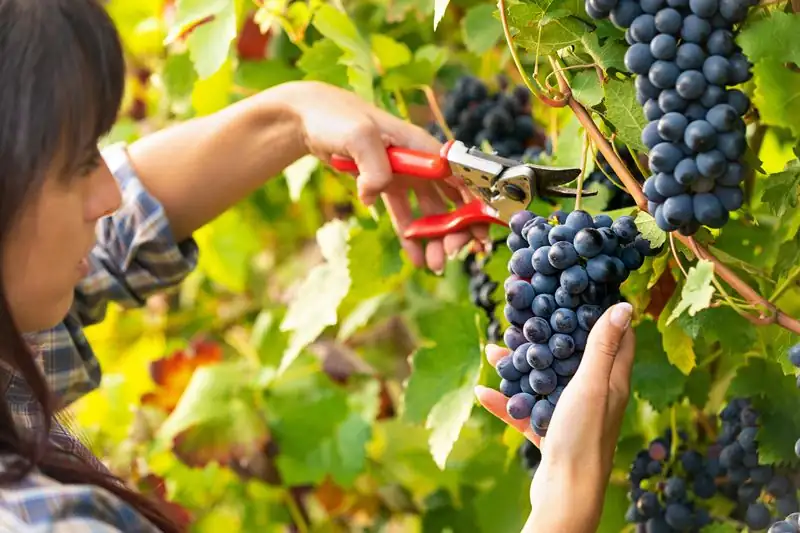
Rioja is starting its earliest harvest on record, with signs of a very strong vintage
Officials indicate that the 185.1 million kilos harvested by September 11 arrived in good condition, although the final size of the harvest remains uncertain.
Tuesday, September 15, 2026
The grape harvest has now begun in the Rioja appellation in Spain, with 185.1 million kilos of grapes collected as of September 11, and officials believe this harvest suggests a vintage of very high quality.
Alejandra Rubio, technical director of the Rioja DOCa Regulatory Council, indicated that the grapes arriving at the wineries are in good condition and that the current weather is helping to preserve quality as the harvest progresses across the region. She added that the recent succession of sunny mornings and much cooler nights has boosted the quality indicators observed in the fruit already received at the wineries.
Of the grapes harvested up to September 11, 146.8 million kilos were red varieties and 38.3 million kilos were white, according to official figures cited by Rubio. She said there was still no reason to rush the rest of the harvest, as conditions remained favorable in the vineyards.
Rubio also indicated that it is still very difficult to provide a firm estimate of the final size of the 2026 harvest. At this stage, the expectation is that production could be slightly higher than the 2025 vintage, which the appellation has classified as excellent in quality but exceptionally low in volume. Last year's harvest totaled 225.4 million kilograms of grapes and 155 million liters of wine eligible for the Rioja appellation, 18% less than the previous year.
Despite everything, current expectations are lower than many had projected at the start of the growing season. Rubio indicated that vine fertility was good, but that periods of intense and prolonged heat reduced berry size and weighed on production. She also highlighted the impact of climate change on the harvest. The 2026 harvest began in the first days of August, making it the earliest in the recorded history of the Rioja DOCa.
La Rioja covers 66,405 hectares across 144 municipalities in the La Rioja, Basque Country, and Navarre regions. The appellation encompasses nearly 13,000 winegrowers and some 600 wineries, a scale that helps explain both the diversity of winegrowing conditions and the tensions that often arise between grape producers and wineries at harvest time.
Agricultural organizations have indicated that they, too, expect high quality for this harvest, but have warned that quality alone will not resolve the economic pressure on producers. Igor Fonseca, secretary general of Arag-Asaja, stated that the work done by producers in the vineyards should be reflected in the prices they receive for their grapes, especially after the increase in the costs of treatments and other inputs.
Fonseca cited data from the La Rioja regional government's price observatory for the 2025 harvest, which showed average payments to producers of €0.83 per kilo for red grapes and €0.79 per kilo for white grapes. He stated that these figures clearly demonstrate that producers have lost ground from one harvest to the next.
Roberto Ruiz-Clavijo, union coordinator for UAGR-COAG, indicated that the organization has noted prices in many cases that are slightly lower than last year's. He stated that even with red grape yields reaching up to 90% of the maximum allowed, producers will again not cover their production costs, marking, according to him, the seventh consecutive season in which this has occurred. He called for full compliance with Spanish food chain law, which mandates written contracts specifying payment terms and prices.
Another concern for producers is whether they have a winery ready to receive their grapes. Néstor Alcolea, organizing secretary of UPA La Rioja, indicated that some producers are still seeking last-minute solutions because they have no guaranteed outlet for their grapes. He said the situation is particularly worrying in certain areas of Rioja Alta, where some wineries have reportedly rejected grapes assessed at over 14% potential alcohol, leaving producers without a market after a full year of work in the vineyards.
This issue could have repercussions beyond the agricultural sector alone. For wineries, distributors, and other wine-related businesses, the combination of a record-breaking early harvest, an uncertain final volume, and selective grape acceptance could impact supply planning, contract negotiations, and the wines that ultimately reach the market. If some buyers accept fewer grapes, or if alcohol levels limit deliveries in certain areas, it could complicate the transport of grapes to wineries during a crucial period of the season.
Producers working in the vineyards say the fruit quality is excellent. Enrique López de Alda, a winemaker harvesting in the Viña El Pozo area near Oyón, Álava, said the grapes on his approximately 60-year-old vines are in good condition. He was harvesting with a team of seasonal workers and said this year's quality allows them to build up wine stocks.
The wineries, for their part, rejected criticism that they were not fulfilling their obligations. Íñigo Torres, general manager of the Rioja wineries association Esencia Rioja, stated that the wineries had complied with the rules, signed contracts before the grapes arrived at the winery, and set prices according to objective criteria. He said that prices would remain stable compared to the previous harvest.
Torres added that yields this year are expected to be significantly higher than in 2025, which he believes should improve producers' profitability, unlike what is happening in many other wine regions of Spain. On the commercial front, he indicated that wineries are still facing challenging sales conditions, as wine consumption continues to decline globally. He said that Rioja is making a strong promotional and marketing effort to maintain its market share both in Spain and abroad.